

By John Helmer, Moscow
@bears_with
When the time of your labour is converted into the profit of the capital which employs you, you belong to the working class. You don’t get time off for vacation. No money.
All Russians know this because it was one of the foundation ideas of the communist party state known as the Soviet Union. Vacations came at state expense because the state, not private capital, employed everybody, and everybody had the communist right to time off for rest and recreation. To be sure, because the US empire was at war to destroy the Soviet Union, there weren’t too many holiday destinations in that empire which Russians were able to get to – unless they too were state owned, communist managed, beyond US empire control. Bulgaria, Cuba, East Germany, and India were possible, but for Russians rare.
So the end of the communist party rule in 1991 meant the freedom of the Russian working class to take off for vacation wherever in the world they wanted to go. Only they couldn’t.
The US empire now ruled the Kremlin and its occupant Boris Yeltsin and his men. On cue, they cut the labour value of the Russian working class so they had less cash to spend, fewer traditional Russian sanitoria to welcome them; a great many no longer needed time off because they were terminally ailing or dead. Under Yeltsin the plan of the reformed Russian health system was to reduce working class numbers by cutting the social welfare cost in the strict new deficit-reduction targets of the state budget and Central Bank monetary controls. No spending on defence against the empire.
No American ICE-type or Israeli Gaza-type extermination methods either. It was death for Russians off the books, so to speak.
In 1997, for example, 74% of Russians polled by the Levada Centre said they had no holiday plan away from their homes; 23% said they had a country dacha to go to; 10% were heading to the beaches of the Russian Caucasus or to another Russian city; just 1% said they would travel to a post-Soviet country; another 1% to the fabled free West.
President Vladimir Putin’s reforms over the past quarter century have improved the real incomes of this working class, but not by enough to make much difference to the time off for vacation. By 2018, Levada polling reported 66% had no holiday plan; that’s an 8 percentage point improvement on 1997. One percentage point more, 24%, said they were going to the dacha; 8% went to the Caucasus; 4% to the fabled free West. That’s a 3 percentage point gain. Call that social mobility under Putin – some Russians were moving up into the ruling class.
Then the war came in February 2022. Levada stopped polling Russians for their holiday plans. They have been polled instead for the reasons they express for not having a holiday plan: rising fear of unemployment; loss of real income, of consumer spending power and of confidence in the economic future.
The Russian media have turned to tourism, travel and hotel industry sources to note that since the May start of the Russian holiday season, the escalation of the US empire’s drone war against hinterland targets has changed the travel plans for the minority of workers wanting to vacation in Crimea and along the Black Sea shore of the Caucasus. Disruption and delays of rail, road and air movements, and attacks on beaches, have had a significant deterring effect.
The ruling class, however, has run into the European sanctions war making flight connections into western Europe difficult, visa issuance more unpredictable, and except for Italy, trouble at the border and anti-Russian sentiment inside Europe. This has been an unwelcome reminder to the Russian ruling class that the colour of their money is still red. “With Europe increasingly out of reach, some Russians are embracing the Kremlin’s pivot to Asia and Africa.”
These Russians, Izvestia reported at the end of July, have headed to the friendly countries where the risk of war is minimal. “The demand for accommodation is growing most dynamically in China and Abkhazia — by 71% year-on-year; in Armenia – by 51%; in Turkey — by 43%; in Georgia — by 29%; in Japan — by 12%. Italy stands out among other destinations: the country has risen from twelfth to sixth place in the ranking of the most popular foreign countries, and the demand for accommodation has increased by 69%. In general, the top 10 most popular holiday destinations for the May holidays include Belarus, Uzbekistan, Turkey, Armenia, Georgia, Kazakhstan, China, Thailand, Abkhazia, and Italy. The average cost of a booked night in foreign hotels and apartments for the holidays is 9.8 thousand rubles, which is 3% lower than last year (10.1 thousand rubles).
These Russian travellers don’t call themselves the ruling class.
President Vladimir Putin spoke about the ruling class last week in exchanges with foreign academics and think tankers. He believed, he said, that the reason for the war against Russia comes from ruling classes of the US, Europe, and Japan. “Faced with adverse economic trends at home, an increasingly precarious position for their ruling political classes, and changing public sentiment, they now seem to be provoking confrontation with Russia and fuelling further crises between Russia and Europe. They are doing so precisely in order to justify preparations for war and to rally as many supporters as possible around themselves, thereby enabling them to remain in power. The logic is very simple. I am convinced that this explains a significant part of the reasoning behind the European countries’ conduct toward the Russian Federation.”
He was hopeful, he added, that the ruling class of the US can be persuaded to behave differently towards Russia, “particularly under President Trump.” Putin omitted to say whether he thinks there is a ruling class in Russia.
However, if you follow the vacation trail, you will find there is one – and it points to lack of the confidence which Putin has expressed in Trump and the American ruling class for the future of their own interests.
They have stopped buying second, vacation, or haven homes in the US, according to recently released survey data. “Cyprus and Greece have moved up to fourth and fifth place in the ranking of popular destinations among Russians for buying real estate, based on the results for January–September 2026, RIA Novosti reported, citing Mikhail Bulanov, managing partner at Tranio. Thailand remained the leader, but its share decreased from 22.9% to 17.8% of applications. Turkey retained second place (an increase from 8.4% to 10.2%), and the UAE came in third (from 8.3% to 9.8%). Cyprus rose from sixth place to fourth (from 5.4% to 8.1%), Greece to fifth (from 5.4% to 7.3%).”
“Cyprus and Greece have increased in the ranking due to visa opportunities: in them, the purchase of housing is combined with the registration of residential status — the golden visa of Greece is issued together with the second passport, permanent residence of Cyprus — through the purchase of new housing starting from 300,000 euros, Bulanov said. Georgia entered the ranking, taking sixth place along with Montenegro. Next are France, Spain, and Italy. The island of Bali has dropped out of the top 10 — buyers are put off by problems with building permits and land status. Earlier, DP reported that foreigners in Bali are not allowed to own land on a freehold basis. Only long‑term leases or usage rights registered in the state register for a period of up to 25–30 years, with subsequent extensions, are permitted. At the same time, over the past two years, the island’s authorities have stepped up inspections and have begun to close down and demolish buildings constructed with violations.”
“The median budget for purchasing real estate abroad increased by 9.5% year‑on‑year — to 298,000 euros. In 2025, Thailand was pulling the budget down, with condominiums costing 120,000–150,000 euros, while in 2026 the share of Turkey, the UAE and Cyprus grew — where the typical budget is 300,000–350,000 euros. In Cyprus, rising prices are driven by the expectation of joining Schengen and the discussed tightening of the conditions for the permanent residence investment programme. As reported by DP, Russians have maintained their leading position among foreigners in terms of purchasing housing in Turkey. In August 2026, they purchased 343 apartments and houses there, holding the top spot since April 2022 — for the 53rd consecutive month.”
On his birthday this week, October 7, the President didn’t celebrate with a holiday at the beach. He stayed at home in the Kremlin where he held a meeting with the Security Council to discuss “current matters pertaining to Russia’s domestic and foreign policy.”
Putin has encouraged Russians to place themselves geographically in a space he calls Greater Eurasia.
He’s been saying this from the beginning of his presidential term in 2000. “Russia has always felt itself to be a Eurasian country,” he declared in a speech written as his calling card for a summit meeting in Borneo of the Asia-Pacific Economic Cooperation (APEC) organization. “We have never forgotten that the main part of the Russian territory is in Asia. Frankly, we have not always made good use of that advantage.”
Did he mean by that, a quarter of a century ago or since, that one of the advantages in Eurasia which Russians should make “good use of” is holiday houses at the Florida beach, chalets in the Swiss snow, apartments at German mineral spas and in Mayfair, the 16th Arrondissement, and Piazza di Spagna?
“The idea of a Greater Eurasian Partnership advanced by Russia some time ago,” Putin said last week about himself, “is acquiring special significance amid growing instability worldwide…The task and responsibility of Eurasian countries is to maximally protect our space from global risks and destructive processes.”
“Our home in the broader sense is Eurasia”, he repeated not only what he’s been saying since 2000, but also the political geography which been fashionable among the Romanov monarchists, Orthodox churchmen, and White Russian officer corps who aimed to replace the international socialism of the Bolshevik revolutionaries of 1917 and their successors over the 20th century, the socialists in one country.
A Moscow sociologist, who asked not to be named because of the sensitivity of the subject, comments: “The continuing outflow of Russian capital abroad even now, despite sanctions and despite the war, is a White Russian phenomenon still. It means that the ruling class, whose interests Putin has served in the way he has managed the war in parallel with business as usual, do not believe their interest, the Russian national interest, and Putin’s policies coincide and reinforce each other. For Eurasia to them is elsewhere. That’s where they want to live; Russia is just another of their holiday destinations, and not a particularly fashionable one at present.”
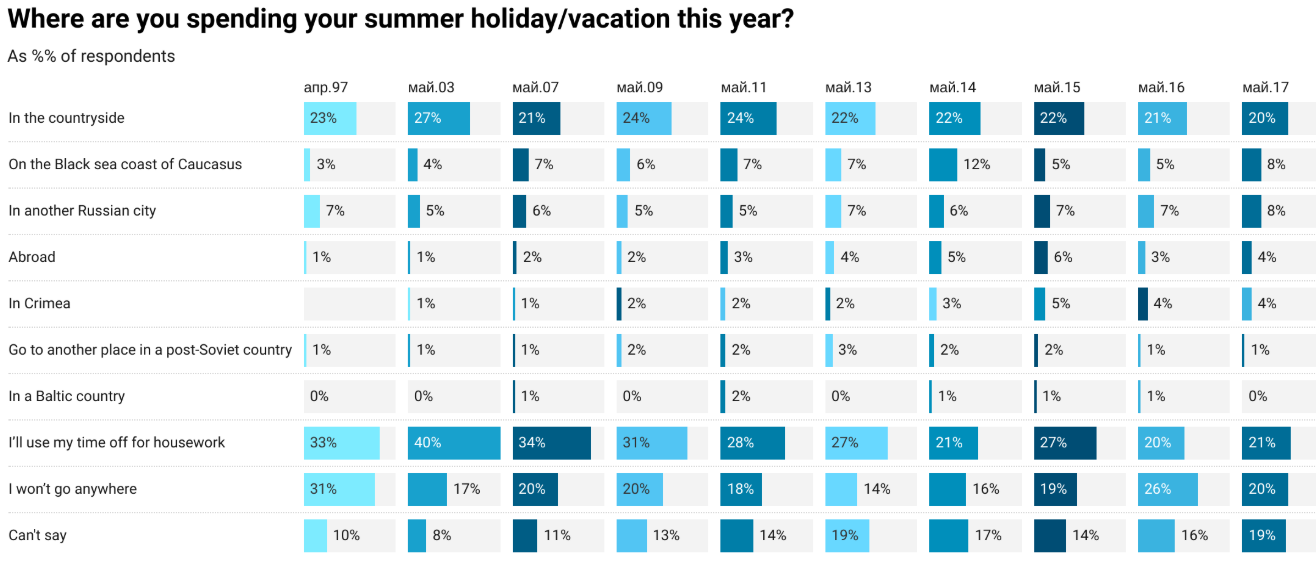
Enlarge to view by clicking on source: https://www.levada.ru/en/2022/10/28/summer-holidays/
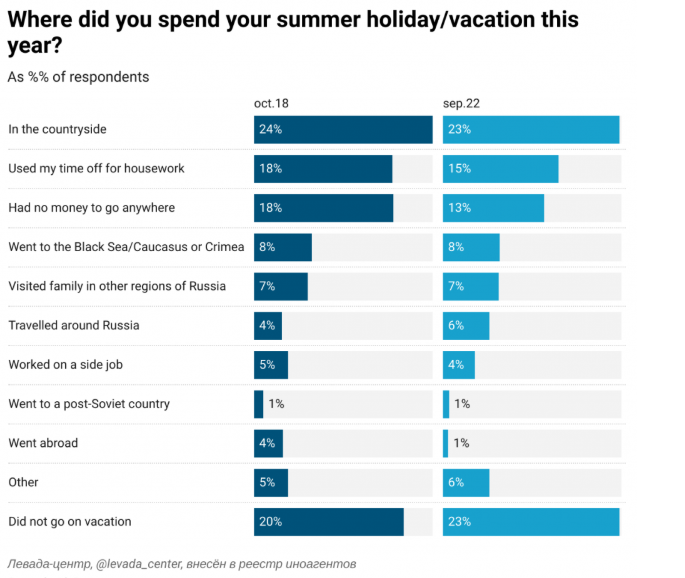
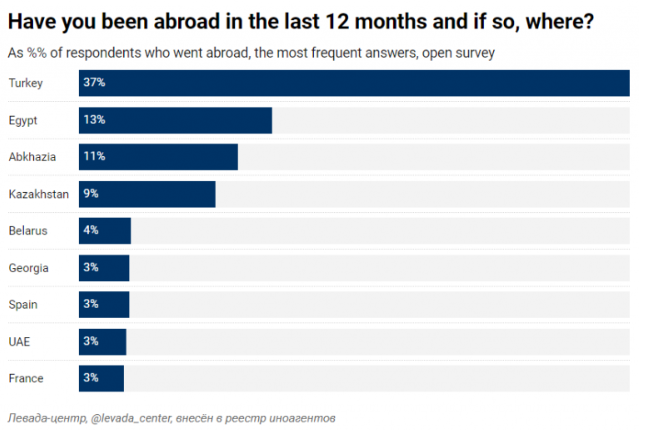
Source: https://www.levada.ru/en/2022/10/28/summer-holidays/



Leave a Reply