 [1]
[1]
By John Helmer, Moscow
@bears_with [2]
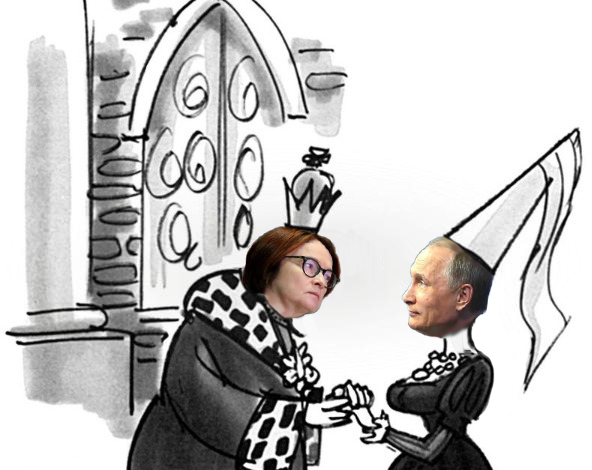
On Friday (June 19), the Governor of the Central Bank of Russia (CBR), Elvira Nabiullina, returned from a three-week silence and absence from office that was due, she claimed [3], to a “cold” and the “loss of my voice”.
The anti-Russia propaganda platform, Financial Times of London, reported [4] three people in the know as calling her ailment “a severe respiratory infection”. There is a deeper malaise, the newspaper added – Nabiullina is fighting on one side of the Kremlin “splits over how to manage the strains in Vladimir Putin’s wartime economy.”
Tass, RT, Sputnik, and other Russian state media have omitted to report Nabiullina’s ailment and the Kremlin malaise.
According to four people in the know, Nabiullina has been telling Putin that she opposes increased state budget spending on fighting the war to a conclusion on Russian terms; and that at the CBR she will continue to keep up the key interest rate in order to lower inflation and cut the budget deficit.
Whether she threatened to resign ahead of term next June if Putin did not allow her to get her way is not known for certain.
Against Nabiullina’s faction of anti-war advisers, which includes the Finance Minister Anton Siluanov and the special negotiator with the Trump White House, Kirill Dmitriev, there are the majority of the Security Council; the General Staff and its intelligence chief, Admiral Igor Kostyukov; and the Foreign Minister Sergei Lavrov. They have repeatedly and publicly signaled their advice to Putin to escalate on the battlefield with “systemic and consistent [5]” attacks because the trust-in-Trump (TiT) line has failed to deliver an end-of-war settlement guaranteeing Russian security.
Both Medvedev and Lavrov have publicly declared [6] that Trump’s August 2025 “Anchorage formula” for the security guarantee has proved to be empty deceit. “It’s time to openly declare that there are no more rules regarding neo-Nazi Kiev and there can’t be any”, Medvedev has reportedly declared [7]. “Everything now depends not on negotiations but on what our frontline heroes are doing,” Lavrov announced [8] on June 8.
Yury Ushakov, the president’s spokesman for the trust-in-Trump line, announced [9] on Sunday (June 21): “Russia does not expect the implementation of the agreements reached in Anchorage, but counts on the victory and the implementation of its own goals…Only one of the parties [Putin] adheres to the agreements today. Another [Trump] was not quite able to go through his part.”
At the same time as Putin authorized Ushakov to issue this signal, he also authorized Nabiullina to give a contradictory one.
At a meeting of government ministers in Nabiullina’s absence on June 10, Putin had claimed [10]: “Overall, the [domestic economic] situation is under control – that much is quite obvious. And the measures we have taken are yielding the expected results. In fact, the inflation rate has declined. Where are we at this point? It is slightly over five percent. Therefore, I believe that we can expect a lower key interest rate and to be able to achieve other key indicators.”
That was the marching order for Nabiullina to lower the CBR’s key rate. But then on Friday (June 19) she announced the smallest possible reduction in the rate – twenty-five basis points – and threatened to raise it again between now and the national parliamentary election on September 18-20.
“On 19 June 2026, the Bank of Russia Board of Directors decided to cut the key rate by 25 basis points to 14.25% per annum,” Nabiullina’s press office said [11]. “The underlying price growth has edged down but remains generally in the range of 4–5% in annualised terms…Lending growth has accelerated in recent months. Fiscal policy over the three-year horizon will be more accommodative than previously expected. This may require a higher key rate path than assumed in the April baseline scenario.”
By “accommodative” Nabiullina meant to rebuke Putin for refusing to cut the war budget or social welfare spending during the election campaign.
Nabiullina repeated [12] for the press the threat that she might not take the President’s orders in the future. “I would like to emphasise that neither a further key rate cut nor the size of it is predetermined at any particular meeting. We might need to take pauses to analyse all incoming information and the effect of our earlier decisions. It is only by maintaining a balanced approach, especially amid high uncertainty.”
This was her riposte to Putin’s announcement of the week before that he wants an increase in government spending and therefore an increase in the budget deficit. “Mr Siluanov talked about the budget,” Putin said [10]. ”It goes without saying that we must launch a new investment cycle taking into consideration present-day reality, as well as the proposals we have just heard from the business community. I think that this much is obvious.”
The clash between the factions over the CBR’s key rate has been public in Moscow for months (years [13] ). Not quite public, but not secret, is Nabiullina’s attempts to manipulate both monetary and fiscal policy to bring the Ukraine war to an end on the US and NATO terms [14].
Still hidden, however, is Nabiullina’s attempt to sabotage Russian military and financial assistance to Iran in the war against the US and Israel.
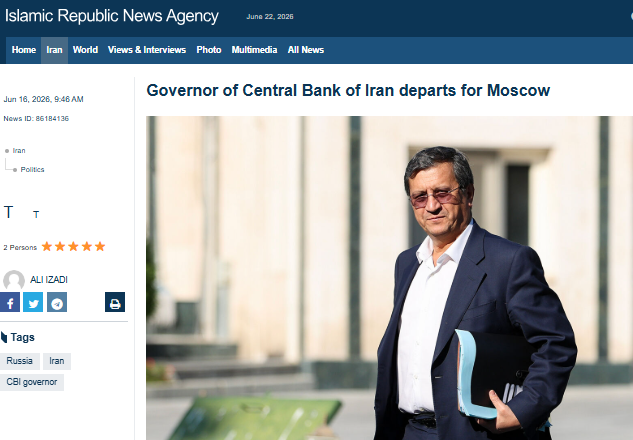
Last week, the Iranian Central Bank Governor, Abdolnasser Hemmati, was in Moscow with a delegation of experts to discuss measures to protect rouble-rial reserves and trade payments from US and European sanctions, and to enable a substantial increase in Russian financial assistance to the embattled government in Teheran. That assistance now includes a Russian loan of up to $20 billion in roubles.
The agenda for these negotiations was announced in the Iranian and Turkish state media; they have followed up with detailed reports of the outcomes agreed so far.
In contrast, the CBR press office has imposed a blackout on the meetings; the Russian media have remained silent. Asked to confirm which CBR officials Hemmati met last week in Moscow, and what they have agreed to do, Nabiullina’s press spokesman refused to answer.
 [15]
[15]Source: https://en.irna.ir/news/86184136/Governor-of-Central-Bank-of-Iran-departs-for-Moscow [16]
In the opening announcement of Hemmati’s trip to Moscow last Tuesday (June 16), the Islamic Republic News Agency (IRNA) said [16]: “The two sides are expected to discuss solutions for facilitating monetary exchanges, enhancing cooperation between central banks, and establishing new mechanisms to increase the volume of economic transactions…Aiming to reduce their reliance on the US dollar and simplify trade exchanges, Iran and Russia have pursued substantial joint efforts to link banking networks, expand national currency usage, and establish alternative settlement mechanisms. The most important measures adopted so far include connecting the two countries’ financial messaging systems, scaling up rial- and rouble-based settlements, and promoting joint activities between commercial banks. Experts believe that strengthening Iran-Russia banking relations could lead to increased trade, reduced financial costs, and greater economic resilience in the face of international sanctions, yet this depends on resolving a number of technical, legal, and implementation-related challenges.”
For “implementation-related challenges” read [17] Nabiullina first, then Kirill Dmitriev. “Right is right”, Dmitriev has tweeted instead, endorsing Trump’s intervention in Russian presidential – typo, Colombian presidential — politics [17].
On the morning of Thursday (June 17), an Iranian government twitter account reported [18]: “CBI Governor @Hemmati_ir met with his Russian counterpart to advance banking cooperation, expand bilateral trade, and strengthen the North-South Corridor. Both sides agreed to enhance financial connectivity and activate a permanent banking committee. #IranRussia #Trade” After his meetings in Moscow, Hemmati joined [19] the Iranian delegation in Switzerland to negotiate with the American delegation led by Vice President JD Vance.
As Hemmati arrived in Moscow but in advance of his talks at the CBR, Fars, the Iranian state news agency, reported “the Moscow visit is part of broader endeavours to deepen financial cooperation and strengthen banking ties between Iran and Russia. The negotiations are expected to cover measures to facilitate monetary transactions, enhance cooperation between the two central banks, and establish new mechanisms to increase bilateral economic exchanges.
Hemmati also stated that economic, trade and banking relations between Iran and Russia have continued to grow, adding that Tehran is seeking to diversify its trade corridors, broaden sources of goods supply and reduce reliance on any single mechanism for international financial settlements. He also added [20] that Iranian authorities have provided financial support to domestic traders conducting business through Russia in recent months, describing the current situation as positive.”
A Turkish state news agency has reported the outcome of the Moscow negotiations in detail.
 [21]
[21]Source: https://www.aa.com.tr/en/middle-east/iran-to-launch-ruble-trading-board-as-central-bank-chief-visits-moscow/3968343 [22]
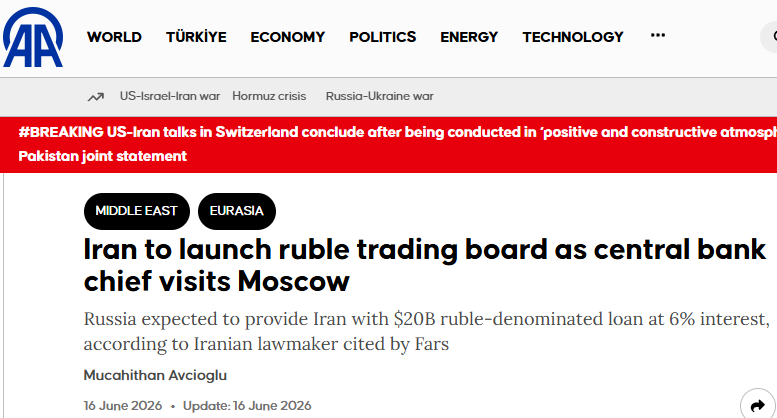
Citing Fars as the source, “Iran plans to launch a ruble trading board at its currency and gold exchange center as part of efforts to deepen banking and monetary ties with Russia, Iran’s semi-official Fars news agency reported Tuesday. Mohammad Reza Farzin, governor of the Central Bank of Iran, said the ruble board would be launched at the Iran Center for Exchange of Currency and Gold following talks with Russian officials, according to the report. Farzin said Iran would also define an “offshore rial-ruble” and work with Mir Business to establish a separate ruble rate based on agreements among traders. He said Iranian businesses could hear “good news” within one or two weeks on resolving payment-related issues in trade with Russia.
The central bank chief said [22] Iranian bank cards currently work at ATMs in Russia.”
“He added that Tehran deposited 1 billion rubles ($13.9 million) into an account held by Russia’s second-largest lender, VTB, at the Russian central bank to help ease a shortage of rubles. Farzin said Iran’s Bank Saderat is serving as the agent bank for the project, while Bank Melli is also expected to join the initiative. He added that Russian cards would later work in Iran, while a third phase planned for next year would allow Russian and Iranian point-of-sale terminals to operate in both countries.”
“Farzin also said Iran and Russia had recently reached agreements on central bank digital currencies, or CBDCs, adding that Tehran would seek to use digital currencies in exchange operations. Separately, Fars reported that Farzin traveled to Moscow on Tuesday for talks on facilitating monetary exchanges and strengthening cooperation with Russia’s central bank.”
The report [22] came as Russia’s planned ruble-denominated loan to Iran had been awaiting approval from the Iranian side, Fars said.”
 [23]
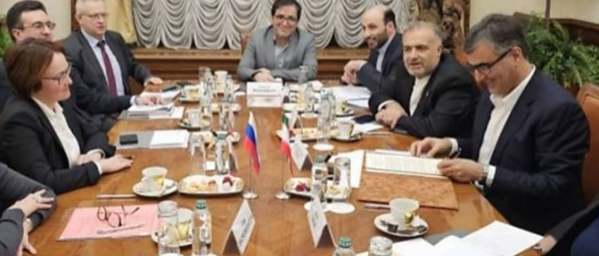
[23]In this photograph published by the BBC after Fars, Nabiullina is shown (left foreground) meeting Farzin (right) in Moscow in December 2023. [24] More detail of their agreements at the time was reported in this IRNA report [25].
“Meysam Zohourian, a member of the Iranian parliament’s Economic Commission, told Fars that Russia would provide Iran with a $20 billion loan in rubles at a 6% interest rate. According to Zohourian, Russia had sought to pay the first $1 billion installment of the loan during the war, but Iranian officials were still assessing whether receiving the loan in rubles would be beneficial.
Fars said [22] the planned loan would exceed Iran’s annual imports of essential goods, which it put at $14 billion.”
A Chinese state media report has claimed [26] that “the dollar’s weapon has weakened, and the rise of parallel finance is seen through the Hemmati Moscow trip. After meeting with Elvira Nabiullina, Governor of the Russian Central Bank, both sides agreed to launch a permanent banking committee between the two central banks. The final integration of Iran’s Sherab payment system with Russia’s Mir payment system is expected to be completed within two months. At that time, Iranians will be able to use their domestic bank cards to pay at Russian store checkout systems using NFC on their phones. It may not sound like a big deal, but the story behind it can be seen as an extension of the US-Israel-Iran war and the Ukraine war…”
A Moscow source in a position to know comments that “the Chinese and Indians have been building a Swift alternative. The plan is for each side to put $100 billion-plus to bypass the US dollar for all Russian trade. The financing would then be available for the energy trade on a fixed-price formula, not on spot pricing.”
Following the departure of the Iranian bankers, Nabiullina did not authorize her press office to disclose details of the talks or confirm the Iranian reports of the sanctions-busting financial transfers. These have been reported in the past. For example, in 2014 a $20 billion food-for-oil swap through the Caspian Sea was reported [27]. Since the Ukraine war began in 2022, several trade financing schemes have been reported to have been agreed by Nabiullina with Iranian officials, notably in December 2023.
At last Friday’s press conference [12], all Nabiullina had to say on the Iran war was this: “The situation in the Middle East has pushed up commodity prices. These changes have already started to translate into inflation acceleration in many countries. A number of central banks have responded to the increase in proinflationary risks by raising their policy rates. Concurrently, expectations regarding global economic growth are declining…Risks of a prolonged Middle East conflict have declined. However, there is still uncertainty regarding the scale of its proinflationary consequences for the world economy, which might affect the Russian economy via imports prices and logistics costs.”