 [1]
[1]
By John Helmer, Moscow
@bears_with [2]
It was a British prime minister, Harold Wilson, who once said that a week is a long time in politics. The Chinese Foreign Minister Wang Yi, who ranks higher than a minister as a Politburo member of the Chinese Communist Party, has just demonstrated that five hundred milliseconds is a long time in politics.
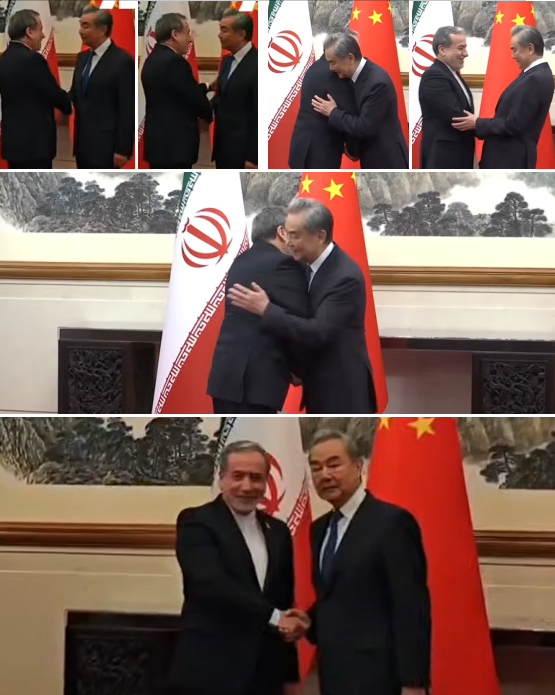
As the lead images show — recorded by the state China Central Television (CCTV) camera crew in Beijing on Wednesday [3] — that minuscule interval in time elapsed as Iranian Foreign Minister Abbas Araghchi was greeted by Wang before they sat down with their delegations to talk. The top row shows Araghchi approaching Wang, shaking his hand, then inclining his head forward. Wang, reciprocating, leans forward, and the two men embrace. They then draw apart, as each man smiles at the other.
The second row picture recapitulates the hug, a few milliseconds after it had begun. Araghchi had been planning the embrace in advance, signalling Wang with a smile. Wang did not reciprocate with his smile until the hug commenced. Wang’s thin smile was broadening as he drew back, continuing to hold on to Araghchi’s right arm and saying something in the language they shared, English.
The third row picture shows the two officials straightening, unsmiling, for a ceremonial handshake for the cameras. This is the picture which most international media have used to illustrate the meeting — the first at this high level since the US and Israel war began against Iran on February 28.
Take note, however — the photo sequence, captured by slowing down the speed and snipping the images frame by frame shortly after they were first released, has been edited, first by CCTV and then by most western media. Between the second and third second of the original film, Araghchi’s left arm and hand went up to Wang’s shoulder as they drew together in their embrace. However, CCTV has edited [4] out the hug: in the footage broadcast subsequently by most international media, the hug has disappeared altogether, to be replaced by the formal handshake. The cut occurred at about the 500th millisecond.
Not everyone erased the Araghchi-Wang hug. The Turkish state media agency Anadolu, for example, has continued to broadcast [5] it.
What has transpired took Wang, the Politburo, and President Xi Jinping a full seven days to decide.
That’s the interval since April 30, when Wang disclosed he had just spoken [6]by telephone with US Secretary of State, Marco Rubio. To Rubio, Wang announced [6] that the Taiwan Strait was a higher geopolitical priority for China than the Hormuz Strait, and that if President Donald Trump agreed, he and President Xi would enjoy their summit meeting on May 14 in a celebration of the “U.S.-China relationship…the most important bilateral relationship in the world, and that head-of-state diplomacy lies at the core of this relationship. Both sides should maintain communication and coordination, respect each other, and properly manage differences to accumulate results for high-level interactions and seek strategic stability.”
That there, declared Wang for Xi, was the precondition for Trump’s arrival in Beijing. “The Taiwan question bears on China’s core interests and is the biggest risk in China-U.S. relations,” Wang said. “The U.S. side should honour its commitments and make the right choice.” As for the Hormuz Strait and Trump’s war against Iran, Wang left that to his last line, an almost empty mention [6]: “The two sides also exchanged views on the situation in the Middle East and other issues.”
Wang’s declaration was published in the evening of April 30, local time. For more analysis, read this [7].
Wang’s ministry then went silent. The last of the ministry’s daily briefings was held shortly before Wang’s conversation with Rubio last Thursday. There was no mention at the briefing [8] of the Iran war or of the Trump summit meeting. The ministry then closed officially to celebrate the nationwide May Day holiday from Friday, May 1, through Wednesday, May 5.
When the ministry returned to the daily briefing on Thursday, May 6, it was late in the day and the Wang-Araghchi meeting had already concluded. Asked what had happened, the briefer replied [9]: “They exchanged views on bilateral relations and international and regional issues of mutual interest. More information on this will be released soon. Please stay tuned.”
State media reporters representing France, Russia, and the US propaganda agencies – Associated Press, Bloomberg, Reuters, New York Times – asked [9] for China’s response to threats by President Trump to escalate militarily at the Hormuz Strait and in sanctions against Chinese purchases and tanker shipments of Iranian oil.
Asked to confirm Trump’s arrival for the meetings with Xi on May 14-15, the official answer [9] appeared to be non-committal. “Do you have any details on that visit, such as when it might happen? Lin Jian: Please stay tuned.” Bloomberg asked the question; it hasn’t reported the answer. Nor have AP, Reuters, or the New York Times who all heard it.
That answer isn’t non-committal. It is now Wang’s and Xi’s precondition for Trump – and this marks a change in China’s policy towards the Iran war. “China believes,” Wang’s spokesman said, “that bringing about a full stop of hostilities is of utmost urgency, a relapse in fighting must be avoided and sticking to negotiations is highly important. China supports Iran in safeguarding its national sovereignty and security.”
If Trump “relapses into fighting” and does not “stick to negotiations”, Xi is communicating that Trump will not be allowed to land in Beijing next week. China will not permit itself to be Trump’s cover for attacking Iran, as India’s Prime Minister Narendra Modi allowed himself to endorse the Israeli-American war against Iran in the Knesset on February 25 [10], two days before the war began. Wang is changing the meaning of what he told Rubio on April 30.
In the China Daily text report [11] of the Wang-Araghchimeeting, the photograph was of the handshake, not the hug. That was not the only editorial cut. The China Daily text omitted Wang’s condemnation of the US and Israeli war since February 28 as “illegitimate”.
Wang’s spokesman was more explicit later [9]: “China believes that bringing about a full stop of hostilities is of utmost urgency, a relapse in fighting must be avoided and sticking to negotiations is highly important. China supports Iran in safeguarding its national sovereignty and security and commends Iran’s willingness of seeking political settlement through diplomatic means. On issues regarding the Strait, resuming normal and safe passage at the Strait is a shared concern of the international community. China hopes that parties concerned will respond to the strong call of the international community as soon as possible. China advocates that the Gulf and Middle East countries need to take their fate into their own hands.”
“Fighting must be avoided…sticking to negotiations is highly important” – these are now China’s preconditions if Trump wants to hold his summit meeting and, as he promised on April 15 [12]: “President Xi will give me a big, fat, hug when I get there.”
China has just demonstrated it gives a hug – to Iran before the US.
The Wang spokesman’s “commend[ation of] Iran’s willingness of seeking political settlement through diplomatic means” is a reference to the one-page, 14-point memorandum of understanding which the Israeli-American press [13] also Saudi state media [14], are reporting as in current talks with the White House through Pakistani mediation.
Wang was also telling the Gulf Arab sheikhdoms not to rely on either American or Israeli, Indian or Pakistani promises and arms for their future security. But not only the Gulf sheikhs – “China advocates that the Gulf and Middle East countries need to take their fate into their own hands.”
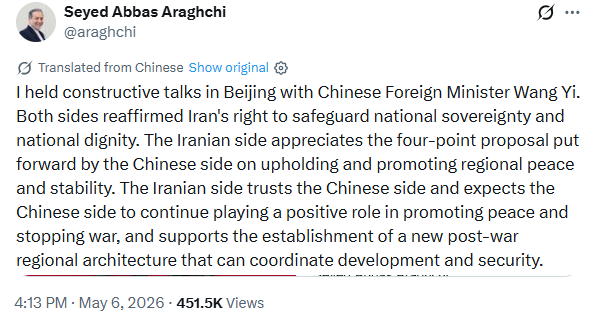
Araghchi posted a tweeted summary of his meeting with Wang at 4:13 pm – it isn’t clear whether this was Beijing time or Teheran time. If the former, it was several hours after the meeting had concluded but before Wang’s spokesman made his disclosures to the press. If Teheran time, Araghchi was reporting as soon as the meeting with Wang concluded.
 [15]
[15]Source: https://x.com/araghchi/status/2052013939936956586 [16]
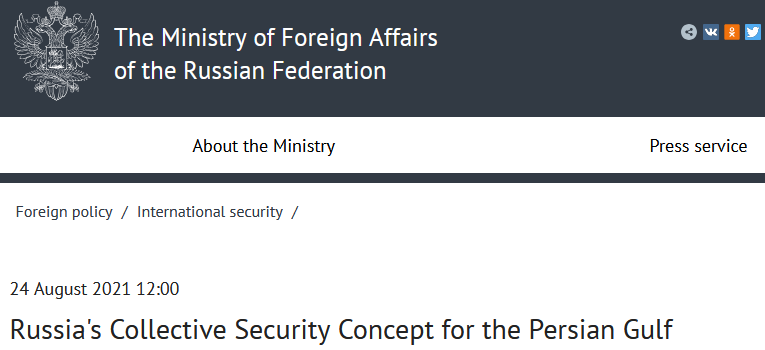
Araghchi confirmed the meaning of the hug: “The Iranian side trusts the Chinese side”, he said [16], “and expects the Chinese side to continue playing a positive role in promoting peace and stopping war, and supports the establishment of a new post-war regional architecture that can coordinate development and security.” That “regional architecture” identified by Araghchi was first spelled out in the Russian “Collective Security Concept for the Persian Gulf”, presented in detail on August 21, 2021 [17].
 [18]
[18]Source: https://mid.ru/en/foreign_policy/international_safety/1466420/ [17] President Xi’s four-point proposal for Gulf security was presented publicly after a meeting in Beijing on April 14 [19] of this year with the Crown Prince of Abu Dhabi. The four points are peaceful coexistence; national sovereignty; international rule of law; and “balancing” of development and security according to a Chinese scheme: “Security is the precondition for development, and development is the guarantee of security. All parties should work to create a favorable environment for the development of Middle Eastern and Gulf states and inject positive energy into the region. China is willing to share the opportunities of Chinese modernization with Middle Eastern and Gulf countries, and to cultivate deeper soil for regional development and security [20].”
The Russian plan was reiterated [21] last month by the Foreign Ministry in Moscow: “We reaffirm the relevance of the well-known Russian initiative to harmonize the concept of security in the Persian Gulf through the establishment of dialogue between all the coastal countries – the Arab states and the Islamic Republic of Iran – with the participation and help of external players who can sincerely contribute to the achievement of an honest and sustainable balance of interests.”
The Russian Foreign Ministry words “sincerely” and “honest” mean to exclude Trump, his negotiators Steven Witkoff and Jared Kushner, and the Israelis.
Foreign Minister Sergei Lavrov’s spokesman repeated [22] yesterday: “We consistently advocate for the resolution of existing differences in this strategically important region of the world by political and diplomatic means, taking into account the interests of all regional states. We reaffirm Russia’s readiness to provide the necessary assistance in achieving this goal, including on the basis of the principles and practical steps set out in our well-known Concept of ensuring collective security in the Persian Gulf.”