 [1]
[1]
By John Helmer, Moscow
@bears_with [2]
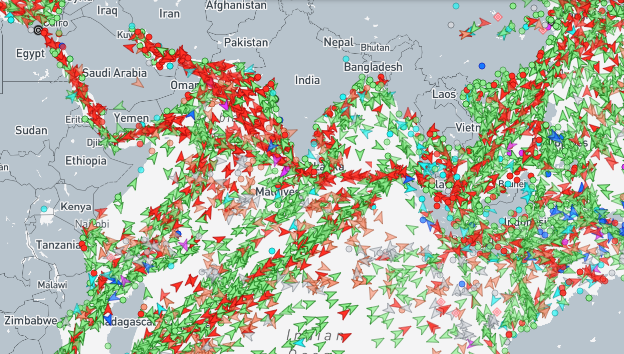
President Donald Trump wants to turn the Indian Ocean (lead image) into a zone of deterrence against war. That’s to say, he aims to deter anyone from objecting to, resisting or defending against his terms for the wars (and ceasefires) US forces are currently fighting against Yemen, Iran, Sudan, and through Pakistan, against India.
Those wars, according to Trump’s National Security strategy, released [3] last month, are being waged, and will continue, against “threats against our supply chains that risk U.S. access to critical resources, including minerals and rare earth elements”; to “ensure that allied economies do not become subordinate to any competing power”; and to “prevent domination by any single competitor nation [3].”
In the Indian Ocean and in the narrow straits between the Indian and Pacific Oceans, that last target, according to the Trump strategy paper [3], is currently China. But when Trump says “our commitment [is to] to a free and open Indo-Pacific” what he means is a warning for India: “we must continue to improve commercial (and other) relations with India to encourage New Delhi to contribute to Indo-Pacific security, including through continued quadrilateral cooperation with Australia, Japan, and the United States (the Quad).”
That parenthetical “other [3]” is Trump’s cat out of the American strategy bag. It’s “unconventional diplomacy, America’s military might, and economic leverage to surgically extinguish embers of division between nuclear-capable nations and violent wars”.
It’s also an ultimatum — either India, the nuclear-armed state which defeated Pakistan in the war of last May, improves its commercial and military “relations” with the US on Trump’s terms now; or else Trump will punish India and target it as a “competitor nation”. Trump’s carrot [3] is that “we should present partners with a suite of inducements—for instance, high tech cooperation, defence purchases, and access to our capital markets—that tip decisions in our favor.” Trump’s stick is that “strong measures must be developed along with the deterrence necessary to keep those lanes open, free of ‘tolls,’ and not subject to arbitrary closure by one country. This will require not just further investment in our military—especially naval—capabilities, but also strong cooperation with every nation that stands to suffer, from India to Japan and beyond, if this problem is not addressed.”
What Trump means by keeping the shipping lanes of the Indian Ocean open, “free of tolls or arbitrary closure”, has the same meaning as the US Navy and allied forces are currently applying [4] against tankers moving Russian, Iranian or Venezuelan oil. Empires don’t use force at sea for piracy; it’s privatization, according to their rules-based international order.
For India, Trump’s meaning is the same as it was six hundred years ago for Afonso de Albuquerque and the Portuguese; they were the first European maritime empire to attack India. Then, as now, it also meant attacking the Yemeni shore of the Red Sea and the Persian Gulf shore, seizing the cargoes of vessels trading with India, killing all on board, and building forts, naval anchorages, and trading bases along the Malabar Coast.
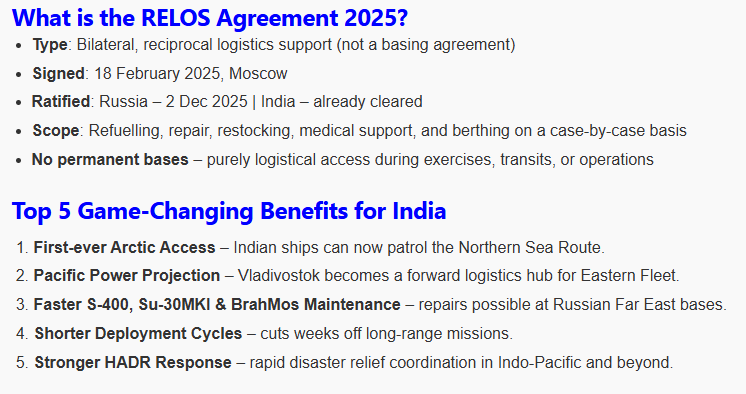
India and Russia have a different idea now. That’s RELOS.
The Reciprocal Exchange of Logistics Support (RELOS) agreement between India and Russia has been a decade in negotiation. It was delayed beyond its first planned completion date when Prime Minister Narendra Modi visited Vladivostok in 2019; then finally signed in February of this year. It was ratified by the State Duma on December 3, the day before President Vladimir Putin flew for Delhi to two days of meetings with Modi.
For a quick Indian media introduction to the new pact and contrast with its US counterpart:
 [5]
[5]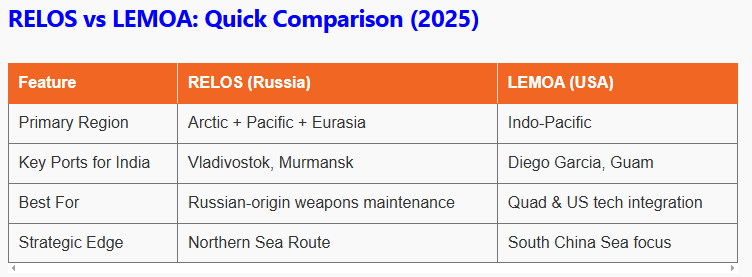 [6]
[6]Source: https://www.studyiq.com/articles/relos-pact/ [7]
RELOS is the seventh Indian pact to extend Delhi’s maritime reach globally, and to enable the Indian Navy to defend the movement of its strategic imports from the Arctic and Pacific around China, and through the chokepoints of the South China Sea, Red Sea, Persian Gulf, and Indian Ocean.
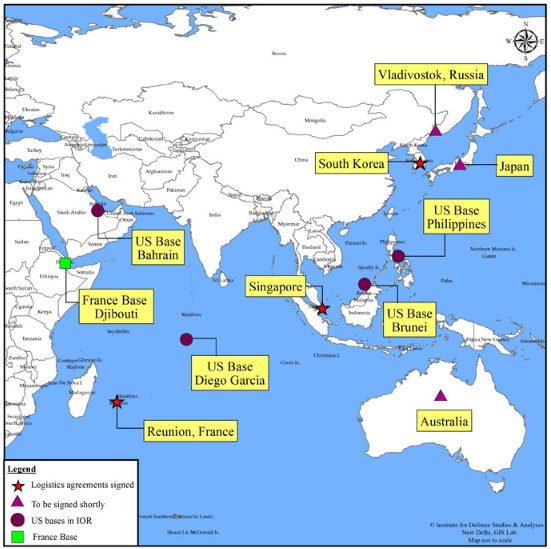
Click to read brief histories of the six preceding military logistics agreements which India has signed with the US (2016 [8]), France (2018 [9]), Singapore (2018 [10]), South Korea (2019 [11]), Australia (2020 [12]), and Japan (2020 [13]).
NAVAL REACH BEYOND THE INDIAN OCEAN REGION – INDIAN MAP OF 2019
 [14]
[14]Source: “Military Logistics Agreements: Wind In The Sails For Indian Navy – Analysis”, Institute for Defence Studies and Analyses (IDSA), New Delhi -- https://www.eurasiareview.com/27112019-military-logistics-agreements-wind-in-the-sails-for-indian-navy-analysis/ [15]
NAVAL REACH BEYOND THE INDIAN OCEAN REGION TOWARD AUSTRALIA – INDIAN MAP OF 2020
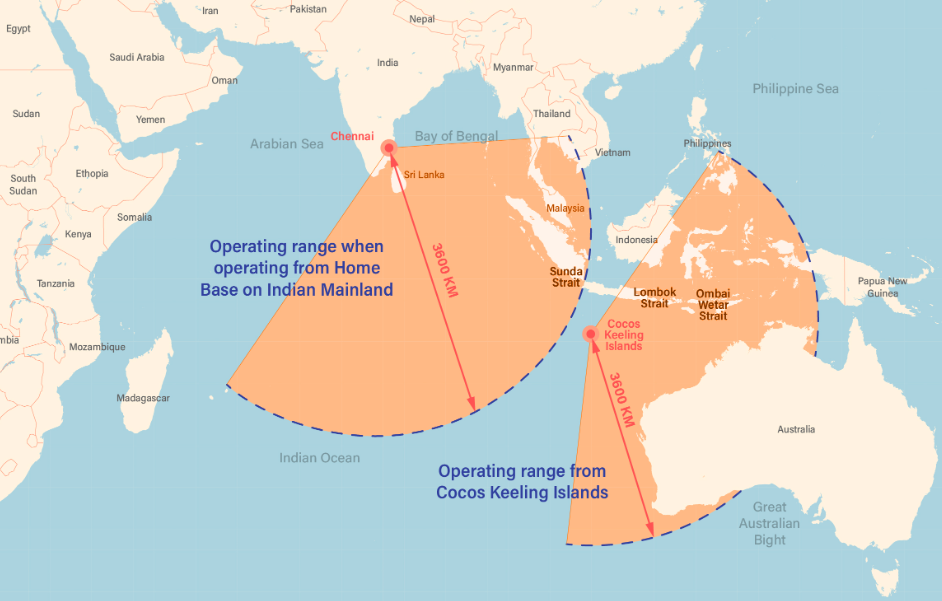 [16]
[16]“A critical logistics agreement with Canberra”, Indian Council on Global Relations, June 2020 -- source: https://www.gatewayhouse.in/logisitics-agreement-canberra/ [17]
NAVAL REACH THROUGH THE INDIAN OCEAN REGION WESTWARD TOWARD FRENCH INTERESTS – INDIAN MAP OF 2020
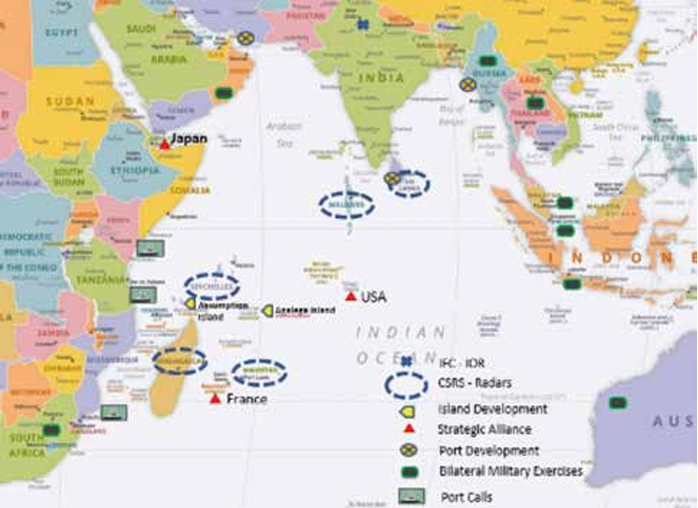 [18]
[18]Source: “India’s Strategic Intent and Military Partnerships in the Indian Ocean Region”, Geneva Centre for Security Policy 2020: https://dam.gcsp.ch/files/doc/india-s-strategic-intent-and-military-partnerships-in-the-indian-ocean-region [19]
MAP OF INDIAN NAVAL DEPLOYMENTS IN INDIAN OCEAN REGION, MID- 2023
 [20]
[20]Vice Admiral Pradeep Chauhan, “The Indian Navy in the changing geopolitics of the Indo-Pacific”, August 2023. Source: https://maritimeindia.org/the-indian-navy-in-the-changing-geopolitics-of-the-indo-pacific/ [21]
In the Indian strategic view, the new Indian-Russian pact is likely to run into criticism in Washington, and from Quad allies like the Australians and Japanese. This is misplaced, according to Brigadier General Arun Saghal, a leading strategic analyst in Delhi. India is “re-balancing” to defend its maritime trade routes when no one else will do so, and “prevent[ing] unnecessary and extremist steps” from whatever source – China or the US.
“India has never accepted a military role for the Quad,” Saghal says. “And from that perspective, nothing should change [with the implementation of RELOS]. But if you are wanting to inject a military element to it, and expect India to be part of that, particularly when you [US] have no presence and provide us no peace or support our security in the area, then India will have to re-think its choices.”
Listen now to the StratNewsGlobal podcast [22], first aired on December 14.
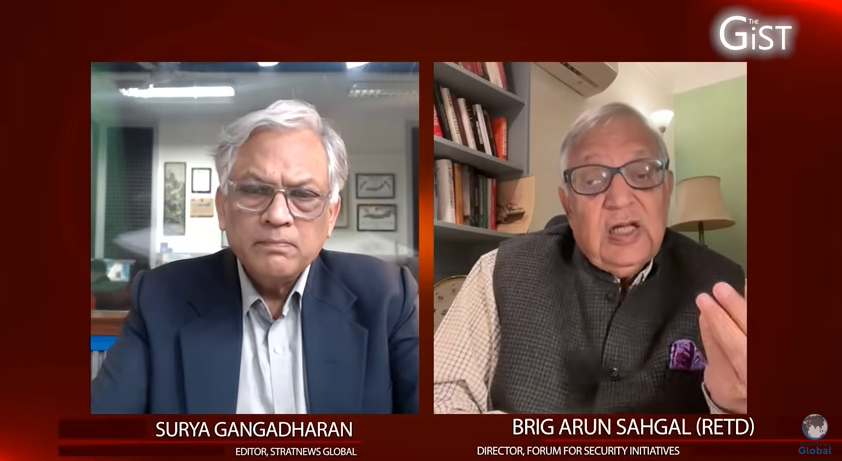 [23]
[23]Source: https://www.youtube.com/watch?v=4jPjH2sXEeg [22]