 [1]
[1]
By John Helmer, Moscow
@bears_with [2]
Before the last of the great Arab strategists was murdered by the Americans, British and French – that was Muammar Qaddafi in October 2011 – he met with an Indian delegation at Sirte, in the Libyan desert.
This is what the Indians recorded [3] Qaddafi telling them: “Imperialism does not want India as a strong nation. Imperialists are trying to divide India, Pakistan and Bangladesh to create mini states there, and create rivalries among them. There is no reason that could lead to a war between India and Pakistan as the boundaries are known, but plots are continuing to engage them into war. Israel and United States want to see both India and Pakistan destroyed. US nowadays is pushing Israel to have a close relationship with India. Of course, Israel is not going to give any appreciable help as it does not like Indians. Israel is inciting India against Pakistan and vice versa. We know the role of the US and Israel. They did same thing during Iran-Iraq war. US was supportive of Iraq to oust Khomeini, while Israel was supplying arms to Iran. Now Israel and US are in agreement to destroy both India and Pakistan.”
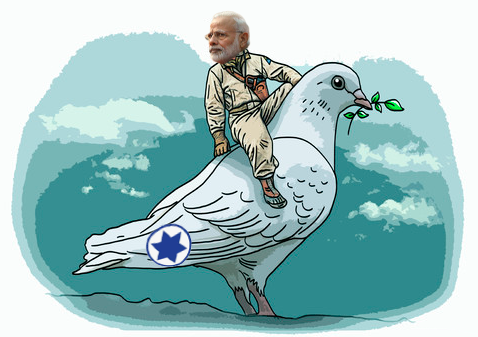
Until recently, there were enough Indian military, intelligence and political advisors moving in person or on paper in and out of Seva Teerth [4] to caution Prime Minister Narendra Modi (lead image) against his making public display of “the enduring friendship with Israel, built on trust, innovation, and a shared commitment to peace and progress” – the banner with which Modi announced his visit to Israel today [5].
Even they did not dare cite Qaddafi. But that was in December [6] when Modi cancelled the “solidarity” visit to Delhi of Israeli Prime Minister Benjamin Netanyahu.
This week, however, the traditional balance in Indian foreign policy between the Arab states, Iran, and Israel, and the cautious balance of power in Delhi has changed, as Modi has tweeted. He will have more to add when he speaks to the Knesset. Modi has made ceremonial addresses to the parliaments of seventeen states since he won the prime ministry in 2014 [7]; each of them either hosts a large Indian diaspora or has co-signed a strategic partnership pact with India.
Until now there has been neither with Israel.
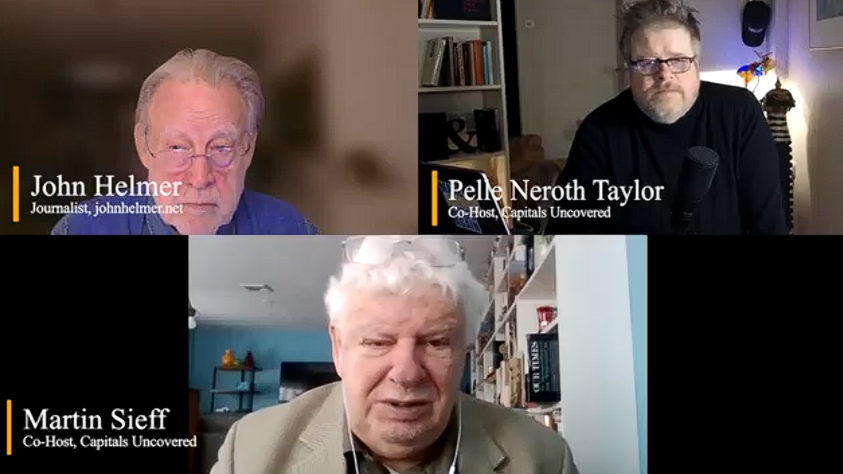
In this podcast with Pelle Neroth Taylor in Stockholm and Martin Sieff in Washington, the evidence is presented that Modi’s trip to Israel is the strategic trap which Qaddafi explained twenty years ago. View or listen by clicking. [8]
 [9]
[9]Asked to clarify the Delhi politics which led to this outcome, an Indian source in a position to know replied:
 [10]
[10]Europe’s editorial class and think-tank cartels should stop lecturing India on Palestine. As PM Modi begins his Israel visit on 25 February 2026, the usual script is already visible. A section of the European media and the transatlantic think-tank ecosystem is once again trying to frame India as morally suspect for engaging Israel — while pretending their own record on Palestine is clean. It is not.
Let’s be blunt: much of this criticism is not about principle. It is about hypocrisy, hierarchy, and habit. The same editorial class that spent decades hedging on Palestinian statehood, soft-pedalling moral outrage, and hiding behind ‘process’ now wants to sermonise India. India does not need lectures from those who arrived late to their own conscience. India’s record predates their talking points. India’s position on Palestine was built long before it became fashionable in Western policy circles:
– 1947: India voted against the partition of Palestine at the UN
– 1974: India recognised the PLO (the first non-Arab country to do so)
– 1988: India recognised the State of Palestine
– 1996: India opened its Representative Office in Gaza (shifted to Ramallah in 2003)
Having been rebuffed for decades by the Arab petro-states and ignored by Europeans and Americans, Indians had a wake-up call after the collapse of the USSR.
Suddenly, Moscow went silent, and supplies of defence equipment — including critical spares — began to dry up. Soon, private players from several former Soviet republics began contacting Indians, offering spares, repairs, and upgrades for ageing Soviet equipment. Most, if not all, of these offers had one thing in common: they came through Jewish émigrés in Israel. Even Uzbek and Azeri spares were often being offered through Israeli channels. With the Russian government aligning with US sanctions on India, embargoes on technology transfer from Moscow, and an increasingly unstable nuclear Pakistan, India needed to wake up.
Israel rolled out the red carpet for India — even as NATO partner Turkey became one of the most hostile voices toward India (while simultaneously resetting its own ties with Israel). India began to build a serious strategic partnership with Israel in defence. Over time, that partnership expanded to technology, agriculture, and innovation.
At the same time, under [Prime Minister Atal Bihari] Vajpayee [1998-2004] and then Modi [from 2014], India strengthened ties with Egypt, Jordan, the UAE, and Saudi Arabia, while continuing to support Palestinians in increasing measure. It was also clear to Indians that large flows of British, European, and US money into Palestinian institutions were often being siphoned off into networks and elites in London, Paris, and Switzerland. Extreme elements in Palestine also developed channels, through Qatar and Turkey, with actors close to Pakistan.
India has therefore taken a realistic and balanced approach to both Palestine and Israel — perhaps more than any other nation. Europe’s media hypocrisy is now impossible to hide.
Many European outlets and policy institutions speak the language of universal values while practising selective outrage. They are loud on morality when it is cost-free.
They are often loudest when the target is India. Let us remember: India recognised Palestine in 1988. Much of Europe delayed, diluted, and dithered for decades — and parts of its media still behave as if they occupy the moral high ground.
A lot of “analysis” coming out of elite policy circles is now formulaic: Flatten history. Erase terrorism. Ignore context. Produce moral equivalence on demand. You can support Palestinian rights and statehood — as India has for decades — without whitewashing:
– Pakistan-backed terrorism against India
– proxy warfare against India
– military-regime manipulation of the narrative
– sustained anti-India disinformation
India is not obligated to accept frameworks manufactured in London, Brussels, or New York and marketed as neutral expertise. These are often anti-India ecosystems, and Indians see them for what they are. They have been complicit in decades of morally repugnant Western elite policies toward the Global South. Where money and influence networks are involved, there is often deep mendacity at the core. The truth is: they will say anything.
The same networks that routinely amplify anti-India narratives from Ankara, Teheran, OIC [Organisation of Islamic Cooperation] platforms, and Pakistan-linked voices suddenly become guardians of morality when Modi visits Israel. That is not moral seriousness. That is geopolitical bias dressed up in academic language. And Indians can see it. Indians see it clearly — and they are done tolerating it.
Before judging Modi, recognise India. If European media and think tanks want to be taken seriously, they should start by acknowledging:
– India’s anti-colonial and anti-imperial record
– India’s long support for Palestine
– India’s democratic legitimacy
– India’s lived experience of terrorism
– India’s strategic continuity from Nehru to Vajpayee to Modi
 [11]
[11]And if they truly believe in a fairer world order, and genuinely care about India’s voice, they should support India’s rightful place as a permanent voice of the Global South in the UN Security Council. For too long, India has been treated as a country to be judged by Western institutions, but not empowered within them. Modi rejects that kind of neo-imperialism.
India will not be judged by any moral yardstick except its own.