 [1]

By John Helmer, Moscow
@bears_with [2]
Just as drones have overtaken traditional infantry, armour and artillery weapons in land war, podcasts are transforming the warfighting weapons on the media battlefield.
This is the first history of war and peace podcasting and of the big-click, fat-money, heavy-weapon podcast names.
Just in time, too, because the evidence uncovered in this book reveals that the podcasters have already hit their peak in viewers and influence. Audience fatigue is setting in; clickbait exaggeration, sensationalism, and fakery are replacing investigative journalism.
Attracted to the podcasters as the newest and most influential of the mass media, the info-warfighting agencies of the US, UK, Russia, China, and Iran are making the podcast impresarios and their guests an offer they find it difficult to resist. Money for propaganda – this is the iron law of media in wartime. The first casualty is investigative journalism, reporting the truth.
There is a second iron law – it’s the old imperial idea of diverting dissent and pulling in crowds with bread and circuses. Blood, too.
Case studies of the war and peace podcasts most popular with audiences in the English-language world reveal why they are failing to stimulate anti-war movements and political parties opposed to the Trump empire’s wars. These podcasters have turned into carneys outside the circus tent – pitching snake-oil cures, advertising exorbitantly priced products to keep as a memento of a night’s entertainment, then replace when the next circus rolls into town
This isn’t journalism, it isn’t politics; it isn’t even armchair warfighting. It’s action gaming — the intellectual equivalent of custom robos which blast away at each other until the commander’s robo has won all the hit points and destroyed the rivals.
Russian robos and Iranian robos versus American, Ukrainian, German, British, and Israeli robos.
This game is fun to play for a short while, but it’s factless, feckless too, because the winner is always the commander’s robos, otherwise the game wouldn’t be worth playing. For gamers, there’s no fun in losing.
This is why in podcasts like Judging Freedom, The Duran, or Greater Eurasia Podcast, the commander’s Russian and Iranian robos are always within days, weeks or months of winning their wars — and always certain to win. The robos with recognisable podcast names are always winning their games, always wrong on the battlefield: if they weren’t robos, this would be a disqualification from the game.
Here is the truth the media manipulators don’t want you to know, and the financial report of the fortunes they are earning in secret for manufacturing false consciousness for their state paymasters, and for deceiving you.
Podcasting, as we call it now, recently passed its twenty-first birthday.
Speaking clinically, that’s past the stage of puberty when the pod dropped, and past virginity when the cast was broken. The podcast is at the stage of consenting adulthood, but it’s still immature.
At first sight podcasting can be intoxicating as Philip Marlowe, the hardboiled private investigator, said in The Long Goodbye (1953): “Alcohol is like love. The first kiss is magic, the second is intimate, the third is routine. After that you take the girl’s clothes off.”
Its relationship to journalism is what the pole is to the striptease dancer – something real to cling to when everything else is wishful thinking and fantasy, at least in the eyes of the audience.
Investigative journalism, speaking professionally, must take the girl’s clothes off – and everyone else’s in the story. At journalism school, that’s called reporting the facts objectively, telling the truth of what there is to see – no matter what the viewer and reader want to see or fantasize that they can see already.
When investigative journalism is the message and podcasting is the medium, the history of their combination is even shorter. In wartime that’s less than the five years since Russia started the Special Military Operation in Ukraine in February 2022; three years since Israel began the genocide of Gaza in October 2023; and eighteen months since the US and Israel launched their war against Iran in June 2025.
According to the most recent surveys of the American podcast audience, more than half listens as a combination of entertainment, lesson, and diversion at the same time – to have something to do when they are doing something else. That’s the big podcast difference from long-read media – you can read Dances with Bears, for example, and drink alcohol, but you can’t take off your own or someone else’s clothes at the same time. Only about one in ten US listeners to podcasts do it in the old-fashioned way with desktop computer, laptop, or tablet.
There’s a hitch with that, though. Packaging information in podcast form may lead to less short-term comprehension and less long-term memory retention than occurs in reading text on the page or on the screen. To date, there is research concluding this is true [3]; and also research that it’s false [4].
There also appear to be national, ethnic and racial differences between blog readers and podcast listener viewers. While more and more of the global audience is opting for the podcast to replace the website, blog, and tweet stream (not to mention heritage newspapers, magazines, books), and spending increasing amounts of time on podcasts at the expense of time reading print, in the US the podcast option is preferred by more blacks, Hispanics and Asians than whites.
Just how short attention spans are for podcasts running for about thirty minutes and in war podcasting for an hour can be compared with the average reading time of long-read journalism, whether it’s published in the mainstream or the alternative media. On telephone devices, the average long read for text is two minutes; on computer devices this average extends to between five and eight minutes. [5]
Measurement of podcasts with a topic focus on current news, politics, government, foreign policy, and war, indicates that the consumption rate – that’s the length of time the viewer stays tuned before clicking off – is at least 70% [6]. This is much, much longer than the average reader spends on blog or tweet.
Wherever you are, whatever you are doing, whichever age, ethnic or gender group you belong to, and however you prefer to think – long, short, parallel, or simultaneous – Dances with Bears has come up with a solution: this is to make podcasts with different geographical coordinates, and follow them up with long-read backgrounders on the Dances with Bears website and short-read headlines on the @bears_with Twitter (X) stream.
It’s a fact, however – proved in Google Analytics which records the source and the medium for readers of blogs and websites, glimpsers of tweets, and viewers of podcasts – that the crossover between them is quite small. Only about one in ten readers of a tweet click on to the website or the podcast which is linked, and which the tweet aims to introduce or advertise. Referrals to podcasts from other sources – for example, social networks, websites, other media – are just as common. But the majority – between 60% and 80% – of the podcast audience are newcomers, not regular followers, subscribers, or fans.
How many of these newcomers turn out to be one-timers isn’t known from the research that has been published to date [7]. Podcast hosts and impresarios don’t tell: they are exceptionally competitive and therefore secretive. More competitive, less transparent, more secretive than the mainstream media which are monitored by sharemarket analysts and regulators, circulation auditors, advertising marketers, and censors. Podcaster revenues and their profits – they are convinced – depend on keeping the lid on their black boxes sealed tight, not only against the investigations of journalists working for rival media, but also to block the artificial intelligence (AI) machines and intelligence agency monitors which are working continuously to combat anti-war podcasts because they are weapons of information war to win the narrative battlefield as surely as they are fighting to win the battlefields on land, sea, in air and space.
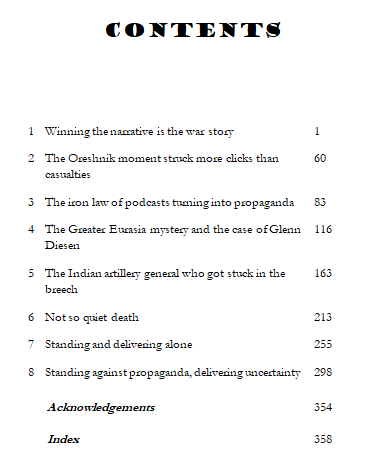
This book is an attempt to present several case histories, combined with the political sociology of podcasting that focuses on the war against Russia in Europe, and the war of Israel and the US in the Middle East. Drawing subscriber audiences in aggregate (including overlap) each week of about four million, and individual viewer audiences ranging from 5,000 to 20 million, this is the next best thing to an anti-war constituency when there’s no such thing in the political party memberships or mass movements of North America, Europe or Australasia.
There are tools for counting these subscribers, daily views, monthly averages, and measuring both the audience aggregates and money earnings of podcasts over the relatively short time they have been active in covering the two great wars. The evidence gathered from these tolls, charted and analysed in the chapters to follow, reveal a common rise to a peak in April 2026, and a slow decline since then. This is a finding, a fact of analysis which the podcast impresarios are reluctant to discuss publicly, as they struggle to reverse the decline. The larger finding, the big fact is that the two great wars are permanent; the battlefields shift in location; so too the podcasts as money-spinners from the propaganda budgets and information wars which are as expensive, and also as inventive as battlefield weapons. Podcasts loiter like drone munitions. But their audiences aren’t fixed in bunkers; they move where the targeters can’t find them; they run away.
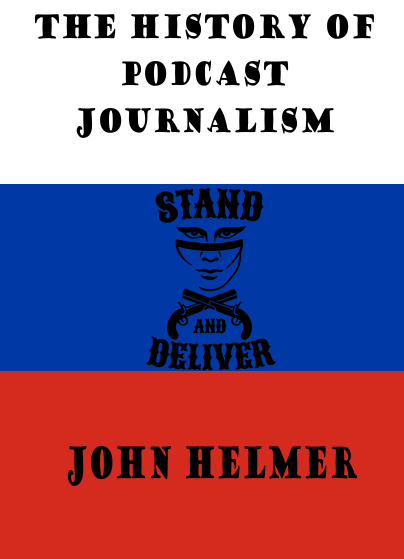
“Stand and deliver!” is the title of this book because this is what I have been doing in the podcasts analysed here [8].
“Stand and deliver!” That has been the highwayman’s ultimatum since road travel without armed escorts became common and middle-class enough for the road robber, armed with a portable handgun, to calculate that the profitability of his enterprise exceeded the risk of getting wounded, captured, hanged. The proliferation of handguns in the hands of disaffected and impoverished soldiers following the English Civil War in the mid-17th century created the manpower and the motivating material conditions.
“Stand and deliver!” was usually addressed to the audience with the muzzle of a flintlock pistol. The ultimatum itself followed: “Your money or your life!” The title of this short history is a reminder to the reader that this is still a stickup in which you pay time and money for the livelihood of the podcast impresarios. Me too.
 [9]
 [10]
Click to read the Kindle edition [11]
Click to read the paperback [12]
Click to read the hardcover [8]