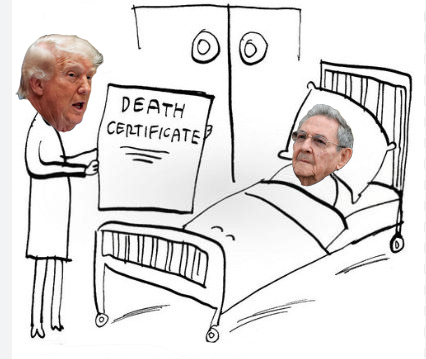
 [1]
[1]
By John Helmer, Moscow
@bears_with [2]
“We will not abandon the Cuban people in their time of need,” Russia’s Energy Minister, Sergei Tsivilev, announced [3] three months ago to the day.
“A Russian vessel [Anatoly Kolodkin [4]] has broken through the blockade. Now a second one is being loaded. We won’t leave the Cubans hanging,” he told an energy industry conference in Kazan on April 2 [5].
A week later in Havana, a Russian ministerial delegation announced that Russia was planning to do more to defend Cuba from the US blockade than shipping crude oil and petroleum products. “The issue of ensuring the island’s energy security is a priority,” said [6] Sergei Ryabkov, first deputy foreign minister. “But it’s too early to say what the next steps will be. It is well known that we generally do not limit ourselves to the supply of that batch of oil that has already arrived on the island on the tanker Anatoly Kolodkin.” “We don’t focus on protocol, on decorative aspects in our relations, but purely on the specifics of the tasks that we face. This is what our leaders are aiming at, and the Cuban president was as specific as possible in today’s conversation [7].”
By then the state shipping company Sovcomflot’s tanker Universal had loaded a 30,000-tonne cargo of petroleum products at Ust Luga and Primorsk, and then headed towards Cuba. Through the English Channel and into the Atlantic, it was escorted [8] by a Russian Navy frigate.
But the Universal never reached Cuba.
Instead, it remained adrift in the Sargasso Sea of the North Atlantic until it turned, not west towards Cuba but south to Brazil. It then entered the Amazon River and reached Manaus on June 21. The Universal had been left hanging for two months. No Russian crude oil, diesel, or other petroleum products have crossed the US blockade to reach Cuba except for the first, the Kolodkin, on March 31.
Delivering 730,000 barrels of crude oil, the Kolodkin was the second Russian attempt to run Trump’s gauntlet. By the time it had unloaded and its crude refined into diesel, the new supplies lasted for about two weeks. The Sea Horse, Hong Kong-flagged and loaded with 200,000 barrels of Russian diesel transferred from another vessel off Cyprus in the Mediterranean [9], had approached Cuba on February 25. However, it was then diverted on Moscow’s orders to Venezuela [10].
Who has been giving the orders in Moscow?
Not Tsivilev at the Energy Ministry, not Lavrov at the Foreign Ministry.
On June 3, Lavrov’s deputy in charge of Latin America, Alexander Shchetinin, announced [11] to the press that “we are engaged in the closest collegial cooperation with our Cuban friends. Undoubtedly, we coordinate the steps that need to be taken in the difficult situation they are currently dealing with. Cuba certainly remains our partner and friend, and we continue to provide political support to the country,” Shchetinin was choosing his adjectives carefully. Political support there was – no more.
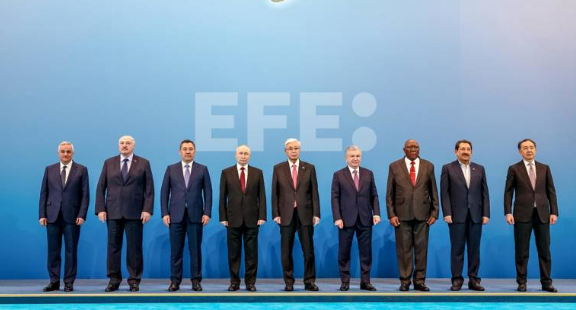
The state media revealed how little Putin had decided to do for Cuba when he was in Astana, Kazakhstan, a few days before, for the summit meeting of the Eurasian Economic Union (EAEU); Cuba is an official participant in the EAEU as an observer; in Astana it was represented by Vice President, Salvador Valdés Mesa. Putin refused [12] to meet him in one of several sideline talks the Kremlin records Putin held with others.
Instead, Pavel Zarubin, a state television artificial intelligence, was told to make a video record of a “brief conversation with a Cuban delegation.” According to Tass [13], “the video shows the Russian leader coming up to the representatives of the Cuban delegation, exchanging a couple of words and shaking hands with them.”
Putin had said more on February 18 when he met the Cuban Foreign Minister, Bruno Rodriguez, in the Kremlin. Lavrov was the senior minister at the table; Igor Sechin, head of the state oil company Rosneft, was also there. Putin told Rodriguez for the record [14]: “We have always stood by Cuba in its struggle for independence, for the right to pursue its own path of development, and we have consistently supported the Cuban people…We are now witnessing a particular period marked by new sanctions. You know our stance on this – we reject such measures outright. The position of our Ministry of Foreign Affairs is clear, unequivocal, and has been articulated openly.”
What Putin meant was that Lavrov would do the talking against Trump’s sanctions, and Sechin would send the oil to break the blockade. But Putin’s secret orders to them were different.
Had Putin wanted, he could have made a show that he wouldn’t leave the Cubans hanging. That was at the end of April, when Fidel Castro’s grandson, Fidel Antonio Castro-Smirnov, a Havana University professor, was in Moscow for the First International Socialist Forum Sovintern. “Much has yet to be done for our motherland, for Latin America, Africa, Asia – and for the whole world,” Castro was quoted as saying by Tass.
Socialism is an anathema to Putin. Instead, he has claimed it is a social welfare expense in capitalist state financing.
“The deep changes that have taken place in our society” — he said [15] in response to a reporter’s question in December 2018 — “make restoring socialism in the sense you mean impossible. There can be social elements in the economy and the social sector, but expenses will always exceed profits, and as a result, the economy would be at a dead end…But the just distribution of resources, the fair treatment of people who live below the poverty line, and a state policy aimed to lower the number of people who have to live like that, to provide the majority of people with healthcare services and education in acceptable conditions, if this is the socialism we are talking about, we are holding to the very same policy.”
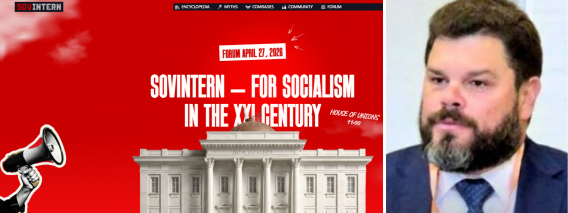
SOVINTERN FORUM APRIL 27 – “NATIONAL CONSTRUCTIVE FORCES”, NOT SOCIALISM
 [16]
[16]Left: source: https://sovintern.org/en/forum [17] The listing of “comrades” by the Sovintern organizers omitted [18] Cuba. Right: Fidel Antonio Castro-Smirnov.
The Sovintern forum, the first of its kind, had been organized by the Just Russia party [17]. Castro does not appear in the programme events but a video message from Putin was broadcast. He omitted the word “socialism”. Instead, Putin claimed [19] that “Russia has consistently sought to expand meaningful dialogue among constructive national political forces. Together with our partners in the Shanghai Cooperation Organisation, BRICS, and the Eurasian Economic Union, we are developing practical mechanisms for cooperation across legislative and party platforms. These efforts are aimed at bringing together political leaders and parliamentarians from our countries to jointly address shared challenges to global and regional stability and security, while also promoting economic and social development.”
A British analysis of the conference explained what Putin was doing: “with the balance of forces in Russia’s opposition. A clear motivation for SR [Spravedlivaya Rossiya, Just Russia [20]] to found the Sovintern is that it puts them on a level with the Communist Party of the Russian Federation (KPRF), the second-largest party in the country and one-time challenger to Putin in the late 90s and early 2000s. Though the KPRF has been nothing but docile, and elections in modern Russia are a foregone conclusion, Putin is happy to allow SR to leach some of the KPRF’s credibility and popularity away from them, leaving both parties comfortably worse off than United Russia [21].”
THE ASTANA SUMMIT APRIL 27 — PUTIN KEEPS CUBA TO HIS LEFT
 [22]
[22]Cuba’s Vice President, Salvador Valdés Mesa, is third from right; President Putin is three places to his right. There is no record that Putin and Valdes spoke for more than a few seconds. The Russian state media Vesti and Tass reported [13] that they exchanged “a couple of words”.
The Cuban President, Miguel Diaz-Canel, has been a regular invitee of Putin’s at the celebration of the May 9 victory in Moscow. He attended in May 2024 and again in May 2025, and there were full bilateral meetings at the Kremlin both times. At the second, oil supplies to Cuba were a priority, and Sechin was at the table.
 [23]
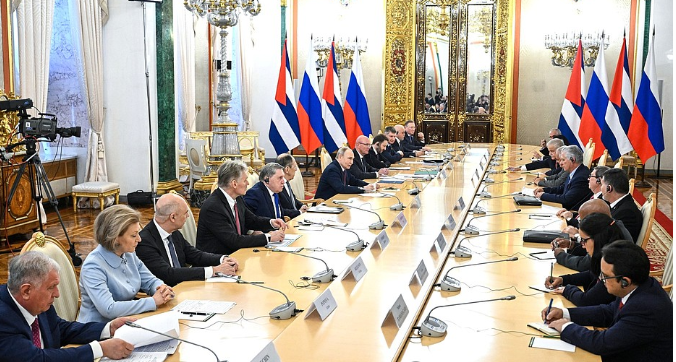
[23]Igor Sechin is at the extreme left of the Russian line; Tsivilev, Lavrov and Sergei Kudryashov, head of Zarubezhneft, another of the Russian state oil suppliers to Cuba, were also present [24].
President Putin told Diaz-Canel nothing about oil, nothing about the Trump blockade.
According to the Kremlin communiqué, he said [24]: “Cuba contributed to the fight against Nazism. I know that you started your visit with St Petersburg, former Leningrad, and I would like to note that volunteers from Cuba fought alongside the Red Army soldiers outside Leningrad, among other places. It is very symbolic that your current visit coincides with the 65th anniversary of resuming diplomatic relations on May 8, 1960. Please convey my best wishes and greetings to Comrade Raul Castro.”
In his past tense, Putin was displaying the history of Cuban solidarity with Russia; he omitted to put in the present tense Russia’s solidarity with Cuba against the US. The year before, also as the Cuban president visited for the May 9 celebration in Moscow, Putin had said [25] much more: “Russia’s relations with Cuba are based on the feelings of friendship and mutual respect. It has always been this way. We have always shown support for the people of Cuba and rejected the continuing and long-standing attempts by the United States to restrain Cuba in its development and harm its economy by imposing illegal sanctions and restrictions. The people of Cuba have been resisting these attempts for decades now and have remained confident in their efforts.”
At the May celebration of 2023 [26] Putin had made a promise to Prime Minister Manuel Marrero Cruz at the Kremlin: “We are aware of the fact that Cuba has been living under illegal sanctions for decades, yet the Cuban people are coping with them. For our part, we will do our best to ensure that our economic cooperation helps overcome the difficulties imposed on you from outside.”
By May 9 of this year, Putin had changed his mind and closed his mouth. President Diaz-Canel returned to Moscow for the Red Square parade. The Kremlin record is silent, however, on a meeting with Putin. If there was one, it has been kept secret.
On June 3, the Kremlin recorded what it announced to be Putin’s birthday greeting to Raul Castro on his 95th birthday: “Dear Comade Raul,” Putin telegrammed [27], “amid the unprecedented external pressure faced by the Cuban people, we once again express our firm solidarity and support. We will continue to work shoulder to shoulder in order to strengthen bilateral cooperation and cooperation on international platforms in the interest of building a just multipolar world order.” This message followed by two weeks the announcement [28] of the US Government’s indictment of Raul Castro for murder.
Lavrov’s ministry kept trying harder. On June 10, at the Foreign Ministry’s weekly press briefing, the question was planted: “What is Russia’s assessment of US pressure on Cuba?” Spokesman Maria Zakharova replied [29]: “The Russian Federation’s position on this matter is unchanged: we are in full solidarity with Havana. We firmly condemn intimidation, the use of unlawful unilateral restrictive measures (which in reality constitute a blockade), and any interference in the internal affairs of a sovereign Cuban state. In this context, the US blockade against Cuba is undoubtedly nothing other than one of the methods used by the US administration to establish its control over the Island of Freedom, as part of attempts to revive the Monroe Doctrine. “
On June 23 Lavrov repeated [30] the old-fashioned terminology for the American operations against Cuba: “This explains Washington’s declared objective of taking control of global energy markets. In January this year, we witnessed a US armed incursion into Venezuela that left dozens dead and injured. The President of Venezuela and his wife were abducted. The United States made no secret of the fact that its primary objective was to gain control of the Venezuelan oil industry. This was followed in March by the unprovoked aggression of the United States and Israel against Iran, which seriously destabilised not only the Middle East but the world in general. A few days ago, US President Donald Trump stated that, should negotiations fail, the United States would take control of the Strait of Hormuz. Once again, it appears that the issue is oil rather than anything else. Neocolonial pressure is also being openly applied against Cuba, with which we reaffirm our solidarity.”
Lavrov’s solidarity with Cuba was empty. Putin had already ordered Sovcomflot to send its petroleum products on board the Universal to Brazil. So, why did Putin order Lavrov, Tsivilev and Sechin to break their undertakings with the Cuban government? If there was a case to be made that Russia’s interest in avoiding conflict with the Trump Administration while the negiotiations were under way to preserve the tenmporary waiver of US sanctions on Russian oil sales was a higher priority than hanging with Cuba, why didn’t Putin or any other Russian official say so? Why did the Kremlin order the Russian press and the State Duma not to raise the question in public and debate the answer?
Putin also has form for saying one thing about Cuba in public, and saying quite another in secret. In October 2001, during a meeting with then President George Bush, Putin proposed to close down the Russian intelligence signals station in Cuba in exchange for US trade sanctions relief [31]. Bush refused. Putin kept his failure a secret – until the White House record was declassified [31] recently.
The Russian parliament is also keeping Putin’s Cuban secret.
According to Dmitry Novikov, deputy chairman of the State Duma Committee on International Affairs, Putin should continue to break Trump’s blockade and deliver oil to Cuba. Referring to the Kolodkin in March, Novikov said [32]: “Let’s keep doing the same. What prevents us from sending a tanker every month?” Novikov said that in a televised podcast on May 20.
Novikov is the deputy chairman of the Central Committee of the Communist Party of the Russian Federation (KPRF). He knows that Putin is the answer to his question. Neither he nor the Russian Communists dare to say so.
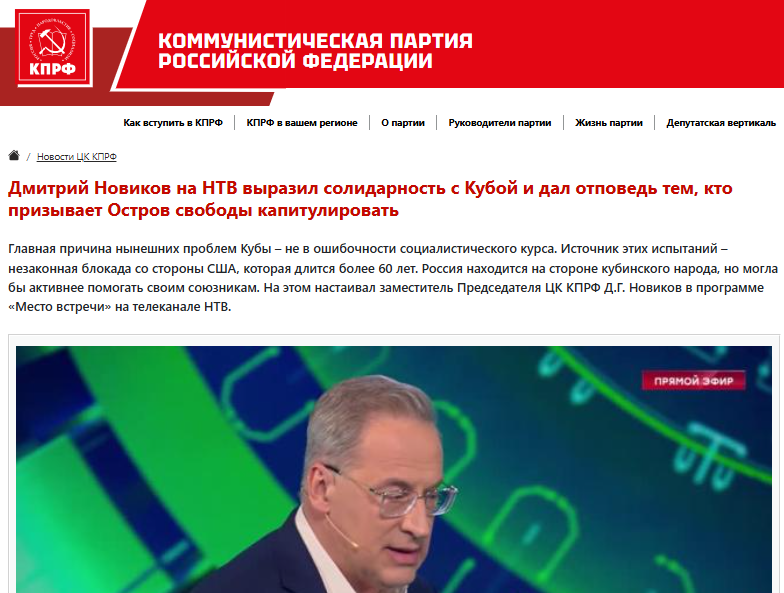 [33]
[33]Source: https://kprf.ru/party-live/cknews/244151.html [32]
The Cuban state media are also silent on Putin. Click here [34] and here [35].
What remains to break this silence are the records which the communists are keeping of the slow capitulation of Cuba’s leadership to Trump as the Castro family, Diaz-Candel, Valdes, Rodriguez and other Cuban officials negotiate – that’s to say, hang alone.
On June 30, the Greek Communist Party (KKE) newspaper published [36] this analysis of the legislative changes in Cuba forced by Trump. The report ends on the conclusion that the new measures will have “negative consequences for the Cuban people”.
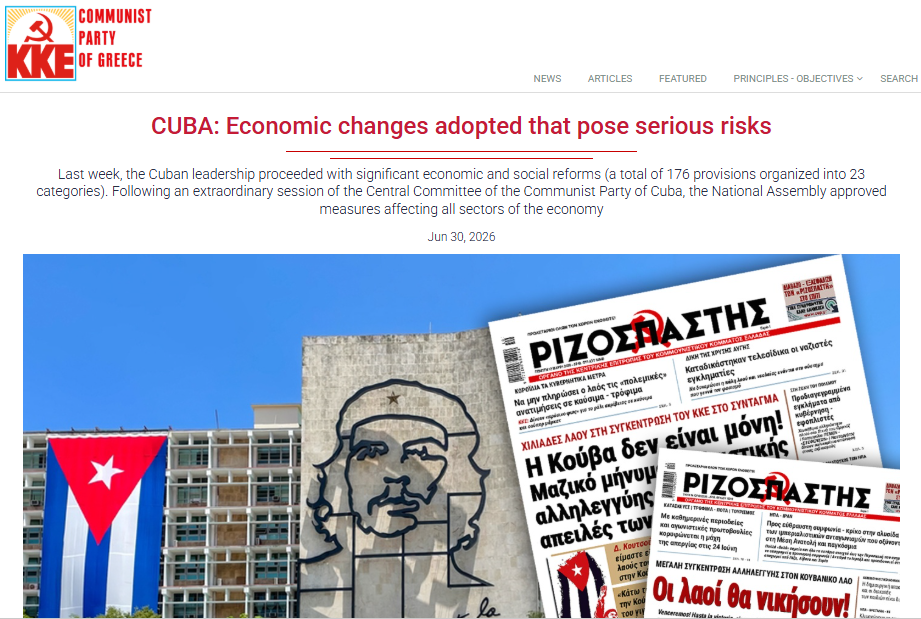 [37]
[37]Source: https://inter.kke.gr/en/m-article/CUBA-Economic-changes-adopted-that-pose-serious-risks/ [36]
 [38]
[38]Last week, the Cuban leadership proceeded with significant economic and social reforms (a total of 176 provisions organized into 23 categories). Following an extraordinary session of the Central Committee of the Communist Party of Cuba, the National Assembly approved measures affecting all sectors of the economy. These were presented as a response to the extremely difficult situation created by the brutal US embargo, which has been in place for more than 60 years, and, in particular, by the energy blockade imposed since January of this year, which has placed immense pressure on the Cuban people.
The measures approved are a continuation of the guidelines and reforms adopted following the 6th Congress of the Communist Party of Cuba in 2011. A central feature is the promotion of foreign private capital investment across all sectors of the economy and the adoption of market mechanisms as a means of allocating resources. Among the most significant changes are the following: state-owned enterprises will enjoy greater autonomy and, like private enterprises, may be converted into joint-stock companies, while all entities —including individuals and foreign investors— will be able to hold shares in as many companies as they wish.
Private employers will be permitted to hire more than 100 workers and engage directly in foreign trade; in other words, the state’s monopoly on foreign trade will be abolished. Furthermore, the existing wage-scale system in state-owned enterprises will be abolished and replaced by a minimum wage that takes inflation into account. Ultimately, wage levels will be determined through negotiations between employees, trade unions and enterprises, and will depend on each enterprise’s financial capacity.
The provisions also introduce changes to ownership relations and recognize the distinction between ownership and management, while at the same time maintaining that “social ownership of the basic means of production remains”.
Within this framework, substantially greater powers are being granted to provincial and municipal authorities to develop the so-called local economy and public utility services by encouraging, as emphasized, direct foreign investment.
A key element of the reforms is the restructuring of land management and land use for all economic actors. The real right of usufruct over land will be granted to state-owned, private, and mixed entities, as well as to natural and legal persons, for an indefinite period and over an area corresponding to the project submitted. This will apply to all agricultural, forestry, and tobacco-producing units, as well as to ecotourism and agritourism development projects. Agricultural cooperatives will also be able to engage directly in foreign trade in order to export their products and import agricultural inputs and technologies.
The reforms also provide for the establishment of private financial institutions, including banks and foreign exchange bureaux, which will operate under the supervision of the Capital Market Commission (BCC) on the same regulatory basis as state-owned banks.
In addition, the tourism sector is being opened up further to private investment through real estate development, while the so-called insurance market is also being opened up. These measures are accompanied by changes to oversight mechanisms, a reduction in the number of ministries and public agencies, and adjustments to the institutional and legal framework through the necessary legislative amendments.
Furthermore, private and foreign capital will be allowed to participate in the importation and trade of fuels, including through the retail network.
The country’s Prime Minister and member of the Political Bureau of the Central Committee of the Communist Party of Cuba, Manuel Marrero, argued that all these changes do not represent a retreat from the state’s social responsibilities, but rather “incorporate the recognition of market mechanisms as means for the efficient allocation of resources”. He added that “the measures do not constitute a deviation from the socialist plan, but rather are in line with the logic of its development”.
However, the further strengthening of commodity relations and the market, together with the erosion of social ownership of the means of production, central scientific planning, and workers’ control —which constitute the fundamental principles of socialist society— has, as the historical experience of the overthrow of socialism in the USSR and other socialist countries tragically demonstrated, profoundly negative consequences for the peoples. Likewise, the predominance of capitalist relations in China have had far-reaching negative consequences.
A critical examination of the changes being promoted in Cuba and the ongoing debate surrounding them must go hand in hand with the duty of communists to stand firmly alongside the heroic Cuban people, express their unconditional solidarity with them, demand an end to the long-standing and barbaric blockade imposed by US imperialism, and support the Cuban Revolution.”
 [39]
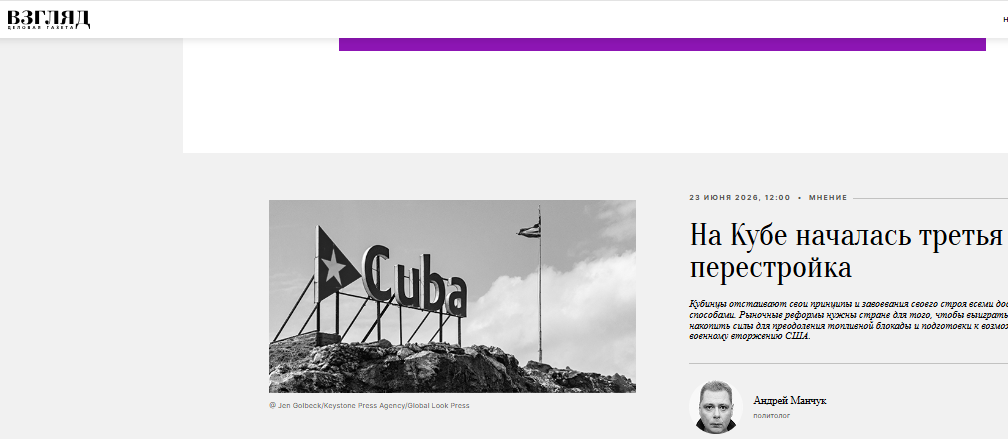
[39]The KPRF has been publishing reports on the US blockade and regime change operations, and the Cuban responses. Click to view here [40] and here [32]. The Kremlin-supported security analysis platform in Moscow, Vzglyad, published this semi-editorial commentary on June 23 [41].
 [42]
[42]Source: https://vz.ru/opinions/2026/6/23/1429057.html [41]
 [43]
[43]June 23, 2026
The third perestroika has begun in Cuba
By Andrei Manchuk
Cubans are defending their principles and the conquest of their system by all available means. The country needs market reforms in order to gain time and accumulate strength to overcome the fuel blockade and prepare for a possible US military invasion.
The National Assembly of Cuba has held an extraordinary session to approve a large-scale economic reform project presented by President Miguel Diaz-Canel. Members of the Cuban parliament have approved 175 government proposals aimed at liberalizing economic relations in the face of a severe fuel blockade and the threat of military intervention from the United States.
Diaz-Canel said Cuba is going through “the most difficult times of this century.” Addressing the residents of the island, he urged them to support the changes so that the country could withstand unprecedented pressure and not become the American colony it was before the 1959 revolution. However, the president promised to “continue the process of socialist construction, which has survived the longest blockade in history by the world’s greatest power.”
The agreed reform plan is aimed at removing restrictions on private business, reducing the number of government departments and changing the status of a number of state-owned enterprises. From now on, they will become joint–stock companies with the involvement of foreign capital, including in the fields of energy, trade and transport. The government allowed the creation of private agricultural companies. Cuban enterprises will be able to export and import products without government mediation.
The official exchange rate, which currently stands at 24 Cuban pesos per American dollar, will be abolished in favor of a flexible market rate while legalizing the activities of foreign banks and private exchangers. The free-floating peso will go through a gradual devaluation, although it has known risks for the country. To mitigate the effects of these measures, the Cuban Government has significantly increased the salaries of public sector employees as a preventive measure to mitigate the effects of inevitable inflation.
Havana does not hide the fact that these steps largely copy the market liberalization of the early 1990s, which took place in the People’s Republic of China and the Socialist Republic of Vietnam. The policy of Beijing and Hanoi was to stimulate the development of the market sector while maintaining overall political and strategic control by the ruling Communist parties. And Cuban officials promise to transfer this Asian experience to the shores of the Caribbean, calling it quite successful.
The reforms on Liberty Island have caused a resonance far beyond its borders. Post-Soviet bloggers are writing that Cuba has finally begun its own perestroika, hinting that it should lead the country to the notorious “regime change.” New market transformations are considered by such experts as confirmation of inefficiency of the planned economy. Although Cubans themselves perceive it quite differently.
 [44]
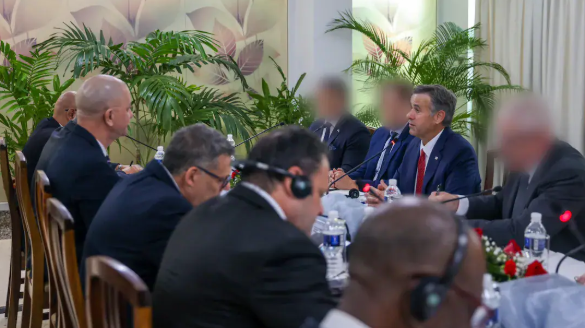
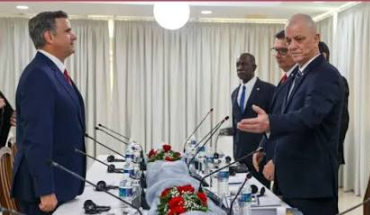
[44]May 14, 2026, Havana – top, CIA Director John Ratcliffe with three masked CIA officials in meeting with Cuban Government officials – CIA press release. Below – Cuban state media release.
 [45]
[45]“It’s like tying a man’s hands, throwing him into the water and saying he can’t swim. Hypocrisy and cynicism,” one of my Havana acquaintances, an engineer, figuratively put it, commenting on the reasoning that the “ancestral vices of the Soviet–style economic system” are to blame for Cuba’s economic problems.
The serious crisis that Liberty Island is experiencing today has completely different reasons. The difficult situation in Cuba is caused by the unprecedented economic war that the United States is waging against it, combining the fuel blockade with various sanctions and direct threats against the Cuban leadership. And the fact that the Cuban system has been surviving for 67 years under conditions of “comprehensive restrictions” that make it impossible to earn money from trade, attract investment and buy basic necessities abroad speaks volumes about its viability.
Cuban leaders remain true to their ideological beliefs, but they are by no means rigid dogmatists. On the contrary, they have always demonstrated enviable tactical flexibility, which made it possible to find ways out of critical situations.
It is worth recalling that the “perestroika” begins on the island for at least the third time. The first wave of moderate liberal reforms was initiated by Havana 35 years ago. In 1991, after the collapse of the Soviet Union, Cuba was on the verge of complete economic collapse, having lost Moscow’s financial assistance and being left without a market for its products. The West expected unconditional political surrender from the Cuban Government. But the Cubans managed to cope with the challenges and gradually took control of the situation.
Fidel Castro announced the beginning of a “special period” that lasted for 10 years. The Communist Party of Cuba opened the country to foreign investors by setting up joint ventures under state control. The energy sector has been reformed, aimed at economical fuel consumption, the development of agriculture and solar energy. But the main thing is that the Cuban government has allowed partial legalization of private business, primarily in the tourism sector, which has been made a key driver in overcoming the crisis.
The United States was confident that the massive influx of foreign tourists would disintegrate Cuban society from within, bringing the fall of the “communist regime” closer. But everything happened exactly in the opposite way. An open and vibrant Cuba has attracted many people from all over the world. Even Americans have flocked to Havana – and not only for tourist purposes. Oscar-winning Michael Moore, the most award-winning documentary filmmaker of our time, has made a film about American citizens who traveled with him to Liberty Island to receive free and high-quality medical treatment there. Because they couldn’t afford it in America itself.
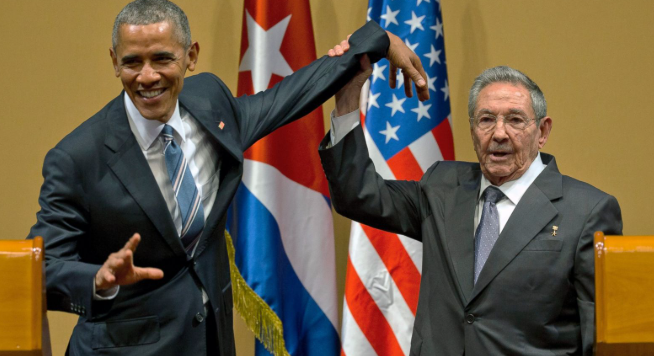
In 2016, experts started talking about the beginning of perestroika in Cuba again, after Barack Obama visited Havana. Washington tried to strangle the Cubans in its arms, offering them to ease sanctions in exchange for liberalizing the political system and dismantling the “one-party communist dictatorship.” But Fidel Castro, and then Raul, who replaced him, categorically did not trust the American leadership and did not put up for auction the political independence of their state.
 [46]
[46]March 29, 2016 [47], Havana – President Obama meets then President Raul Castro.
Now Cubans are also defending their principles and conquering their system by all available means. The country needs market reforms in order to gain time and accumulate strength to overcome the fuel blockade and prepare for a possible US military invasion. This is because the Trump administration has begun to realize that Cuba will not collapse by itself under the pressure of the current embargo.
Cuba continues to be itself – even now, in the midst of a severe crisis, Cuban researchers have tested a new cancer vaccine, which has attracted a lot of attention in the scientific world. And this gives hope that it will stand up to the imperialist hegemon, which has just received a resounding slap in the face in the Middle East.
 [48]
[48]