 [1]
[1]
By John Helmer, Moscow
@bears_with [2]
Russia’s escalation options for ending the war on the original terms of the Special Military Operation of February 2022 are now too little, too late.
This is because demilitarization of the Ukrainian battlefield cannot stop or deter the rearmament of the NATO allies for permanent war against Russia.
Nor can denazification of the Kiev regime succeed when the NATO allies have become nazified, like the Trump regime in Washington. Militarization and nazification have become US empire war aims against Russia. They are highly profitable ones for President Donald Trump, his family and associates, and for the military-industrial complexes, the banks, the stock, betting and crypto markets, and election financing machines of the US in league with the Germans, French, and British.
They are planning the permanent war future in which the territorial concessions Putin agreed to in Anchorage a year ago – Crimea and the four Novorussian regions in exchange for a US guarantee of Russia’s security in Europe – will not produce the “the security of our country and our citizens, and the inviolability of Russia’s borders for decades ahead”. That was Putin’s promise to Russian voters in his first election campaign rally early this week (June 28 [3]).
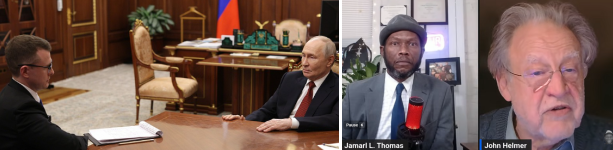
The President then admitted the negative in an evening interview with Pavel Zarubin (lead image, left), a reporter favoured by the Kremlin for his artificial intelligence.
“As for the attacks on critical infrastructure in general and energy infrastructure in particular,” Putin said [4], “they are, of course, creating problems. That is obvious. We are currently seeing certain shortages, although they are not critical, as I will explain. There are several tasks we need to address, and we have just discussed them.”
That discussion [5] was at Putin’s meeting an hour earlier with the oil oligarchs and government ministers.
With the reporter, Putin also acknowledged [4]“the strikes on our civilian infrastructure are intended not only to inflict damage on us – although I believe that is certainly one of the enemy’s objectives – but also to fuel an information campaign, or perhaps more accurately, an information operation as part of the broader confrontation with Russia. At a minimum, its purpose is to undermine our confidence in ourselves and our capabilities and, ideally, to create divisions within Russian society, force Russia to suspend, even temporarily, the advance of our forces along the line of contact and create conditions for launching negotiations on terms favourable to our adversary.We will not give them that opportunity. It is all the more important to understand that these terrorist attacks have no impact whatsoever on the situation at the front.”
Putin also disclosed the new variants of the Anchorage formula which Kirill Dmitriev has relayed from Steven Witkoff and Jared Kushner: “One is that both sides should stop carrying out long-range strikes deep inside each other’s territory. The reason for this proposal is obvious. Our retaliatory strikes deep inside Ukrainian territory are far more powerful, more effective and, frankly, more destructive, resulting in genuinely serious consequences for the Kiev regime. Another proposal is to limit military operations – please note this carefully – to just four territories: the Kherson and Zaporozhye regions and the Donetsk and Lugansk people’s republics, while halting hostilities everywhere else.”
So what is the end-of-war plan now?
“Our primary objective [is] the final liberation of Donbass and Novorossiya,” Putin continued [4]. “We know that the West continues to pursue Russia’s strategic defeat. There have been occasional suggestions that this is no longer the case, but officially no one has abandoned that objective. The goal remains Russia’s strategic defeat. If that is so, then why are they calling for a ceasefire and peace negotiations, and increasingly expressing a desire to take part in them? If Ukraine is, as they claim, capturing more and more territory and liberating it – in other words, if it is winning – then Western leaders simply need to wait. Russia’s strategic defeat would, it would seem, come about of its own accord. So let them wait. Meanwhile, our troops will continue doing their job and will do everything necessary to achieve the objectives of the special military operation.”
Does Putin end up admitting what the critics of his trust-in-Trump strategy have been saying, but at the same time remaining fixed where he was, and intends to remain?
In the podcast on Wednesday evening (July 1), Jamarl Thomas asks the questions Zarubin didn’t ask and Putin didn’t answer. Click to view or listen: https://www.youtube.com/watch?v=8FBbvrc0S6U [6]
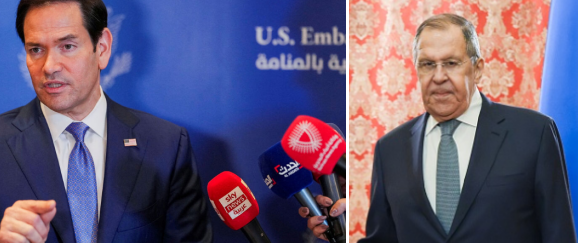
In the discussion, US Secretary of State Marco Rubio’s statement on the Anchorage Formula was contrasted with Foreign Minister Sergei Lavrov’s elaboration.
Rubio said: “There was no agreement in Alaska. There was a proposal in Alaska, but there was no agreement in Alaska. If there had been an agreement, we would have had an end to the war. So as I said, the President is prepared, as the United States remains prepared, to play whatever constructive role we can to bring about an enduring end to this war in Ukraine, and which has been bloody – 25 – 20,000 soldiers killed every month; 5,000 a week, most of them Russian. So it’s been debilitating for Europe, for the – but especially for Ukraine and for Russia increasingly.
So if they’re – we are prepared to step forward and play a constructive role, if there’s one for us to play, in bringing the parties together and bringing that war to an end. That’s what the President’s tried to do now for a year and a half, but there was no agreement in Alaska. There was a proposal made in Alaska, but it was never an agreement…Russia wants the entirety of Donetsk to be turned over to them, among some other things that they raised, but there was never an agreement. Had there been an agreement, there would have been an end to the war, and that’s been the fundamental problem [7].”
 [8]
[8]Lavrov replied [9] the next day with a special press release from his Ministry: “It is imperative to elucidate the situation as we perceive it. I trust this will provide clarity for our audience.
US Secretary of State Marco Rubio asserted that, in Alaska, there were only proposals and no agreements concerning a settlement in Ukraine. Consequently, as he put it, it is unclear why Moscow appears so concerned. The reality of the situation is that, viewed in the broader context, several days prior to the Alaska meeting, US President’s Special Envoy, Steve Witkoff, arrived in Moscow bringing those very proposals from President Donald Trump. We duly took them into account. President of Russia Vladimir Putin pledged to present his response during the Alaska meeting.
Subsequently, in Anchorage, as the two presidents sat down for negotiations – and I must note that Marco Rubio and your humble servant were also present – President Vladimir Putin, addressing Steve Witkoff, who was likewise in attendance, began to enumerate the US proposals point by point. Following each item, in the presence of US President Donald Trump and Secretary of State Marco Rubio, he enquired of Steve Witkoff whether he had accurately captured the ideas brought to Moscow ahead of Anchorage.
To each of these queries, Steve Witkoff responded in the affirmative. Therefore, when my colleague Marco Rubio contends that only proposals were made in Alaska and no agreement was reached, I am left to question what precisely is meant by “agreement.” If one party, in this case the United States, puts forward its proposals for a settlement – for an approach to resolving this crisis – and the other party expresses concurrence with these proposals, then to state that no agreement was reached appears, to put it mildly, somewhat inelegant.
US Secretary of State Marco Rubio also remarked, at another engagement somewhere in the Middle East, that the United States stands ready to move forward and play a constructive role, should the opportunity arise. In his words, bringing the parties together and bringing an end to this war is precisely what US President Donald Trump has been endeavouring to achieve for a year and a half.
All of this, presumably, may be “credited’ as confirmation that there were indeed American proposals in Alaska, which we accepted. However, the quotation I have just referenced prompts a further question. I am referring to Secretary Marco Rubio’s recent testimony during hearings in Congress, during which he stated that the United States cannot act as a mediator because it supports Ukraine.
Yet, when an interest is expressed in the United States playing a constructive role, in uniting the parties – this already begins to resemble a claim to mediation. It is, of course, necessary to bring clarity to the entirety of this situation. Nevertheless, the fact remains: in Alaska, the US proposals were discussed and were accepted by the Russian side [9].”
Questioned on Russia’s retaliation strike options for NATO targets, the Foreign Ministry spokesman, Maria Zakharova, said this on June 26 [10]:
“Question: Russia’s Defence Ministry said on Tuesday that it had intercepted five UK-made Storm Shadow missiles on June 23. At the same time, several media outlets and military bloggers reported on Ukraine using Storm Shadow or US-made ERAM missiles when carrying out strikes against Voronezh on June 22, 2026, which left five people dead. In April 2026, Deputy Foreign Minister Sergey Ryabkov said that Russia asked Washington to stop supplying weapons to Ukraine but this request was ignored. Has there been an effort to continue these contacts with Washington? Have there been similar requests for London? Will Russia try to ensure by diplomatic means that the West stops supplying weapons to Ukraine or is Russia weighing other options for achieving this aim?
Maria Zakharova: We believe that Kiev is unable to use sophisticated Western weapons, including the Storm Shadow/SCALP British and French long-range cruise missiles, without the direct involvement of foreign specialists who provide for the operation and targeting of these missiles, as well as without certain NATO countries supplying intelligence data the Armed Forces of Ukraine need. We have been talking about this all the time. There is no doubt that the West is all in.
We have used both diplomatic and public communication channels to warn the key Western sponsors of the Vladimir Zelensky regime, including London and Paris, just as the Foreign Ministry did it on March 13, 2026, that they were directly responsible for the escalation and for dragging out hostilities in Ukraine. This, coupled with the fact that they gave the green light to carrying out strikes deeper inside Russian territory using long-range missiles, de facto makes these countries parties to this conflict.
The United States is also well aware of Russia’s position regarding military aid and supplying lethal weapons, and regarding the US military assisting the Armed Forces of Ukraine and sharing intelligence. We have repeatedly informed the United States about this, starting back in the day of the preceding administration. In our contacts with Washington, we have noted many times that supplying the Kiev regime with military assets could have an unpredictable bearing on regional and international security. We have also drawn their attention to the fact that Russia views these convoys as legitimate military targets [10].”