 [1]
[1]
By John Helmer, Moscow
@bears_with [2]
On January 27 President Donald Trump (lead image) announced [3]: “In June, we obliterated Iran’s nuclear capacity in Operation Midnight Hammer. You saw that. People have been waiting for 22 years to do that, and we were right at the end. They were about a month away from having a nuclear weapon. We had to do it. And just — and by the way, there’s another beautiful armada floating beautifully toward Iran right now, so we’ll see.”
The contradiction between the “obliteration” of the Iran threat seven months ago and the resumption of Trump’s attack now has drawn no Kremlin response.
On January 13, the Foreign Ministry condemned the regime change operation by the US then under way inside Iran. “Hostile external forces,” declared [4] Maria Zakharova, the Ministry spokesman, “are seeking to exploit the mounting public tension to destabilise and undermine the Iranian state…We unequivocally condemn the subversive external interference in Iran’s internal political processes… The threats emanating from Washington regarding further military strikes against the Islamic Republic are categorically unacceptable.”
As the internal regime change operation was defeated, Trump has retaliated with the escalation of his military strike capacity outside Iran’s borders.
The Iranian response to this is to threaten the strategy long understood in Washington to be the killer of US presidents at election time – blood and oil. That is the combination of sharply rising US battle casualties and spikes in the price of crude oil and retail gasoline at the pump ahead of mid-term and presidential elections.
“A limited [US] strike is an illusion”, announced [5] Ali Shamkani, representative of Supreme Leader Ali Khamenei on Iran’s equivalent of the US National Security Council or the Russian Security Council. “Any military action by America, of any kind and at any level,” Shamkani has said, “will be considered the start of a war, and the response will be immediate, comprehensive, and unprecedented, directed at the aggressor, at the heart of Tel Aviv, and at all who support the aggressor.” Shamkani posted this on the evening of Wednesday, January 28.
Two days later, Friday January 30, Ali Larijani, went to Moscow and presented the full Iranian war plan to President Vladimir Putin at the Kremlin. Larijani, a brigadier general in the Islamic Revolutionary Guards Corps (IRGC), is the current Secretary of the Iranian Security Council.
This was the Kremlin sequence: Putin’s telephone calls to Israeli Prime Minister Benjamin Netanyahu [6] and then Iranian President Masoud Pezeshkian [7] on January 16; a summit meeting at the Kremlin with the UAE ruler, Mohammed bin Zayed [8] al Nahyan (MBZ), on January 29; and then the January 30 meeting with Larijani [9]. The Kremlin record reveals no photograph of the Larijani meeting and no communiqué of their agenda or the participation in the talks of military officers from the Russian and Iranian sides.
Putin had been recorded [6] as telling Netanyahu a fortnight ago that he was “making mediation efforts and promoting a constructive dialogue involving all concerned parties.” . Two hours later, the communiqué [7] reported Putin telling Pezeshkian: “Russia and Iran unanimously and consistently support deescalating the tensions — both surrounding Iran and in the region as a whole — as soon as possible and resolving any emerging issues via exclusively political and diplomatic means. The leaders confirmed their mutual commitment to further strengthening the strategic partnership between Russia and Iran.”
What military assistance Russia is providing, according to the Russia-Iran treaty [10] of last year, to counter US and Israeli attack was the key issue on the table with Larijani; it remains secret.
There have been Iranian media reports [11] of a joint live-fire naval exercise in the Sea of Oman engaging Iranian, Russian and Chinese vessels between now and February 2. However, there has been no public confirmation from Moscow or Beijing of the participation of Russian and Chinese naval units.
President Xi Jinping’s ongoing purge of the military has left no Chinese general or admiral with combat experience and unstable command-control relations between Xi’s politburo and the Central Military Commission. This disruption of war readiness has been confirmed indirectly in the only official reaction to Trump’s armada threat against Iran. According to Guo Jiakun, the Foreign Ministry spokesman, on January 23 [12]: “China hopes that Iran will maintain national stability and that all parties will cherish peace, exercise restraint, and resolve differences through dialogue.”
Chinese hope has never been recorded as so wistful and wishful. In international politics, wistful is retrospection over power which failed to strike target; wishful is the forward plan for hitting target in the untested future.
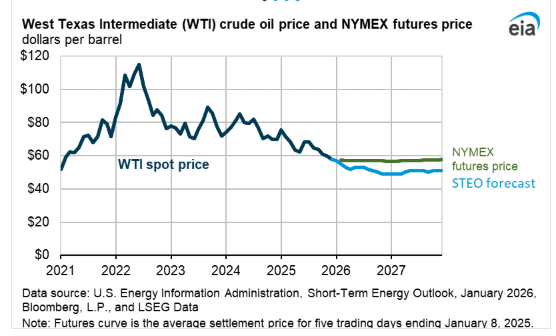
The US Government has also been expressing wishful thinking. Two weeks ago, the US Energy Information Administration published its prediction [13] of no disruption of the international oil market in the coming months; no Hormuz Strait spike in the oil price now; and falling retail gasoline prices by the time the American summer driving season begins, along with the Congressional election campaign. “We expect oil prices will decline in 2026, as global oil production exceeds global oil demand, causing oil inventories to rise. Global inventories continue increasing into 2027, albeit at a slower pace. We forecast the Brent crude oil price will average $56 per barrel (b) in 2026, 19% less than in 2025, then average $54/b in 2027…We forecast U.S. gasoline prices in 2026 will average just over $2.90 per gallon (gal), a decrease of nearly 20 cents/gal from 2025. In 2027, we forecast prices to remain mostly flat at an annual average of just over $2.90/gal.”
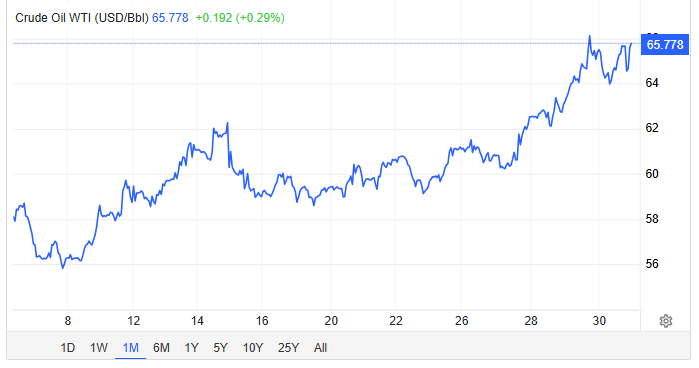
The crude oil futures market is indicating a very different expectation for the Brent and West Texas Intermediate (WTI) price markers. Since January 1, Brent is up 19%; WTI up 21%.
The Kremlin has now sponsored an unusual warning, published yesterday as an editorial in Vzglyad, the Kremlin-backed security analysis platform. This is a warning to Trump to call off his bluff and to Khamenei not to call it.
US GOVERNMENT’S SHORT-TERM ENERGY OUTLOOK AS OF JANUARY 9, 2026
 [14]
[14]Source: https://www.eia.gov/outlooks/steo/ [13] The data cutoff date is shown in the footnote as end of January 8, 2026.
OIL FUTURES MARKET CHART FOR WEST TEXAS INTERMEDIATE (WTI) THIS MONTH – UP 21%
 [15]
[15]Source: https://tradingeconomics.com/commodity/crude-oil [16] The Brent oil price chart can be viewed here: https://tradingeconomics.com/commodity/brent-crude-oil [17]
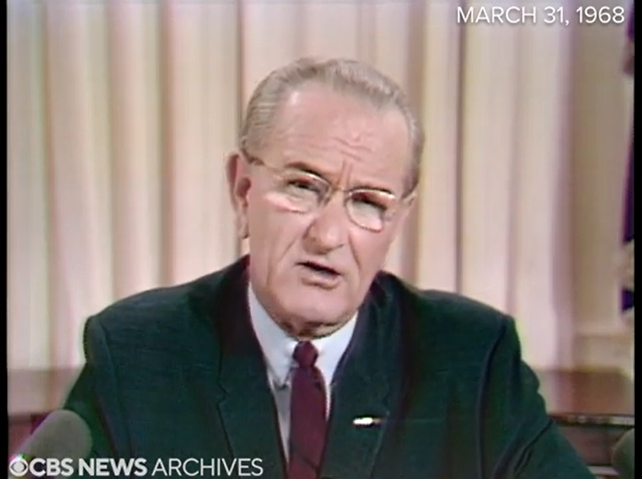
PRESIDENT JOHNSON ANNOUNCING HIS WITHDRAWAL FROM THE 1968 ELECTION
 [18]
[18]President Johnson’s announcement of his withdrawal from the presidential election campaign was made on March 31, 1968. In the preceding polling of that month, US voter approval for Johnson had fallen to 36% and disapproval had risen to 52%; these were the worst poll results for Johnson since he had become president in 1963. https://www.presidency.ucsb.edu/statistics/data/lyndon-b-johnson-public-approval [19] Johnson calculated he would lose the re-election campaign because of the rising Vietnam War casualties and the inflation rate which had jumped from 3.1% in 1967 to 4.2% for 1968. https://www.in2013dollars.com/inflation-rate-in-1968#:~:text=Inflation%20in%201968%20and%20its,Statistics%20to%20officially%20determine%20inflation [20]. Source: https://www.youtube.com/watch?v=D9gddYDbhV4 [21] “Tonight,” Johnson said, “I have ordered our aircraft and our naval vessels to make no attacks on North Vietnam, except in the area north of the demilitarized zone where the continuing enemy buildup directly threatens allied forward positions and where the movements of their troops and supplies are clearly related to that threat.The area in which we are stopping our attacks includes almost 90 percent of North Vietnam’s population, and most of its territory. Thus there will be no attacks around the principal populated areas, or in the food-producing areas of North Vietnam. Even this very limited bombing of the North could come to an early end—if our restraint is matched by restraint in Hanoi. But I cannot in good conscience stop all bombing so long as to do so would immediately and directly endanger the lives of our men and our allies. Whether a complete bombing halt becomes possible in the future will be determined by events. Our purpose in this action is to bring about a reduction in the level of violence that now exists… in these times as in times before, it is true that a house divided against itself by the spirit of faction, of party, of region, of religion, of race, is a house that cannot stand. There is division in the American house now, there is divisiveness among us all tonight… I have concluded that I should not permit the Presidency to become involved in the partisan divisions that are developing in this political year. With America’s sons in the fields far away, with America’s future under challenge right here at home, with our hopes and the world’s hopes for peace in the balance every day, I do not believe that I should devote an hour or a day of my time to any personal partisan causes or to any duties other than the awesome duties of this office—the Presidency of your country. Accordingly, I shall not seek, and I will not accept, the nomination of my party for another term as your President.” Full text -- https://www.lbjlibrary.org/object/text/presidents-address-nation-03-31-1968 [22] Background:https://en.wikipedia.org/wiki/Withdrawal_of_Lyndon_B._Johnson_from_the_1968_United_States_presidential_election#:~:text=On%20March%2031%2C%201968%2C%20then,1968%20United%20States%20presidential%20election [23]
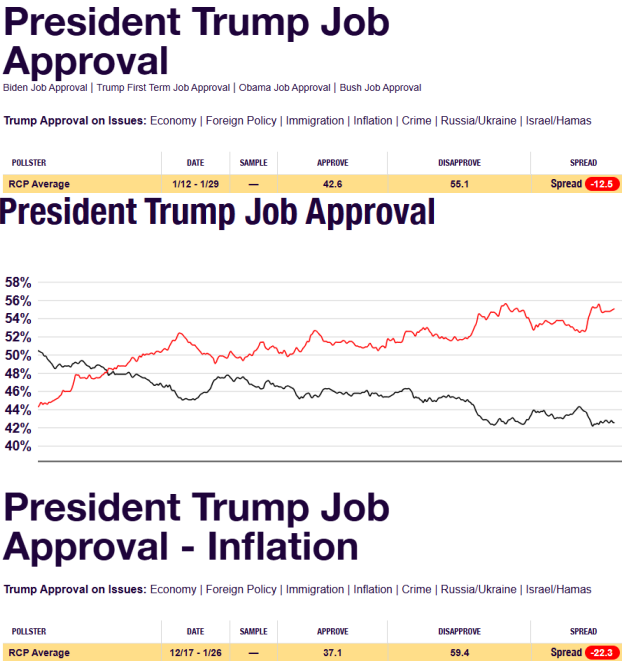 [24]
[24]Source: https://www.realclearpolling.com/polls/approval/donald-trump/approval-rating [25] These current charts show that US voter disapproval of Trump’s overall performance has been growing sharply during January, and that disapproval of his policies on controlling inflation is double the overall rate. The trend lines, as explained to Trump by his White House pollsters, indicate widespread and growing fear that Trump’s warmaking in Venezuela and in the Middle East will trigger a sharp rise in inflation by the summer. The current US inflation rate is 2.7% annual. This represents a drop caused by last autumn’s reductions in gasoline and fuel oil prices [26].
Here is the Vzglyad [27] piece published on Friday afternoon and headlined: “How will Iran fight against US aggression”. The Russian text has been translated verbatim; the maps and illustration have been added.
Note that in this the assessment of Iran’s defence against US attack, there is no mention of any Russian assistance to the Iran forces.
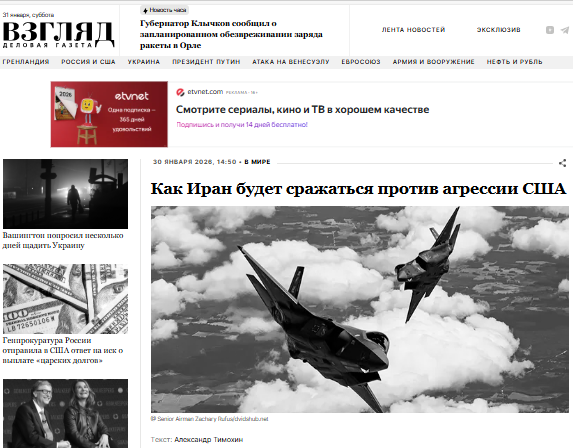 [28]
[28]Source: https://vz.ru/world/2026/1/30/1390797.html [27]
 [29]
[29]January 30, 2026
How will Iran fight against US aggression
Byline: Alexander Timokhin
Against the background of the concentration of large American forces in the Middle East and direct threats from the United States, Iran declares its readiness to resist. It looks like Iran is facing a battle for survival. What are the strengths and weaknesses of the Iranian armed forces and what might their military response operations look like in the event of American aggression?
Donald Trump has given Iran an ultimatum to stop enriching uranium, allow UN inspectors into the country, and also, judging by some hints from American officials, reduce its missile program. The head of the State Department, Marco Rubio, declares readiness for a preventive operation against Iran, although he hopes that “it will not come to that.” The Iranian position is as follows: it is ready for negotiations but without preconditions, and declares its readiness to defend itself against any attacks.
Meanwhile, the build-up of US forces continues. F-35A fighter jets and EA-18 Growler jammers designed to suppress air defense systems, which were used in the attack on Venezuela during the capture of Nicolas Maduro, are being transferred from the Caribbean to the Middle East. Measures are also being implemented to increase the defensive capabilities of American troops in the region.
Iran’s position is not enviable. It has no chance of inflicting a decisive defeat on the attacking side. And missile warfare, as 2025 has shown, requires an enormous number of missiles. In theory, Iran has the technological capabilities to accelerate the production of cheap missile weapons, but it won’t have enough time to start.
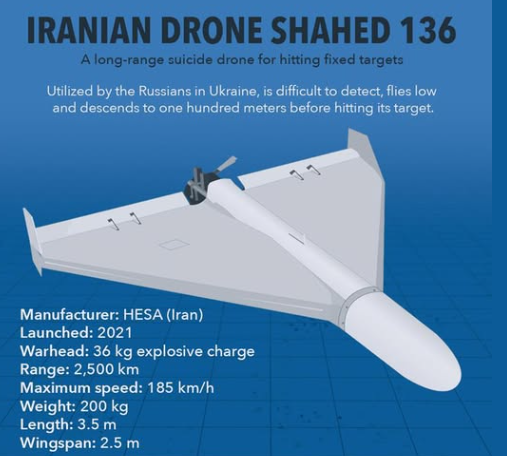
The tests of the Iranian ICBM — if they actually took place [30] — also do not solve anything. In order to cause serious damage to the United States, a large supply of such missiles is needed, and a strike on one or more American targets will only trigger anger. Attack drones like the Shahed-136 would work against an opponent like Ukraine, but probably not against the United States and Israel. At least in the last war, the Israelis shot down almost all such drones using a small number of attack helicopters. A massive strike by the Shaheds may work against American bases, but it is necessary to launch a really large swarm of these drones into the attack – more than the enemy can shoot down.
 [31]
[31]Iran will be able to do little against Israeli and American aircraft – modern air defence systems are almost useless against US and Israeli strike aircraft. Iran may be able to use fighters, but only where they can hide in the folds of the terrain when flying to the area of combat operation. In small quantities, with a low chance of success and the highest risk of loss. And even if Iran shoots down a number of enemy aircraft, it will not affect the course of hostilities.
And, of course, one should not take into account fantasies about how Iranian drones or submarines will hit an American aircraft carrier – such antics against the US Navy are useless and will lead to nothing but losses. The Iranians fought the Americans at sea in 1988 and were butchered by ridiculously small American forces. Iranian ships should stay away from US ships.
Iran’s weakness is also the quality of its force management – all decisions are made and agreed upon in advance, and the security forces themselves are prone to simple and predictable actions. Iran can only dream of a western approach to military management, when any problem that suddenly arises is not hidden, but immediately voiced and begins to be solved. All this, however, does not mean that Iran has absolutely nothing to put on the table.
The Islamic Republic’s first strong point is its missile arsenal.
No matter how effective American ships are as a means of air defence, you can either overwhelm them with a swarm of missiles, or take other measures to make missile defence difficult. In addition to ballistic missiles, Iran also has a number of cruise missiles.
The second advantage is motivated personnel willing to sacrifice themselves. They will be able to recruit volunteers for dangerous missions, and for suicidal ones too, mainly through the Islamic Revolutionary Guard Corps (IRGC). Iran has an army organized and trained not like the religious soldiers from the IRGC, but according to western methods. And this army has well-trained special forces, including combat swimmers, who can be used to sabotage enemy targets.
Iran has land-based anti-ship missile installations. Finally, Iran still has a number of “proxies” in Iraq. And there is a land connection with them across the Iranian border. These resources immediately hint at what the response might be.
The first is massive missile strikes on American bases. Iran openly declares its readiness for them. To do this, Iran needs to get as many missiles out of harm’s way in advance, disperse them and disguise them so that they cannot be destroyed by multiple air strikes. Then attack all available American bases, using missiles in such quantities that the Americans will not be able to shoot them down.
Secondly, the attacks of the Shaheds must be synchronized with missile strikes. The opponent must be faced with the choice of which strike to tackle.
The third is sabotage on enemy territory, in neighbouring countries. They may be small in scale, but they will force the enemy to strain and waste energy on countering.
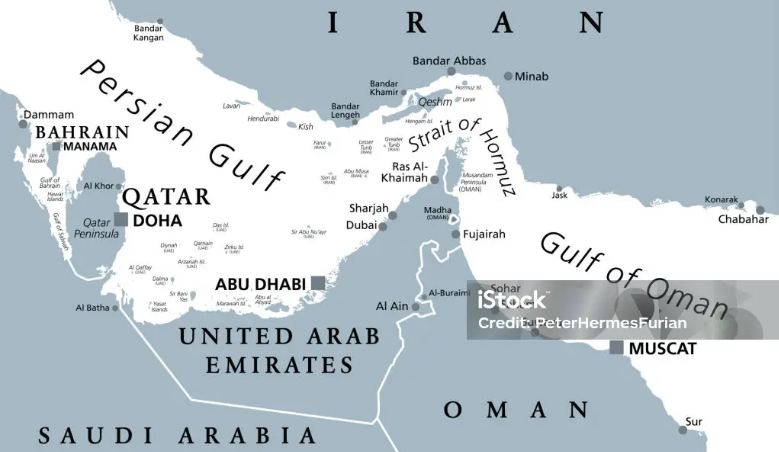
Fourth, Iran should start laying mines in the Strait of Hormuz, blocking oil supplies to the world market and inflating prices. This will make the American operation extremely toxic for all oil consumers in the world and create serious pressure on the United States. Despite the fact that the collapse of the global energy market may even be beneficial to American [oil producers], but politically the [Trump Administration] may not be able to withstand the pressure of oil consumers. Iran has hundreds of small high-speed boats as part of the IRGC naval forces, their crews are trained to lay sea mines, and Iran has a lot of these mines.
 [32]
[32]The mining will cost Iran dearly in terms of casualties. But here, personnel motivated to self-sacrifice will speak out—no matter how many mine-laden motorboats sink, more must return to sea.
A mine war will require the United States to take mine clearance measures. The Iranians will be able to attack the forces that will carry this out, drawing the US into battles on their own terms and forcing ships to go where Iran can use anti-ship missiles from the shore. If the strait is blocked, Iranian mini-submarines will be able to cross the Persian Gulf, ensuring the actions of saboteurs and also covertly laying mines.
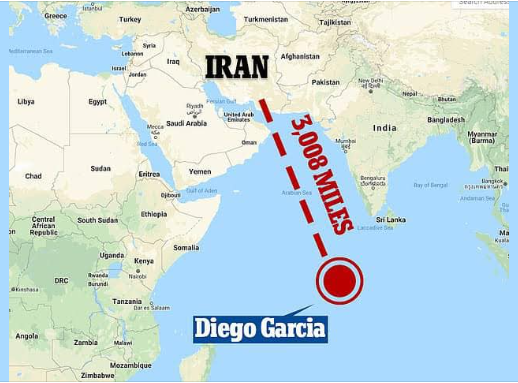
It might even be possible to launch a drone carrier disguised as a merchant ship, complete with a special forces unit, and test the strength of the Diego Garcia base once military action begins. Here again, personnel prepared to sacrifice themselves could prove useful.
 [33]
[33]The Kataib Hezbollah group in Iraq should receive as many long-range weapons as possible, which would give these formations the ability to strike American troops from a long distance and, once hostilities begin, use them against US bases.
With such measures, it will be possible to control the escalation of the war while conceding to the United States in the air and not being able to inflict a military defeat on them.
Unfortunately, Iran has found itself in a desperate situation. The special character of the American approach is that the United States uses negotiations as a weapon or a way to prolong the war, as a way to deceive a foolish adversary, but never as actual negotiations. Therefore, Trump’s ultimatum is a lie. The United States will still attack, just later.
All the Iranian negotiators in 2025 were killed — this was more than a clear hint from the Israeli-American alliance. Iran has no choice, it will have to fight. And since it has nothing to lose, it’s better to raise the stakes to the limit and turn the war into an all-out one, using every available means.
 [34]
[34]Yes, there will be heavy losses, and there will be a risk of the Americans using nuclear weapons. But surrender will also mean losses and death, only later and in installments. Iran has nothing to lose anyway. And soon we will see whether Iran is ready to fight for real.