 [1]
[1]
By John Helmer, Moscow
@bears_with [2]
Excerpts from the Red Pill Diaries with Rasheed Muhammad, podcast on July 11, 2026: click to view or listen: https://www.youtube.com/watch?v=5R4_bD4EcHs [3]
At the NATO summit in Ankara, President Donald Trump has committed to maximum escalation against Russia risking and costing nothing for US voters but enriching the US military-industrial complex, the Trump family, and their financiers.
The Kremlin strategy of sucking on TIT – Trust in Trump – has failed.
Russia is not able to send any message of pain to US voters in the way Iran has learned through its Hormuz Strait regime.
Our ruling classes are not running away in fear.
Empires don’t have to learn from their mistakes. Their victims do.
Most Russians are not Zionist. There is only one Zionist in the country – and that’s President Putin.
A hefty dose of the truth is better for your long life and health than a hefty dose of muscle-building fantasy.
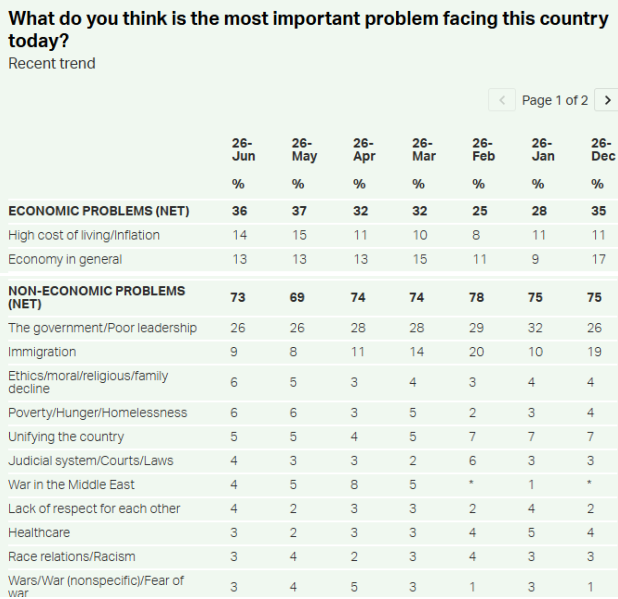
WHY THE WAR AGAINST RUSSIA IS PAINLESS FOR US VOTERS
 [4]
[4]Source: https://news.gallup.com/poll/1675/most-important-problem.aspx [5]
OLIGARCHS OF THE WORLD UNITE, YOU HAVE NOTHING TO LOSE BUT THE WAR – THE ECONOMIST INTERVIEW WITH ANDREI MELNICHENKO
 [6]
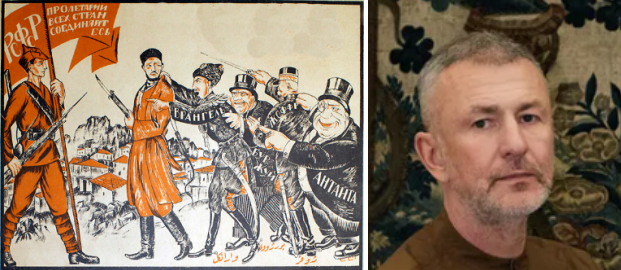
[6]Left: Bolshevik poster of the Civil War time with banner reading “Workers of the world unite”. Right: Andrei Melnichenko photographed among his possessions by The Economist.
Melnichenko’s essay, accompanied by a history of his business dictated to Arkady Ostrovsky, once a junior reporter in the Financial Times Moscow bureau and now The Economist’s Russia correspondent based in London.
Click to read Melnichenko’s essay without paying the publisher:
https://archive.md/OZ5U8#selection-1065.0-1069.117 [7]
Excerpts:
“There are four scenarios for post-war Russia being discussed in the West. For all their variation in political packaging, each entails the loss or curtailment of sovereignty and thereby destroys the only mechanism through which responsible behaviour is possible at all.
“The first imagines a humiliated Russia, lingering on the periphery of the West. This, in the longer term, would generate aggressive revanchism… In the second scenario, Russia ends up in China’s orbit… Russia would appear to retain the trappings of a great power but in reality would become an outer contour of Chinese strategy: a market for Chinese goods, a source of resources, a transit corridor and a buffer absorbing pressure directed at Beijing…The third scenario is the fragmentation of Russia, which would rapidly become unmanageable. There would be a struggle over the nuclear arsenal, resources, borders and history. This scenario destroys the cohesion that makes nuclear deterrence functional… The final possibility is for Russia to become a fortress: closed, mobilised, in permanent siege. Technology, science, capital and civic trust do not grow in a state of perpetual emergency. Such an order does not end the war; it transforms conflict from an event into a mode of organising the state…
“Under current conditions, Russia’s original objective—a new European security order in which Russia is a participant rather than a managed object—is out of reach. Battles can be won or lost; a war of attrition, by itself, cannot. It perpetuates the problem rather than resolving it.
“The present format cannot continue indefinitely. An economically and technologically superior coalition sustaining an adversary’s army while limiting its own direct involvement will eventually give way to something else: either a different and more direct form of confrontation, or a political settlement. The question is not whether that transition comes, but when and on what terms.
“Nuclear weapons make this question existential. Deterrence works not because the weapons exist, but because rational decision-making centres exist, communication channels are open and both sides understand where the limits lie. When trust collapses and emotion displaces calculation, nuclear weapons cease to be an instrument of last-resort deterrence and become background radiation of constant risk. Any strategy that treats nuclear escalation as a manageable extension of conventional pressure rests on a false assumption: that a complex system can be pushed to the edge and stopped precisely where it is politically convenient. Real systems do not work that way. Russia’s business community consists of people who are capable not merely of surviving within given rules, but of changing the environment itself: designing and building new markets, industries and management systems. Over recent decades their selection has proceeded not along ideological lines but through competition, crises and restructurings—a selection of those who know how to calculate consequences, hear other interests and find workable compromises. Their role in the discussion about the direction of Russian sovereignty is not political but creative; not a question of who governs, but of what is being built.
“Large Russian businesses that invest in a sovereign Russia will, in time, become an integral part of it. The same will hold for other important institutions. As a consequence, Russia itself will become different. If we strive for a sovereignty that creates unity between citizens and institutions, I hope that in time we will correct all the internal imbalances for which we too bear responsibility—through the fact that we were once glad to absent ourselves.”