 [1]
[1]
By John Helmer, Moscow
@bears_with [2]
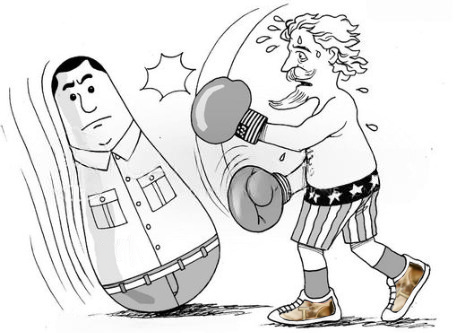
When you are the fastest growing tree on the street, every dog in the neighbourhood will try to lift his leg on you.
When the tree is Indian, the American dogs express their resentment. They are Steven Witkoff, Jared Kushner, Howard Lutnick, Marco Rubio, Scott Bessent, and Stephen Miller. They also tell each other privately they can’t understand the accent Indian officials use when speaking English. They don’t have the same disability when listening to Hebrew-accented Israelis.
Lutnick has just been appointed by a decree President Donald Trump signed at the White House on Friday (February 6) as the American watchdog to control Indian import and export trade with countries Lutnick considers enemies – Russia, Iran, China, Venezuela. The decree says [3]: “The Secretary of Commerce [Lutnick], in coordination with the Secretary of State [Rubio], the Secretary of the Treasury [Bessent], and any other senior official the Secretary of Commerce deems appropriate [Witkoff, Kushner, Miller], shall monitor whether India resumes directly or indirectly importing Russian Federation oil, as defined in section 7 of Executive Order 14329.”
This is the sharp end of President Donald Trump’s exchange of tweets with Prime Minister Narendra Modi on February 2, announcing [4] – Trump’s words – that “he is one of my greatest friends” and that together “our amazing relationship with India will be even stronger going forward, Prime Minister Modi and I are two people that GET THINGS DONE, something that cannot be said for most.”
The watchdog is one of the weapons US officials aim to wield against the Indians as the negotiations on terms for a US-Indian trade agreement – first begun in February 2025 [5], halted by Trump seven months later, in August — have now “reached a framework for an Interim Agreement regarding reciprocal and mutually beneficial trade (Interim Agreement).” That is the lead line in the “United States-India Joint Statement” which the White House released on February 6 following negotiations Rubio and Bessent held two days before with Indian External Affairs Minister Subrahmanyam Jaishankar.
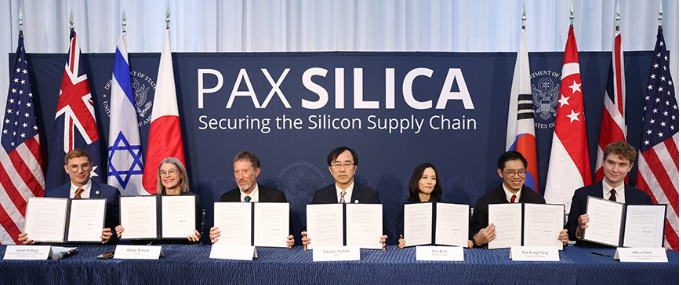
In his 9-line communiqué [6], Rubio identified no point of agreement with Jaishankar on “critical minerals exploration, mining and processing… shared energy security goals [and] expanding bilateral and multilateral cooperation through the Quad.” The first of Rubio’s points [7] is the so-called Pax Silica, launched by the US with its allies against trade with China. The second of Rubio’s points means the prevention of India’s oil and other trade with Russia; the third means the militarization of the Quad states – US, Japan, Australia and India – against China and Russia in the Indian and Pacific Oceans, and the Straits of Malacca connecting them.
Bessent’s Treasury office released no record or readout of his talks with Jaishankar on February 4 [8]. Instead, Bessent tweeted that they had “addressed the importance of securing supply chains, as well as other national and economic security issues of mutual interest.” The Indian ministry released [9] a single line and a hand-shake picture.
Supply chain security was low on the priority list issued by the White House — 10th of 12 points [5]. What it means is the scheme the Trump Administration started in December calling it Pax Silica: this is a plan for the US and its allies to combat Chinese and Russian systems of fabricating critical minerals into semiconductor chips and other components of advanced computers and artificial intelligence systems with dual, civilian and military, applications. The allies who have signed [10] on so far are Australia, Greece, Israel, Japan, Qatar, South Korea, Singapore, United Arab Emirates (UAE), and UK. Another NATO ally on the list [11] is The Netherlands. The domestic pressure on the Modi government to join up is coming from US-backed opposition politicians like Rahul Gandhi [12].
Trump’s subordinates – Witkoff, Kushner, Lutnick, Bessent, Rubio, and Miller — remain uncertain of India and uncomfortable with Modi. The emergence last month of India as the new strategic protector of the UAE in combination with Russia has caught the Americans by surprise [13].
Russian sources confirm that Witkoff’s and Kushner’s value in negotiations on the Ukraine war has dwindled. “They have been telling us Trump’s aim is to project American power to keep peace in Europe. We’ve been telling them we keep peace on our terms. Now, finally, they’ve got the message. They agree – Russia has won in Ukraine. Also, they have been bought out,” one source says in Moscow, referring to the dealmaking for US companies and bribery for the Trump family which have been presented by Kirill Dmitriev, the Kremlin’s negotiator for economic cooperation.
In their place at the Abu Dhabi negotiations with the Russian military delegation on February 4-5, and then in Muscat with the Iranians on February 6, Witkoff and Kushner have been subordinated by US commanders and military intelligence officers.
Projecting their personal aggression into flashpoints at home and abroad has been the Witkoff-Kushner strategy for escalation control, for exercising dominance everywhere at once. But it’s not a tactic which they can easily adjust or sequence — one trade war, one military front at a time — when they run into more resistance than they have anticipated; their costs go out of control; their domestic constituencies lose confidence in them.
For the time being, Miller’s miscalculation in militarizing US cities, especially the murders in Minneapolis, and in directing the President’s racist tweets, have stopped his ambition to succeed Rubio as National Security Adviser and forced him into invisibility [14]. Last year Miller had been one of the lead officials pushing the anti-India line and triggering Trump’s reversal of his personal goodwill towards Modi [15].
Bessent’s and Rubio’s combination of the anti-Russia, anti-China, anti-India lines [16] has also been tempered by the resistance their tactics have faced, not only from Russia, Iran, China, and India, but also from the leading Arab states, Saudi Arabia and the UAE.
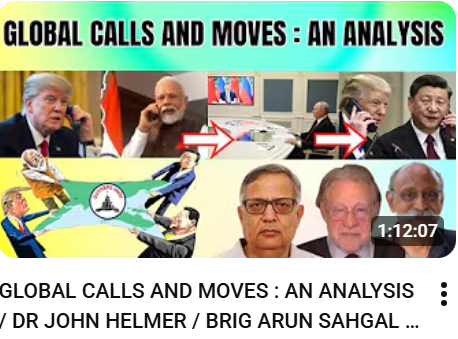
Watch or listen to the new Gunners Shot podcast [17] with Lieutenant General P R Shankar and Brigadier Arun Saghal:
 [18]
[18]The references and background documents identified in the discussion include:
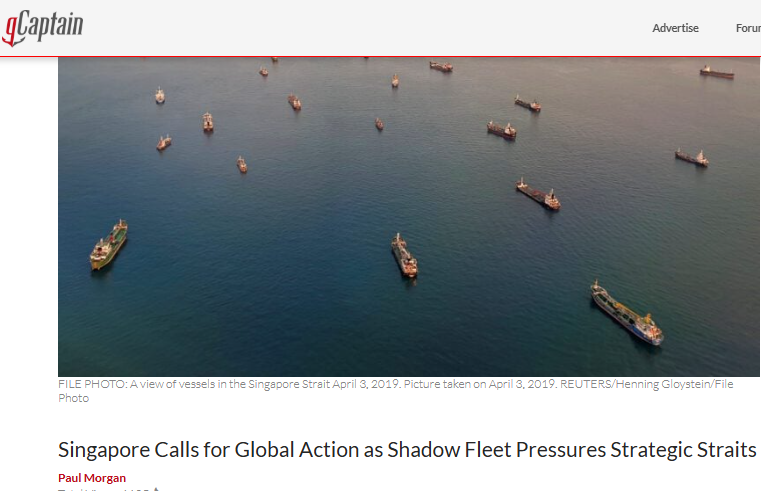
US escalation of the war at sea against Russia, Iran, China, India
 [19]
[19]Source: https://gcaptain.com/singapore-flags-shadow-fleet-risks-in-strategic-straits/ [7]
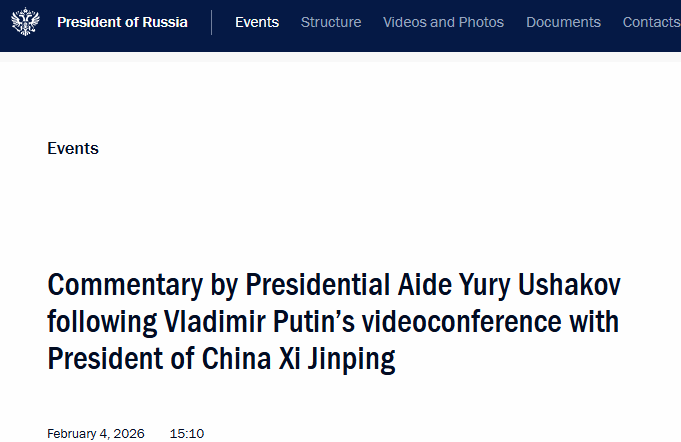
The new Russia-China exchanges. On February 4 [20] President Vladimir Putin made the point that there was nothing unusual in his holding the video conference with President Xi Jinping because it has become a “good tradition we have established – to hold face-to-face conversations at the beginning of the year…This offers us an opportunity to sum up the results of the preceding period and outline our plans. Moreover, we are having this conversation on a symbolic day. According to the Chinese calendar, today is Lichun, which signifies the beginning of spring. This is when cold weather starts receding, and nature enters the renewal and awakening phase. But in terms of Russia-China relations, it can be argued with complete certainty that spring continues throughout the year, no matter the season.”
What was unusual is that, three hours later, the Kremlin felt obliged to issue a readout [21] to emphasize three interpretations. The first was to reinforce coordination: “it is necessary to maintain permanent bilateral consultation mechanisms across all channels – the security councils, foreign ministries, and defence agencies – to complement their personal communication, that is, the direct dialogue between the leaders. This pertains to the swift alignment and coordination of approaches on current matters, including sensitive ones, to ensure timely responses to emerging challenges and threats.”
 [22]
[22]Source: http://en.kremlin.ru/events/president/news/79101 [21]
The second point [21]: “consultations were held on February 1 in Beijing between Secretary of the Russian Security Council Sergei Shoigu and Director of the Office of the Central Commission for Foreign Affairs of the Communist Party of China Central Committee, Minister of Foreign Affairs of China Wang Yi. The heads of state discussed the information received following these consultations.” This is a hint there were issues Shoigu and Wang deferred to their superiors to resolve because they could not.
The third point [21] was more than a hint. “Vladimir Putin and Xi Jinping also exchanged views on their countries’ relations with the United States. Their approaches almost fully coincide, which is evident from their attitude to the US President’s initiative for creating the Board of Peace.” This is a signal that on an undisclosed point or more there remains the same serious Sino-Russian disagreement which was identified in the official Russian communiqué following the meetings in Moscow last December [23] of Foreign Minister Sergei Lavrov and Security Council Secretary Sergei Shoigu with Chinese Foreign Minister Wang Yi.
Lavrov’s communiqué said then: “the sides noted overlapping or close positions on all key bilateral and international issues.” As adjectives of separation go, “overlapping” and “close” imply there were then significant points on which the Russians could not get the Chinese to agree. The Ushakov readout phrase, “almost fully coincide”, continues to expose the unexplained disagreement on something so important the Russians want to reveal it.
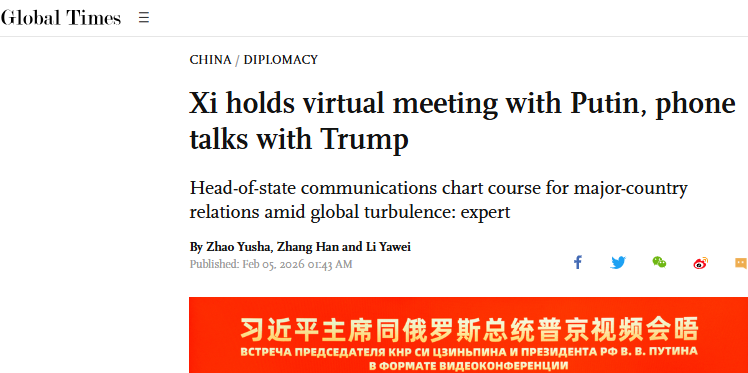 [24]
[24]Source: https://www.globaltimes.cn/page/202602/1354836.shtml [25]
The official Chinese commentary on the Putin-Xi exchange from Wang Yi was uninformative. “They had an in-depth exchange of views on bilateral relations and international and regional hotspot issues of mutual interest,” Wang’s spokesman said [26]. “The two presidents have maintained strategic communication in various ways and steered the bilateral relations in the new era to steadily move forward.” The Chinese read-out [25] which followed hinted at a loss of Xi’s self-assurance: “the international community has reached broad recognition of China’s core role and standing in international affairs… China to play a stronger leading role in the transforming international landscape and order… China’s positioning as an anchor for world peace, stability, prosperity, confidence and hope… all parties including the US and Russia have realized that the constructive settlement of these issues is inseparable from China’s participation and must involve full communication, exchanges and dialogue with China. This has made China a core and critical connecting point in current international relations.”
Trump’s Pax Silica
 [27]
[27]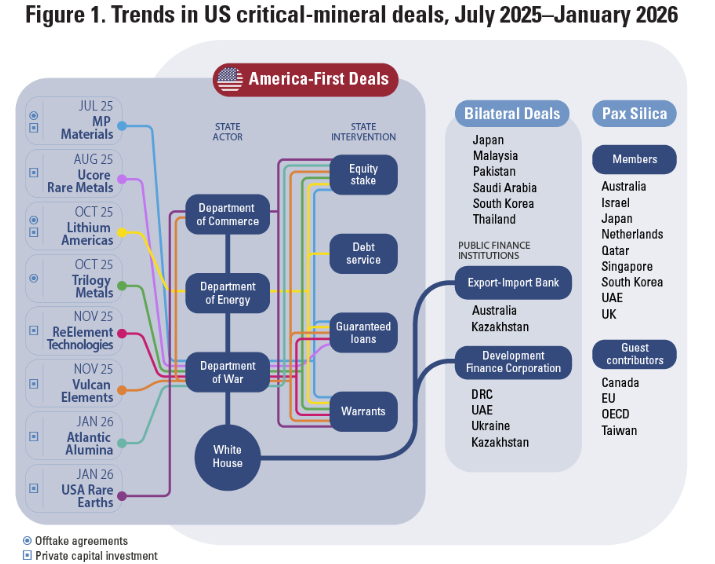 [28]
[28]