

By John Helmer, Moscow
@bears_with
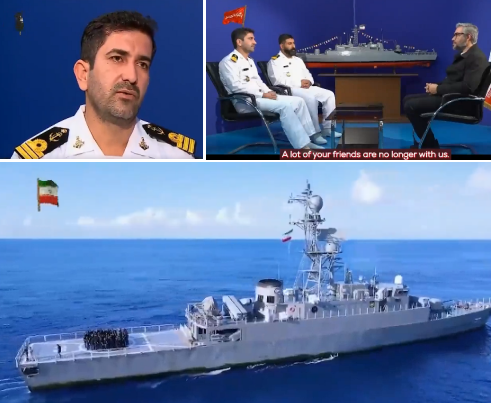
Testimony from the survivors of the Iranian frigate, IRIS Dena, attacked and sunk in a US Navy operation, led by the submarine USS Charlotte on March 4, has just been released in Iran, broadcast by an Iranian television outlet (lead images, top and bottom, are screenshots, bottom image is a file photo).
The two survivors who appear in the six-minute videoclip are the captain of the Dena, Commander Abuzar Zarri (top left), and accompanying him is the first officer of the Dena, who is not identified by name (top, second image, centre). Zarri has been wounded; at the end of the video he appears to be standing with the support of a crutch. Zarri had previously been reported as having been killed in the attack.
Photographed in India when the Dena was participating in the Indian Navy-hosted MILAN 2026 review and exercise, Zarri was the second senior Iranian officer in India. The ranking officer was Rear Admiral Shahram Irani, Commander of the Islamic Republic of Iran Navy, who flew back to Teheran when the Dena, and its two escorts, IRIS Lavan and IRIS Bushehr, departed Visakhapatnam port on February 25. Their visit had lasted for ten days, February 15-25. Photographs of Zarri at Visakhapatnam match his appearance in the new video, which was released on April 21.
Watch the film here.
The evidence provided by the two officers indicates the Mouj-class warship did not have its regular armament of anti-ship and anti-air missiles, and torpedoes for anti-submarine combat. This was a condition of the Indian invitation for the exercise. The US Navy, which also participated in MILAN 2026, not only knew this but US air-patrol electronic surveillance of the Dena in the days before it reached Visakhapatnam on February 15 confirmed this disarmament.
“One of the exercise’s conditions,” Zarri said, “was weapons like missiles and torpedoes, which are strategic weapons, shouldn’t be carried by the participating vessels”. The Indian Navy set the condition and the verification procedure when the Dena entered Visakhapatnam. Asked if “the destroyer [sic] was not armed at all”, Zarri replied: “No, we didn’t have torpedoes.” He was not excluding the Dena’s six deck guns.
During the approach to the Dena, on its attack run, the USS Charlotte command knew the Dena was disarmed.
Zarri also reveals that two US torpedoes were fired. The first has been reported in the US media as having missed the Dena. In fact, according to Zarri, the first torpedo struck the ship, “and we lost our mobility. The ship’s shaft and propeller were destroyed so we had no mobility at all…we suffered no fatalities.”
Zarri said the local time was 3:35 am. At 5:06 am, US and other reports indicate the Dena was hit in the aft section with a large explosion breaking the keel. This evidence of a 90-minute interval between the torpedo firings is new and has not been explained. If confirmed, it indicates that after its first strike, the Charlotte asked for orders from its base at Pearl Harbour, Hawaii, the US Pacific Fleet, and the Pentagon. The time in Washington, DC, was between 4 and 5 in the afternoon of March 3.
In that interval, the testimony of the Dena’s first officer indicates that Zarri ordered the crew to assemble on the aft deck and prepare for evacuation, surrender, scuttling, or other options which have not been revealed by Zarri; return of fire was impossible without sub-surface torpedoes. “The second torpedo killed 104 of our friends, our comrades, our dear brothers,” Zarri added, confirming he knew “that was their intention.”
“After the first shot,” the second officer said, “I sent the crew to the flight deck [lead image, bottom] and went back inside to check that everyone was out…I went back in, started checking from the stern to midship to make sure that no one was left inside. I came back up toward the stern. I was in the corridor when the second torpedo was fired.”
Dawn in the waters off Galle, western Sri Lanka, the location of the Dena on the morning of the attack, did not occur until 5:59 am. Although it was still dark, however, the Charlotte captain, Commander Thomas Futch, and his weapons officer, were able to verify that the Dena crew had assembled on the rear deck. In the customary laws of naval warfare, if the attacking captain can verify that the target crew is readying to abandon ship, and is not preparing counter-fire, it is unlawful for him to fire to kill. Futch also knew the Indian Navy had guaranteed that the Dena was not carrying anti-submarine torpedoes.
The second torpedo fired by the Charlotte, according to Zarri, “was meant to cause heavy loss of life”. The second US torpedo was aimed at the aft section of the Dena’s keel underneath the assembled crew.
The newly disclosed survivor evidence does not reveal the Dena’s course south and then westward after leaving Visakhapatnam on February 25 with orders to seek sanctuary from the expected US attack at a Sri Lankan port or an Indian port. Zarri said that “on the way home we received a message that the US had attacked our country and that we’re at war.”
While that message was dated February 28, Indian and Sri Lankan sources indicate that in anticipation of the attack, the Iranians had been requesting safe haven for the Dena and its escorts from Sri Lanka from before February 25, and then from India on or before February 28. From the departure from Visakhapatnam, more than four days elapsed before the Indian agreement was issued to open Kochi port to the three-ship squadron on March 1.
A report from an Indian source reveals that the Iranian ships had “called at Hambantota in Sri Lanka, and then spent over eight days [February 25-March 4] in international waters.” This has not been acknowledged by Sri Lankan or Indian officials.
However, it was their delay – under intense pressure from US officials to disallow safe haven or to stall it – which exposed the Dena to the ambush the US was preparing. Knowing that the Dena was disarmed on the Indian Navy’s request and that the US Navy was in hot, armed pursuit, the Indian Prime Minister Narendra Modi and Foreign Minister Subrahmanyam Jayshankar, together with the Sri Lankan President Anura Dissanayake, were responsible for the delay which was fatal.
Their subsequent statements disclaiming culpable knowledge and concealing the Dena’s course at sea between February 25 and March 4 add to the evidence of their complicity in the American war crime.
PENTAGON VIDEO OF THE SECOND TORPEDO STRIKE ON DENA CREW
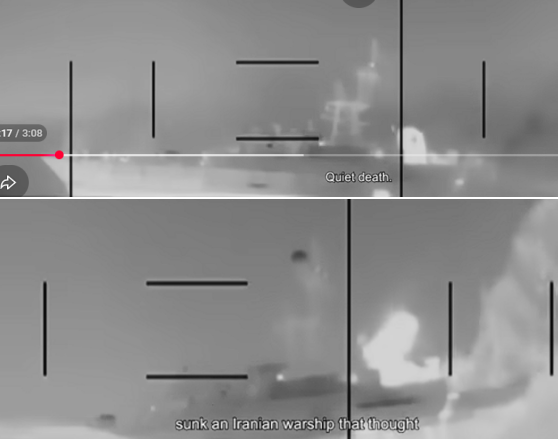
CREW ASSEMBLY ON THE DENA’S AFT DECK HELICOPTER LANDING PAD
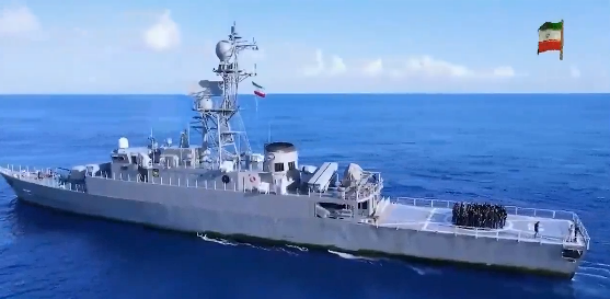
Iran Navy source: https://x.com/iranscreenshot/status/2046568428283027755
Iran Screenshot, the media platform for the new evidence, is a source publishing mainly on Instagram, Telegram and other social media. A Google search reports that “Iran Screenshot refers to social media accounts (such as on X and Instagram) that claim to provide on-the-ground, real-time updates and footage from Iran, often focused on topics like street-level protests, military activities, and surveillance. It positions itself as a source for raw, alternative information, often showing surveillance cameras or, as of April 2026, user-driven content from Tehran.”
For the first two episodes of this investigation, click to read the first published on March 24, and the second on March 29. Indian and Sri Lankan journalists of mainstream and alternative media refuse to republish or follow up.
In the public and parliamentary record made to date, Indian Foreign Minister Jayshankar has disclosed that a request for safe haven had been received from Iran for the Dena and its escorts, the IRIS Lavan, a landing mission vessel, and IRIS Bushehr, a support auxiliary, on February 28. Jayshankar has also said the port requested by the Iranians was Kochi on the west coast of India. He said agreement was communicated for all three ships on March 1.
If as newly reported, the squadron had been in Hambantota, Sri Lanka, on or about February 27 and refused permission to remain from the Sri Lankan government, sailing time at the Dena’s cruising speed of 30 knots northwest to Kochi was less than 24 hours. From off Galle to Kochi was less distance, less time.
Why then, if permission for sanctuary at Kochi was granted by Jayshankar on March 1, did the Iranian vessels not arrive the next day, March 2 — two days before the attack? Why did Jayshankar, and behind him Prime Minister Modi, not grant sanctuary at the closest Indian port to the squadron’s location in Sri Lanka – that was Tuticorin (Thoothukudi)? At 30 knots speed, the Dena, Lavan and Bushehr would have made safety there within 14 hours.
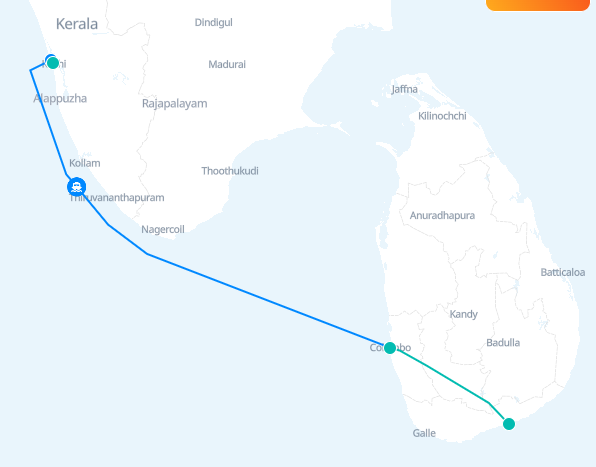
The President of Sri Lanka, Anura Dissanayake, has said the Iranian request for sanctuary was received for the three ships on February 26. Iran’s Ambassador to Sri Lanka, Alireza Delkhosh, has said the request was made earlier; this came from Rear Admiral Irani to Sri Lankan Navy chief, Vice Admiral Kanchana Banagoda, during the MILAN 2026 exercise in Visakhapatnam on or before February 24.
The delay of political time; the elapse of the Dena sailing time; the location of the attack off Galle, in western Sri Lanka, and the evidence of the US Navy’s double-tap strike – after the order was received from higher command in the US – make this story for which, in time, Commander Futch, War Secretary Peter Hegseth, Prime Minister Modi, Foreign Minister Jayshankar, and President Dissanayake may be called to give account.








Leave a Reply