

By John Helmer, Moscow
@bears_with
There is a mistake that warfighters sometimes make, and that wartalkers – diplomats, academics, journalists, podcasters – always make.
That’s the mistake which Carl von Clausewitz, Prussian staff officer and mercenary against France, made when he repeatedly told his superiors (between 1816 and 1832) that “war is no more than the continuation of politics by other means” (Der Krieg ist eine bloße Fortsetzung der Politik mit anderen Mitteln).
This was — still is — the line which small and middle-sized kings, states, and armies think when they are up against empires with bigger guns and more men than they have. Clausewitz’s dictum is the wishful thinking of wannabe imperialists. It’s the lullaby — Star light, star bright/First star I see tonight/I wish I may, I wish I might/Have this wish I wish tonight. How comforting that is for children to hear — how delusional for grownups to believe.
The dictum of real empires and genuine imperialists is the opposite – politics, for them, is no more than the continuation of war by other means. War is an end in itself because force kills argument and resistance; genocide kills everybody; and politics has no deterrent effect to stop either. Politics — that’s to say talking, negotiation, diplomacy, bribery, propaganda, podcasts – is a trap which emperors and their staffs set for persuading their targets to mistake the empire’s schemes for their own interests and subverting their judgements into compliance. But if and when persuasion fails, there must always be the force of killing.
Killing comes first. JD Vance, the Republican Party candidate to succeeed President Donald Trump, is demonstrating how this works in the talking he has led with Iran – plus Qatar and Pakistan – to achieve the US war aims in the Middle East.
Briefing US reporters in Switzerland yesterday, before returning to the US, Vance explained the politics of talking with Iran in five sentences: “This is not a deal that the United States is imposing on the region.This is a deal that the region has desperately asked the United States to put in place…this region has been a basket case for a very long time. And what the president has sent us to do, again, lay the foundation, see if we can get to a permanent peace. If we can’t, the president of the United States still has a lot of options to accomplish America’s security objectives.”
The US empire “deal” and the”options” – Vance’s terms — are the force of killing which, from the empire’s point of view, has been successful most recently in Gaza, Palestine, and Syria; and before them, in Morocco, Tunisia, Egypt, Libya, and Iraq. Adding them up since World War II, this is US empire control of the Arab world almost taken care of, with Yemen and Lebanon still to be finished off. The present “basket case”, as Vance calls it, is the consolidation of the stocks of oil, gas and money held by the “Gulf Coast Coalition”, as Vance calls the unsteady and nervous family businesses and sheikhdoms on one side of the Persian Gulf; and the destruction of Iran’s military and economic power on the opposite side.
“Permanent peace” in Vance’s mouth means permanent war against Iran until it resists the US empire no longer.
Iran’s success in combating the waves of war launched against it since 1979 remains a challenge still for the US empire. Claims of tactical and operational success in Teheran and in Washington don’t add up to strategic victory for either side, however. Not yet for the Americans and their allies until the Iranians are destroyed – not only on their southern (Arab) and western (Kurdish) fronts, but also on their eastern (Pakistan), northern (Azerbaijan, Armenia), and Caspian (Russian) fronts.
Not yet for Iranians until the US empire and its allies, Israel and the Gulf Coast Coalition, can be deterred from resuming their war.
In the meantime, if the Iranians can be induced into giving up their escalation control and destroying themselves, Vance has offered the means for them to do so. That’s the talking committee scheme announced frst by Qatar and Pakistan; ; and then accepted by Iran’s Foreign Minister Abbas Araghchi.
Araghchi calls this talking scheme a “roadmap”, “high-level committee for political oversight”, “technical working groups on nuclear and sanctions issues”, “dispute resolution mechanism”, “communication line”, and “de-escalation unit”.
Vance calls Araghchi’s acceptance of this scheme “a very, very good day. We made a lot of good progress. We did exactly what we wanted to do… a mechanism for keeping the Strait of Hormuz open… a mechanism…for deconfliction for the regional cease fire… process for the technical negotiations that will follow.”
To the Iranian charges that the US and Israel are in violation of the Memorandum of Understanding (MoU) he signed a week earlier, Vance has said there is an agreement to keep talking about the violations while they continue: “we’ve actually got the process in place to ensure that that doesn’t — that escalation doesn’t happen. Now, I will say you already see the fruits of that. Over the past 24 hours have probably been the most peaceful that we’ve seen. That situation in Lebanon, the previous 24 hours were pretty good. Obviously, there was some shooting about 72 hours ago, so this is a work in progress. But what we’ve done is actually set up the operation so that we can ensure it doesn’t spiral out of control in the future.”
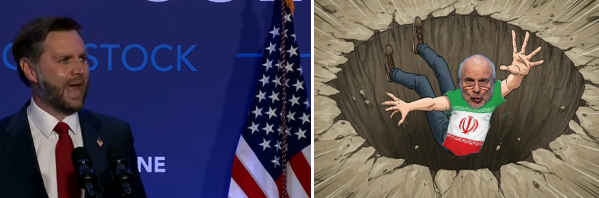
US strategic control by inviting the Iranian negotiators into several committees for talking is what Vance and the Iranian delegation in Switzerland, led by Mohammed Bakr Ghalibaf (lead image, right) and Araghchi, have agreed to now. By admission and omission, they have accepted that Israel will not withdraw from Lebanon, and the US will not abandon the war aim of destroying Hezbollah Instead, Araghchi has tweeted, “ a de-escalation unit involving Lebanon will also be created to ensure compliance with the cessation of military operations in Lebanon.”
By the same process of saying and meaning differently, Ghalibaf and Araghchi have withdrawn Iran’s war aims for control of the Hormuz Strait and for transit tolls or reparations for war losses. Instead, “crucially, a communication line has been established between the parties to ensure safe passage for commercial vessels through the Strait of Hormuz—a key commitment under the memorandum.”
They have accepted the say-so by the US Treasury to allow Iran to sell its oil until August 21; this is the General License X. Interpreted by Araghchi, “Iranian oil is officially returning to global markets for the first time since 2018 after the US Treasury issued OFAC General License X authorizing all transactions related to Iranian crude oil, petrochemical and petroleum products through August 21, 2026. This implements the MOU commitments Iran’s FM Araghchi confirmed hours ago, with the license covering all transactions including those involving sanctioned vessels, crew safety, insurance, bunkering, and importation into the US, freeing up to 140 million barrels of Iranian crude currently stranded on tankers at sea.”
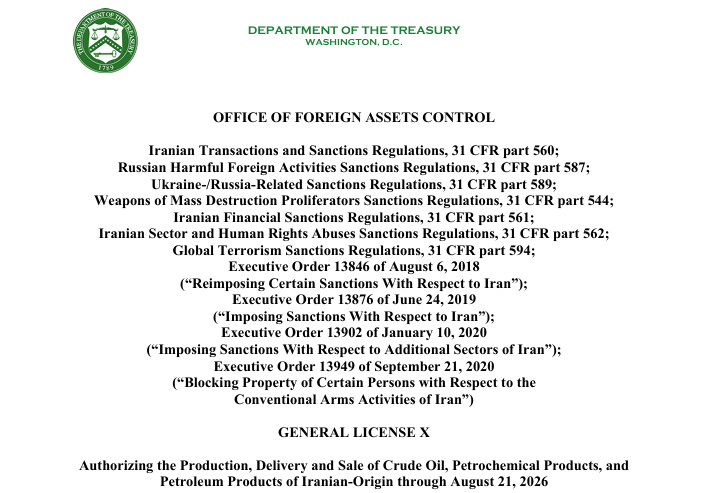
Source: https://ofac.treasury.gov/media/936206/download?inline
In exchange, Ghalibaf and Araghchi have dropped war reparations and left release of sanctioned Iranian assets to a talking committee in the future. Araghchi’s version: “Tireless Pakistani and Qatari mediation has delivered major progress to end Lebanon War. Oil and petrochem exports are waived, blockade lifted, some frozen assets released, and major reconstruction & development plan launched for Iran. 1st real test: Lebanon deconfliction cell.”
Vance says differently: “I’ve seen some misreporting about frozen or unfrozen Iranian assets. One of the other things that we wanted to do, and, you know, wasn’t as high of a priority for us for obvious reasons, but we wanted to make sure that we set up a process where if — if we ever unfreeze Iranian assets, we can ensure that those that — that money, that Iranian money goes to help the people of Iran and not to fund terrorism. So, Jared Kushner actually came up with a — with a very interesting solution with the Qataris where basically, again, if there is any frozen Iranian assets that are unfrozen, then we have approval over that process, the Qataris have approval over that process, and then the money would actually go to buy American soy, American corn, and American wheat for the benefit of the Iranian people.”
This is an American bribery scheme in which the talking to follow will require the Iranians to pay Kushner’s bagmen and the Qataris to release what the US is refusing to release as required by Point 11 of the MoU. That says: “The United States of America undertakes to make fully available for use, the frozen or restricted funds and assets of the Islamic Republic of Iran upon the implementation of this MoU. The United States of America and the Islamic Republic of Iran will mutually agree on the procedures related to the release of these funds during the negotiations.”
Fully available, it turns out, doesn’t mean fully, and doesn’t mean available. Instead, it means talking into the future on “procedures related to the release of these funds.” Iran has accepted that the US will now be its banker. Like all banks, it will use arms to enforce the security of the bank’s cash window and its cash vault. It will also charge fees and earn commissions on returning what Iran has claimed to be its sovereign property.
“Fundamentally,” Vance celebrated, “what Jared and the Qataris and the entire team here in Bürgenstock accomplished is, to me, a classic Trump deal where, if Iranian assets are ever [sic] unfrozen, they’re going to go to make American farmers richer and to feed the Iranian people. That’s a very, very good and very classic Trump deal that’s great for our people, great for the people of Iran, and fundamentally, again, will contribute to this regional security architecture that we’ve built and that we’re going to work very hard to ensure that it endures.”
The empire has opened its talking trap; Ghalibaf and Araghchi have agreed to pay Kushner and the Emir of Qatar the toll for falling into it.
Once they have given up their military options by subordinating them to the “high-level committee” and the “deconfliction unit”, the Iranians can do no more — Vance has declared — than complain. “When they [Iran] make threats that aren’t rooted in reality, they have to accept that the President of the United States is actually going to set the record straight. That’s all that happened. So, yes, there was a little bit of threatening. There was a little bit of whining. But at the end of the day, the talks continued, and we made great progress.”
In the US empire, “rooted in reality” means you either pay for US protection or you will be killed. “Great progress” means submission, surrender.
According to Vance, Ghalibaf and Araghchi have already agreed to allow inspectors of the International Atomic Energy Agency (IAEA) into Iran’s nuclear facilities in advance of the scheduled technical negotiations to follow on nuclear issues, and even before “a satisfactory framework being agreed upon in the final deal” – the language of Point 8 of the MoU signed a week ago.
“In terms of when the nuclear inspectors are going to start,” said Vance. “it’s funny. We were trying to call some of the inspectors last night around two in the morning. As you can expect, not many people were answering their phone at two in the morning. I expect that will happen at the minimum this week, but we think even some of those conversations with the inspectors and with the IAEA could happen as soon as today.”
It’s funny indeed.
As for the future of the last Arab resistance to the empire in Lebanon, Vance believes he has Ghalibaf’s and Araghchi’s agreement to “rein in Hezollah”. In Trump’s language, that means “immediately stop”.

Source: https://truthsocial.com/@realDonaldTrump/posts/116788337995785578
“[Vance] Sometimes, you know, you’ve got a bit of a chicken and egg problem that you’ve got a junior guy who fires a drone that didn’t have approval from the high command.”
“[Reporter question] Does the US want Israel to withdraw forces from southern Lebanon?
“Well, we want Israel’s security to be protected, and we also want Lebanon’s sovereignty to be protected. And this is going to be an ongoing conversation. The Israelis have been very clear they do not have territorial intentions on south Lebanon. The reason they feel they have to be there is because they’re worried about Hezbollah fighters in south Lebanon firing into Israel. We do believe — of course, it’s going to require a lot of hard work — that we can get to a place where Lebanon’s territorial integrity and sovereignty is protected, Israel’s security is protected, and that’s going to require some coordination with the Lebanese armed forces and also, it’s going to require the Iranians to rein in Hezbollah.”




Leave a Reply