

By John Helmer, Moscow
@bears_with
This website and I have been banned from appearing on Gunners Shot, the strategic and military analysis website produced in Chennai by Lieutenant General (retd) P.R. Shankar which is widely read by the national security and military staffs around Prime Minister Narendra Modi.
The reason is that no analysis is to be allowed of Modi’s alliance with Israel and the US in the war against Iran which began on February 28, three days after Modi declared to the Israeli Knesset, Am Yisrael Khai – that is the Hebrew call to war against the enemies of the Jews. Jai Hind, Modi added to standing cheers, clapping, and stamping from the Knesset.
State censorship has followed for any publication the Modi government considers critical of his alliance with Israel. This month it has been extended to films.
Criticism of that (and of me) has been endorsed by veteran Indian officials and military officers. “You”, said one, “seem to have fallen into the category of Westerners who make a quick trip to this diverse, ancient civilisation and arrive at conclusions which suit their preconceptions…Modi is one of the best Prime Ministers this country has ever had…India is an old civilisation which has always welcomed and absorbed those who came here…including the Jews… Pragmatism in foreign policy is welcome, whether you agree with individual issues or tilts at a particular point in time or not. However, India is definitely not anywhere near fascism.”
The pragmatism, confirmed by Indian sources, is this:
The 7-day war to destroy Iran which Modi expected and supported from before it began has failed; his India Middle East Europe Corridor (IMEC) strategy has been exploded as defenceless; Israeli air defence and air attack missiles, drones, electronics, and other materiel, for which Modi has agreed to pay almost $9 billion, have been defeated; Modi’s security pact with the Zayid al-Nahyan family of the United Arab Emirates (UAE) is a dead letter forty days after Modi signed it; Indian worker remittance incomes and business revenues from the Gulf Arab states are ruined; Modi and his officials have been reduced to telephoning Teheran to request emergency oil, gas, and fertiliser relief through the Hormuz Strait.
The short-term cost of repatriation and exporter compensation (war premiums for demurrage, freight rates and insurance, etc.) is already budgeted in New Delhi at $6.2 billion; the loss of remittances may grow to ten times as much. New investment bank reports indicate that the projected 7% annual growth of the Indian economy will go into reverse; the fall of up to one percent of GDP will cost up to $45 billion.
Inside the Indian security establishment, Prime Ministry, Ministry of External Affairs, Indian Navy and the intelligence services there are desperate attempts to retrieve position and power, deflect blame, and escape the scapegoating now under way.
Here are the questions and my answers which are no longer allowed in India.
- The Indian Minister of External Affairs, Subrahmanyam Jaishankar, is the only foreign minister of a major world power whose son, Dhruva’s salary is paid for by US alliance entities, such as the Dutch Foreign Ministry and Australian Defence Ministry, and American billionaire foundations.
Attempts from within Modi’s circle of advisors to replace Jaishankar accelerated late last year, but were postponed by Modi himself because neither he, nor his National Security Advisor Ajit Doval, could agree on a replacement. Jaishankar’s attempts to keep his post have included support for Modi’s trip to Israel last month over other officials’ recommendations to delay; and attempts to activate the Jewish lobby in Washington to neutralize Trump Administration hostility towards Modi.
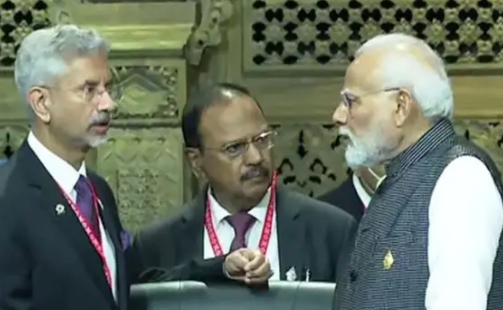
Left to right: Jaishankar, Doval, Modi – May 10, 2025.
The course of the war, however, has forced Jaishankar to attempt to negotiate with Iranian Foreign Minister, Abbas Araghchi, by telephone and tweet; and at the same time with the Arab sheikhdoms and NATO allies in Europe. So far Jaishankar has failed to persuade Teheran to allow more than token shipments of oil and gas out of the Hormuz Strait – five tankers permitted, at least 22 remain in the Persian Gulf. The questions for Jaishankar are: why he told Modi to back the Israeli-US war against Iran; why he should retain his post after such a misdirection; and why Modi keeps him after Iran and its allies have signalled they cannot believe any undertaking from Jaishankar in future?
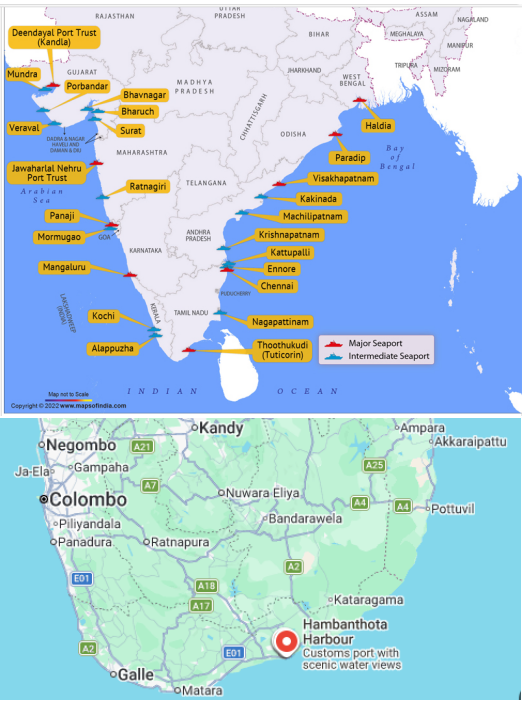
- The Iranian Navy frigate, IRIS Dena, was torpedoed and sunk by a US Navy submarine on March 4 at a position 210 nautical miles (nm) southeast of the Indian coastline and 19 nm west of the Sri Lankan coast near Galle. It has been reported as unarmed at the time. Three Australian Navy personnel also took part in the attack. About 148 Iranian crew were killed.
Indian sources confirm that Indian naval intelligence monitored the Dena’s course southwards from Visakhapatnam, on the central eastern coast of India, departing on February 25.
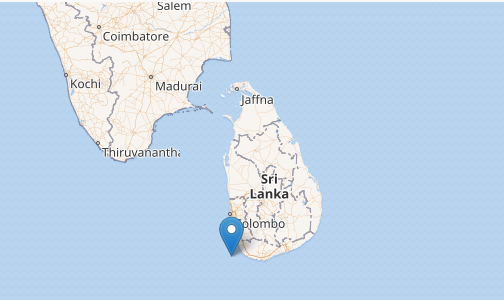
A map of the position of the IRIS Dena when sunk on March 4. According to subsequent comments by Indian officials, the Dena was accompanied out of Visakhapatnam by the IRIS Lavan and the IRIS Bushehr but no official or credible map of their voyage south has been published.
Technically, there is no doubt, according to Indian sources, that Indian naval intelligence was monitoring the movement and communications of the Dena south and then westwards, with its home port destination at Bandar Abbas.
It has also been confirmed by Jaishankar that the Dena had been accompanied by two auxiliary vessels, the IRIS Lavan and IRIS Bushehr. At least one of them, according to Jaishankar, requested safe haven in an Indian port on February 28. Jaishankar has claimed this was granted the next day, March 1. From then on, the Indian Navy was monitoring not only the three Iranian warships but other warships in the vicinity, including the US Navy. “ You had these ships,’ Jaishankar was reported as saying on March 7, “and we got a message from the Iranian side that one [sic] of the ships, which presumably [sic] was closest to us–to our waters at that point in time, wanted to come into our port. They were reporting that they were having problems. And so, my recollection [sic] is this was on the 28th, and on the 1st we said, ‘Okay, you can come in.’ And it took them a few days [sic] to sail in, and then they docked in Kochi. And the ship is there. And obviously, the people on the ship, a lot of them were young cadets–that is my understanding. They have disembarked; they are, you know, in a nearby facility. When they set out and came here, the situation was totally different. They were coming in for a fleet review, and then they got, in a way, caught on the wrong side of events [sic]. So for us, when this ship wanted to come in, and that too in difficulties, I think it was the humane thing to do. And I think we were guided by that principle. And in a sense, of the other ships, one obviously had a similar situation in Sri Lanka, and they took the decision which they did, and one unfortunately [sic] didn’t make it. So I think we really approached it from the point of view of humanity, other than whatever the legal issues were. And I think we did the right thing,” the Minister said.”
The editorial indicator sic marks the points in Jaishankar’s remarks which Iranian sources understand to be cynical fabrications.
A parallel BBC report claims Jaishankar acknowledged that all three vessels, including the Dena, requested Indian port sanctuary on February 28 and were granted it on March 1.
These admissions reveal that there was high-level Indian Government knowledge of the movement of the vessels on a course which some maps claim was east of Sri Lanka and then rounding Sri Lanka on a northwestward bearing.
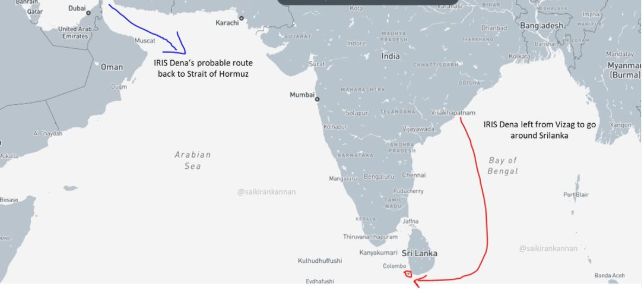
Source: https://www.facebook.com/Team.ISF/posts/-as-per-available-details-the-iranian-iris-dena-ship-left-vizag-to-go-around-sri/1348376753979232/ The course through the Bay of Bengal appears be too long eastward to have been likely if the Dena’s orders were to return to homeport as quickly as possible. A course with that objective should have taken the frigate and its escorts through the Palk Strait between Dhanushkodi, India, and Talaimannar, at the northern tip of Sri Lanka; the strait there is 16nm-wide territorial waters divided between India and Sri Lanka. No Indian Navy map of the course of the Dena, Lavan and Bushehr after February 25 has been published nor any report identifying their precise positions on February 28 when the request for safe harbour was officially made to India. The safest and closest safe harbour for the three Iranian vessels on February 28 should have been either Tuticorin, India, or Hanbantota, on the southwestern tip of Sri Lanka. It is controlled by the Chinese government.
According to reported statements by the Indian Army’s chief of staff, General Upendra Dwivedi, “ ‘as long the Iranian ship remained in Indian waters, they remained protected,’ he said, emphasizing India’s security responsibility while the vessel participated in the exercise. However, he added that once the frigate crossed into international waters, the intelligence dynamics shifted significantly. ‘Once they crossed international waters, as Israeli strategic allies it was our duty to inform Israel about their exact location as a part of our newer strategic deal,’ he said. Dwivedi concluded by reiterating that India did not participate in the attack itself, emphasizing: ‘We can provide intelligence to Israel, but we had no role in the attack.’”
This report has been denied by the Indian government as an AI fabrication composed in Pakistan and circulated in Turkey. The evidence in matching the two circulating videos confirms Dwivedi did not discuss the Dena sinking or India’s military relationship with Israel during the interview as originally recorded.
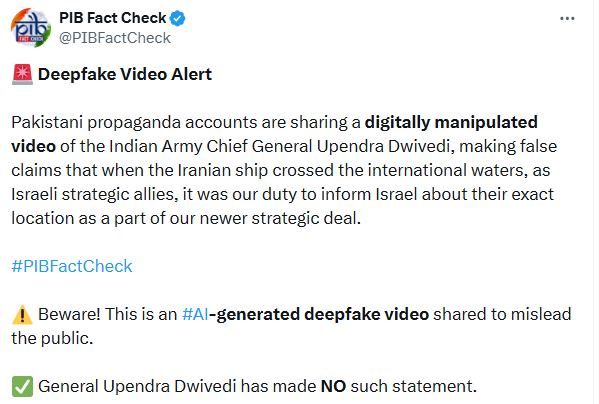
Source: https://x.com/firstpost/status/2030230888706097201?s=20 The original 21-minute Dwivedi interview is here.
However, what has not been reported is how much Indian intelligence on the course of the three Iranian vessels was shared with the US; what communications took place between the Indian military and intelligence services and their US counterparts beginning from February 28, when the war began and the Iranian vessels applied for Indian sanctuary, and March 3-4, when the decision to sink the Dena was taken in Washington; and between Jaishankar, Modi, Doval and their US counterparts over those four days when the Indians, Iranians, and Americans all knew what was at stake.
In war, four days is too long a time for commanders to prepare operational orders, but time enough for politicians in Delhi and Washington to argue the risks and benefits.
Did Iranian officials in Teheran and the captain of the Dena suspect the Indians of betraying them to the Americans by delaying them at sea, forcing them to sail 400 nm northwestward to Kochi when there was at least one Indian naval port within a fraction of the sailing distance and time; that was Tuticorin at less than 100 nm? Did US officials decide to strike just thirty minutes before the Dena could reach safe harbour in Galle? Did Modi signal Am Yisrael Khai, again, and was Jaishankar his accomplice, again?
The answers are known to officials in Teheran, New Delhi, and Washington. The questions are not permitted to be asked publicly in or near Modi’s office; in the bars of the Gymkana and the Delhi Golf Clubs; or in the Delhi think tanks on contract for their advice to the military and intelligence services. This is a circle which has developed such confidence in India’s rising political power, military prowess, economic growth, and civilizational superiority that it brooks no correction, least of all from the evidence.
- Delhi and Abu Dhabi sources say Jaishankar played a secondary role in Modi’s negotiations with the ruling Nahyan family of the UAE in January; this culminated in the flying visit to Delhi of Mohammed bin Zayid al Nahyan (MbZ), the UAE President, on January 19, and the signing of several papers. The sources claim Jaishankar was then cut out of the subsequent negotiations which were conducted on the UAE side by Tahnoun bin Zayid (TbZ), the President’s brother, national security advisor, and the UAE’s chief bribe payor.
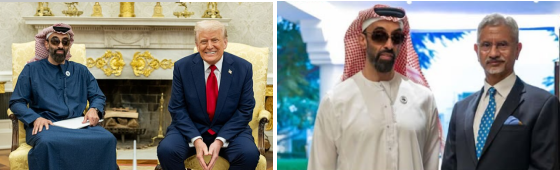
Left, Tahnoun bin Zayid (TbZ) with Trump, March 18, 2025; right, with Jaishankar, December 17, 2025. For a profile of TbZ by a veteran UAE reporter, read this. To Trump officials, whom he calls his “brothers”, Tahnoun expresses condescension bordering on contempt for the Indians; to the Indians, whom he calls his “brothers”, he expresses the same towards the Americans. The Indians believe him.
Over eight weeks of courting, with promises of hundreds of billions of dollars’ worth of trade, investment, military procurement, and secret financing, the two Emiratis convinced Jaishankar and Modi that they understood inter-Arab politics well enough to take sides against Saudi Arabia and in favour of Israel, outwitting the Americans, neutralizing the Pakistanis, and building a longterm oil, logistics, and investment relationship that would give them a strategic advantage over Russia and Iran. With such confidence in their Emirati brothers, Jaishankar and Modi then went to war with Iran. For this overreaching, Jaishankar is now trying to recover his job, Modi to stave off defeat in the five Indian state assembly elections scheduled in April.
The price spikes for fuel and fertilizers, spot shortages, hoarding, and black marketeering are understood by voters to have followed Modi’s alliance with Israel and the US. Modi had planned his election tactics in this fashion: “In a move to redefine digital campaigning, the Bharatiya Janata Party (BJP) has finalised a sophisticated, multi-layered social media strategy for the upcoming assembly elections in five states: West Bengal, Tamil Nadu, Kerala, Assam, and Puducherry. The plan centres on the ethical use of artificial intelligence (AI) and hyper-local accountability through assembly-specific ‘charge sheets.’” With relatively large Muslim voter populations in West Bengal, Kerala and Assam, an attempt by Modi and the BJP to polarize the votes by his own anti-Muslim war would have destabilizing impact across the country.
In this voter analysis state by state, just published, there is no mention of the Iran war impacts. The only references to the BJP’s anti-Muslim tactics are in Assam and Tamil Nadu. In Chennai, the capital of Tamil Nadu where General Shankar and Gunners Shot are based, the BJP voter strategy requires concealment of Modi’s backing for Israel and suppression of the evidence in the media.
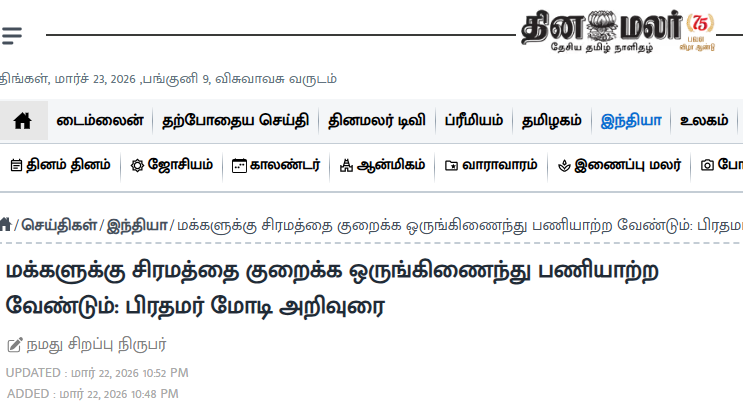
In a Tamil Nadu newspaper report of yesterday, Modi’s war against Iran is presented as an “inconvenience”. The headline reads: “PM Modi advises people to work together to reduce inconvenience to people”. Source: https://www.dinamalar.com/news/india-tamil-news/we-need-to-work-together-to-reduce-hardships-for-the-people-pm-modi-advises/4179956
An expert source from northern India comments: “In Kerala, they can’t go full anti-minority because there are so many Muslims and Christians, who are also facing BJP prejudice. Similarly in Tamil Nadu they can’t play their usual cards. So I think they will try to play their hateful rhetoric in Assam (with a few local changes), will half-try and fail at their hateful rhetoric in West Bengal, and will obfuscate and lie in the South. If they try to foment too much violence in Bengal or Assam I think it would be too destabilising.”
- Modi’s visit to Israel in February also produced confidence among his policy advisors and election financiers in the promise of up to $9 billion in new military procurements from Israeli companies. According to this Indian source, Israeli superiority over all other defence suppliers to India is in missile operations, principally for air defence. “The India-Israel defence channel is defined by high-end, high-utility systems rather than marquee platforms. Over the 2020-2024 period, India’s purchases from Israel are concentrated in advanced, technology-dense categories that directly shape deterrence and response times. 35% of all imports are missiles, including long-range missiles, loitering ammunition, and precision-strike weapons. 24% are sensors, such as radars and optical systems that help India monitor borders and airspace. 22% are air-defence systems, which protect Indian territory from enemy aircraft and missiles.”
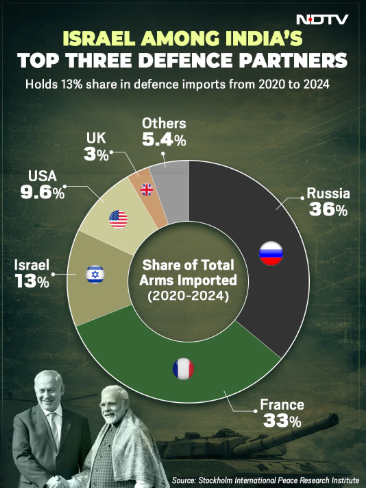
This Israeli superiority has been promoted by the two largest Indian oligarch groups, Adani and Ambani, who are heavily invested in Israel and in Modi’s election campaigns. It has been advertised in the specialist Indian media, including Chakra News, PGurus, and Gunners Shot, and in the podcast partnership between Sandeep Unnithan, Sree Iyer, and General Shankar.
The papers advancing the Indo-Israeli memorandum of understanding of November 4, 2025, to the “framework agreement” negotiated in Israel last month, were described by Jaishankar’s ministry as “significant growth made in defence cooperation between their nations, both in scope and scale. Both leaders provided a vision and a roadmap for future defence cooperation.” The details in the papers remain secret. Indian officials have told reporters they include “Israel’s multi-layered missile defence system that includes the Arrow missile and the Iron Dome system — that offers layered air defence. Currently, India has been using the Russian S-400 anti-aerial threat system, systems based on Akash and Barak, and QRSAM systems. Among drones, Elbit Hermes 900 drones are already being made in India while New Delhi is keen on having more SPICE-guided ammunition.”
The Iranian defeat of these Israeli military systems is a miscalculation by the Indians that is public knowledge in Moscow.








Leave a Reply