
By John Helmer, Moscow
@bears_with
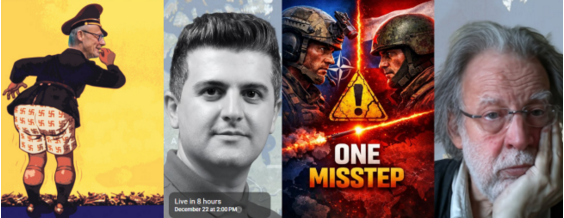
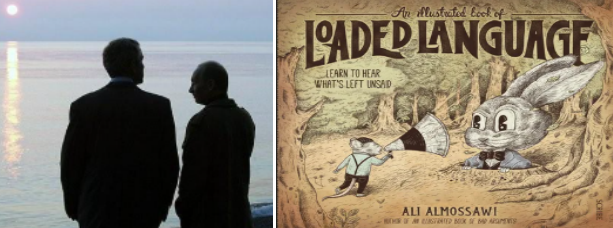
The official record of three conversations President Vladimir Putin (lead images, right) had with President George W. Bush (lead images, left) in 2001, 2005, and 2008 has just been released in Washington.
This follows a federal court lawsuit to compel the US National Archives to speed up the declassification process which was initially to have ended in 2018, during President Donald Trump’s first term, and which the Biden Administration then attempted to block for another decade. A lawsuit, filed in November 2024, identified 19 separate face-to-face meetings between Putin and Bush, and 73 telephone calls over Bush’s two terms, 2001-2009.
Stonewalling by the National Archives and the White House ended with the release of documents early this month. Three texts have been released and can be read in full here. Other records, including telephone calls, are expected to follow.
The hitherto secret remarks of Putin are almost identical with what he was saying at the time in public, and what he has subsequently said in opposition to the US plans to make the Ukraine a platform for NATO threats to Russia.
Equally unsurprising is the record that Bush made of his readiness to listen to Putin, and also of his evasiveness and misrepresentation in response – amplified at the time by his Secretary of State Condoleezza Rice and Secretary of Defense Donald Rumsfeld. Although Russian Foreign Minister Sergei Lavrov and Yury Ushakov, then Russian Ambassador to the US, were present at the second and third meetings, the record shows they had less than their counterparts to say – that is, next to nothing.
Read in retrospect since Putin has negotiated strategic partnership and defence agreements with North Korea in 2024 and Iran this year, Putin’s negative references towards the North Korean and Iran leaders he had met are noteworthy. “There may be a lot of nuts there”, Putin said of the North Koreans in 2005, “but not everyone is.” About the Iranians, whom Bush called “religious nuts with nuclear weapons”, Putin responded: “They’re quite nuts…They may be crazy in their ideology, but they are intellectuals…That was quite a surprise to me.”
Putin added a qualifier. He believed North Korea’s policies, he told Bush, were the result of the security threats imposed by the US and its ally South Korea, and that no change could be expected until and unless these were lifted. “The North Koreans live in more seclusion than we lived in,” Putin said. “They are more isolated than the Soviet Union under Stalin. The overwhelming number are prepared to die. This is not East Europe or East Germany. For any serious change in mindset, there needs to be rapprochement between the North and South.” Bush did not reply.
Putin’s response was different when Bush told him Iranian nuclear weapons technology was “scaring” Israel. “The military option stinks,” Bush claimed, referring to Israeli threats to attack Iran’s nuclear enrichment operations. “But we can’t take it off the table. [Israeli Prime Minister Ariel] Sharon is thinking about the military option. If you or I were Sharon, we’d be thinking about the military option. Iranian nukes really scare the Israelis. Diplomacy must work. That’s an important point to keep in mind. If Sharon feels he needs to strike Iran, all hell will break loose. I’m not saying it will happen, only that the most likely military reactions will come from Israel.”
Putin is evasive. “But what will they target?” he asks. Left unsaid is that Putin conceded that Israeli nuclear weapons threatened Iran with US support, and that he accepted that US would support Israel to attack Iran’s counter-deterrent. Putin did not tell Bush that until and unless the US and Israel lifts the nuclear attack threat against Iran, there could be no reciprocal security although the Iranians, like the North Koreans, had told him exactly that.
This is telling with the hindsight of Putin’s acquiescence in Israel’s June 2025 attacks on Iran during a telephone call on June 13 with Israeli Prime Minister Benjamin Netanyahu, and his response to Trump’s bombing of three nuclear technology sites on June 23. “Who says we should have done more,” Putin declared on June 20, “— what is more? Starting some kind of combat operations, or what?”
Twenty years earlier, on September 16, 2005, Bush had told Putin: “But we aren’t doing the targeting for Israel”. Putin knew then Bush was lying; Putin prevaricated. “But it’s not clear what the [Iranian] labs have, where they are. Cooperation with Pakistan still exists”, Putin went on, attempting to get Bush to respond on US military and intelligence assistance to Pakistan.
Bush was evasive. “I am concerned about Pakistan,” Putin said. “It is just a junta with nuclear weapons. It is no democracy, yet the West makes no criticism of it. Should talk about it.” Bush didn’t want to, so Putin asked Bush about the problem of terrorism spilling out of Afghanistan to attack both Russia and the US. “What should we do about the Taliban? I asked Clinton but never got back a straight answer.”
Bush was evasive again. “Armitage [Deputy Secretary of State] and George Tenet [CIA Director] have my full cooperation”. Putin replied: “Perhaps now, after your elections [November 2006], there will be fewer games.”
There weren’t.
Five weeks later, on October 29, 2005, the Pakistan-directed terrorist group Lashkar-e-Taiba (LeT) bombed crowds in New Delhi, India, killing 67 and wounding more than 200.
(more…)