
by John Helmer, Moscow
@bears_with
A little bird has materialized to sing that the record of the German generals discussing their plan to attack Russian targets with the Taurus missile was intercepted and leaked to the Russians by the Americans.
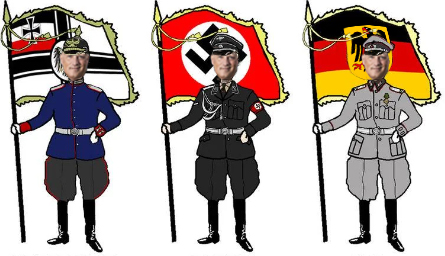
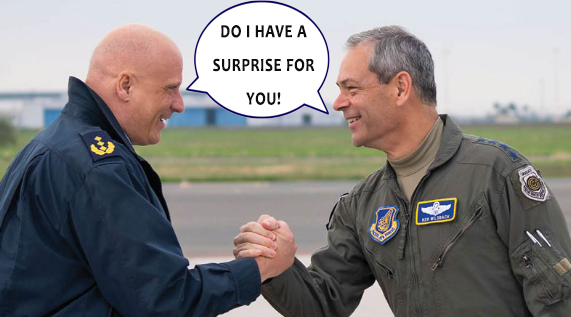
A big bird, actually. The telephone conference of German Luftwaffe chief General Ingo Gerhartz (lead image, left), one of his staff generals, and two Luftwaffe lieutenant-colonels on February 19 was listened to by US signals intelligence after the first meeting the Germans had with a new regional US Air Force (USAF) commander, General Kevin Schneider; Schneider took command of the USAF Pacific Air Forces (PACAF) on February 9 after two and a half years in a senior staff post at the Pentagon under General Charles Brown Jr. Brown was promoted from USAF chief to Chairman of the Joint Chiefs on October 1, 2023. When Schneider left Brown’s staff, he took a promotion from lieutenant general to four-star general.
Schneider has never flown or staffed USAF operations against Russia. He was in Singapore for the bi-annual Singapore Air Show to demonstrate what the USAF press office called “the opportunity to sharpen ties with Singapore, demonstrate flexible aircraft capability, enable engagement with foreign partners, and expand power projection.” His agenda of meetings with other country airforce officers is classified.
Intelligence coverage of the airshow proceedings by the US, Russia, and China was especially intense because of the participation in the show of aircraft from the warfighting states. Russia, which has participated actively in past Singapore airshows, did not participate officially this time.
The allegation that the Gerhartz teleconference was intercepted by the Russians originated from the Germans and British, and has been amplified in US and NATO media. The first Russian report that it was US intelligence which picked up the call and then leaked it, appeared in Moscow on March 4; click to read.
What has now surfaced is the audio record and transcript of the first minutes of the teleconference, before Gerhartz came on the line. In these five minutes, much more has been revealed by the three German officers than has been published by RT in Moscow on March 1, when the audio record and transcript began with Gerhartz’s appearance.
The full audio record in German, produced and published by RT Deutschland can be heard here. The publication date is March 1. The voices recorded at the beginning are those of Captain Hergang, who introduced and managed the teleconference from Germany; Luftwaffe Brigadier General Frank Graefe, speaking in his Singapore hotel room and describing what he could see out his hotel window; Luftwaffe Lieutenant Colonel Udo Fenske and Lieutenant Colonel Sebastian Florstedt, who are speaking from Germany.
A report and transcript in German, auto-translated into English, was published by Tobias Augenbraun in Dirk Pohlmann’s internet platform Free21 on March 8.
The interpretation of the additional evidence by Augenbraun and Pohlmann is that “apparently, the plans were already presented to [USAF] General [Kenneth] Wilsbach [lead image, right] in October 2023, which are also the subject of further discussion… This is astonishing for the following reason: All the rest of the conversation is about how to bring Taurus closer to the Minister of Defense, Boris Pistorius… How can it be that top German generals have already presented these plans to a US general, a full 4 months… before talking about how to discuss these plans with Boris Pistorius (Minister of Defense). Something seems to have gone badly wrong with the order here. Is it normal to first talk to generals from other countries before initiating your own defense minister? Who is in charge in Germany? Is the military out of control?”
Augenbraun and Pohlmann believe the German operational plan discussed with Wilsbach last October was the Gerhartz missile attack on Russia, and that the German Defense Ministry and the Chancellery were unaware of it at the time. This interpretation has been amplified in a report by a Brazilian who claims “here apparently we have a clear cut case of top German military officers taking direct orders regarding an attack on Crimea – part of the Russian Federation – directly from American officers in the Pacific Air Forces.”
There is no evidence of this in the record of what the Germans actually said and meant.
According to Graefe, “he’s [General Schneider] only been in office for 2 weeks and he didn’t even know what I was talking about. And that’s why I said, I’d better come by again, because that was October, when we presented all this to Wilsbach.” This is Graefe’s acknowledgement that Schneider, who was director of the USAF staff at the Pentagon from September 2021 – five months before the Russian Special Military Operation began – and then for two and a half years of the war, knew nothing at all about the German air attack plan for Russia. In Russian, that’s spelled вообще ничего.
Instead, there is evidence that Gerhartz and Graefe have been concealing their Russia-attack plan, not from their German political superiors, but from the Americans; and misrepresenting what they have been doing in Berlin in discussions with the two USAF generals, Wilsbach and Schneider. These two USAF generals are focused on China as their enemy; they have never held a staff or operational command in Germany and against Russia; their current commands are limited to the Asia-Pacific region targeting China.
Wilsbach was at his PACAF headquarters in Hawaii concentrating on Chinese targets, when Graefe says on the tape that “we presented all this to Wilsbach.” “All this” was Luftwaffe planning against China, not Russia – reason for Chinese military intelligence to have been keeping the Germans under close surveillance in Singapore, along with the Russians.
The German reporters are unaware of the Russian press report identifying the US as the source of the leak. They haven’t realized that the first five minutes of conversation reveal the special interest which the USAF had in keeping Graefe under surveillance in Singapore. Also revealed now is the USAF motive in making the Gerhartz war plan against Russia public before – not after — it had been agreed with Washington.
The timing of the newly disclosed Luftwaffe briefing of USAF General Wilsbach last October is also revealing. It was then that the Pentagon was considering what to do next in the Ukraine – and the forward budget required — after the Zelensky-Zaluzhny counteroffensive had collapsed into the rout which the Pentagon had been anticipating since the Teixeira leaks of early 2023.
In short, on display here is evidence that after the Kiev regime capitulates, the Germans are the enemy the Russian General Staff know they must defeat as the American generals look for a way of their own to retreat.
(more…)