It was former British prime minister Harold Wilson who said in answer to a question from reporters that a week is a long time in politics. He couldn’t remember in what week he said it. A century earlier, when reporters were quicker witted than they are now, another British politician had said: “In politics, there is no use in looking beyond the next fortnight.”
The fabrication for publication of US military intelligence documents on the timing and capabilities of a Ukrainian army offensive has taken five weeks for reporters to realise its political impact in Washington and Kiev. But since the documents were intended to fool reporters, the political impact in Moscow has been zero.
Much more important – and much less reported – is the impact of the municipal and Senate elections in The Netherlands three weeks ago which were won by a nationwide protest movement against anti-farm policies called the Farmer–Citizen Movement (BoerBurgerBeweging, BBB). This surprise victory is turning the BBB into political party with a much larger agenda.
The March 15 election result is the first in Europe to defeat an incumbent prime minister (Mark Rutte, lead image, left) since the Russian special military operation began on February 24, and the Slovenian parliamentary election evicted the pro-Ukrainian prime minister on April 24.
The Dutch vote result is also the first national defeat in Europe of a hot-war, Russia-hatred Green party; the first time a street protest movement has been successfully turned into parliamentary power, following the collapse of the Gilets Jaunes movement in France in 2020; and the first time a surprise election outcome in a NATO warfighting state has not (repeat not) been blamed in the mainstream media on Russian interference.
Everyone who has ever heard rice go snap, crackle, and pop! knows that eating the grain is good for your energy.
At the front, Russian soldiers are eating more rice, on per capita average, than any other soldier in Europe, twice as much as the Ukrainian troops. And the rice the Russians eat is Russian grown; in fact, Russia is a net exporter of rice to bigger rice-eaters in Turkey, Mongolia, Jordan, and Belarus.
Russians don’t eat their rice like the really big consumers of China, India, Bangladesh, Indonesia, or Vietnam. They don’t cook it into risotto, noodles, paella, biryani, nasi goreng, pudding, or krispies. Instead, it is served up as kasha for breakfast or plov for dinner.
Because rice is a traditional part of the Russian cuisine and diet, rice growing is an important agricultural business, especially in the Krasnodar region, along the Black Sea coast, which accounts for more than three-quarters of the annual harvest of over one million metric tonnes, according to the Russian Rice Union and reports from the US Department of Agriculture.
Naturally, growing consumer appetite will turn into growing demand for the agricultural land required for cultivation of the rice crop. Water is the next most valuable input to rice growing; if water is in short supply, no amount of special seed breeding, fertiliser, manual and machine labour on the land can lift both yields per hectare and total production for milling.
When the irrigation of Krasnodar’s rice paddies stopped in April 2022, following the collapse of the Fedorovsky hydroelectric dam, production fell sharply, and so did exports. Imports increased to compensate. The rice harvest had been growing from 1.099 million tonnes in 2019 to 1.142 mt in 2020, 1.076 mt in 2020, and 1.099 mt in 2021. But drought last year cut the harvest to 797,600 mt – a loss of 27%. To hold down the price, keep up supply, and protect domestic consumers, the government banned rice exports starting in July of 2022. This restriction has been extended until at least July of this year.
The dam failure was the result of long delayed state spending on repairs and upgrades. The effect on rice growers of the ensuing drought has been to the advantage of the largest, best capitalised farms in the region. The rice oligarchs, in short.
It’s an evil place which keeps evil secrets of murder. Leicester town (lead, logo) is one.
The ancient and the recent secrets in this place form a line between five hundred years of falsification of the death of King Richard III on August 22, 1485; the delayed coroner’s findings on the death of Richard Mayne on July 17, 2014; and the still hidden pathologists’ report on the death of Dawn Sturgess on June 30, 2018. The public papers of all three are propaganda concealing the truth of crimes for the benefit of potentates in London, one hundred miles to the south of Leicester.
An almost invisible and crooked line but a direct one connects Leicester, its university, its coronial court and coroner, the university’s forensic professors, and a Leicester newspaper from the Battle of Bosworth Field, to the downing of Malaysia Airlines Flight MH17, and several poisonings attributed by the British Crown to Russian assasssins between March and June of 2018.
This is how to draw the line, and the lesson to be drawn from it.
Pundits, journalists and public intellectuals don’t commit suicide for professional reasons. And not since Diogenes, the Cynic of Athens, have they opted to live in a barrel, keep the company of dogs, and urinate on their audience.
Even among the most progressive of current journalists, it’s difficult for them not to follow, sit, stay, or bark on the leash and command of their masters. . These days the Substack paywall behind their scoops doesn’t pay enough to buy dogfood. Seymour Hersh’s million for his Nord Stream story is the exception that proves the rule.
Patriotism is the safer, better-paying refuge for journalists, even when they risk indictments for being scoundrels — like Evan Gershkovich, the first Moscow Times reporter since Catherine Belton to be recognized in Russia for what he has been doing.
Looked at closely, the evidence of espionage against Gershkovich turns out to be much more than a bark up the wrong tree, as Washington officials claim, and Russian government statements deny.In Russian this evidence is already appearing in print from Gershkovich’s friends and contacts. It has yet to be recognized in the US media.
There is already enough to reveal close parallels between the Russian indictment of Gershkovich and the wording of the US government’s espionage case against Julian Assange. This evidence adds unexpected exchange value for Gershkovich – and to a turn of events to come which neither side will have anticipated.
Listen to the discussion in the first segment of this week’s War of the Worlds.
And then for the first analysis in the English language of what the rebellion of the French against President Emmanuel Macron means for the US and NATO war against Russia, listen to Slobodan Despot.
The NATO intelligence publicity department known as Bellingcat has just produced new NATO-sourced evidence of an elaborate cat-and-mouse game which the navies and air forces of Denmark, Sweden, Germany, Poland, and the US played against Russian forces in the Baltic Sea off Bornhom Island in the week before the detonation of explosives on the Nord Stream gas pipelines last September 26.
Cat and mouse is also the game the NATO propaganda agencies are now playing.
The aim of the intelligence, published last week by the quasi-state German media platform called T-Online, and in the Danish offshoot of Bellingcat known as Oliver Alexander, is to accuse the Russian Navy of the pipeline attack, using a mini-submarine and deep-sea divers. This is based on NATO and US identification and tracking of a six-vessel Russian flotilla several days before the explosions – an intelligence vessel, a deep-sea operations vessel, two tugs, and heavily armed anti-ship and anti-submarine frigate and corvette.
“It was precisely such mini-submarines that could have placed the explosive charges attaching it to the pipelines, experts suspected from the very start,” T-Online claims, using the hypothetical followed by a conditional plus three more hypotheticals.
“If it was confirmed that the SS-750 was at the scene, the Russian Navy would probably be the prime suspect from then on. ‘It would make absolute sense to use something like the AS-26 for such an attack,” Danish corvette captain and military analyst Johannes Riber told T-Online about this matter. ‘That would be the most plausible explanation so far for what happened to the Nord Stream pipeline.’” T-Online concluded: “In official statements, the activities of the Russian navy in the days before the attacks have so far played no role. Neither the German, Danish or Swedish investigators, nor NATO or the armed forces of the Baltic Sea states wanted to comment on them when asked by T-Online. Thus, the criminal case remains unsolved for the time being, but a chain of evidence has been added. It does not point to the USA or Ukraine. Some tracks now are leading to Moscow.”
Riber, the Danish navy source, has made a career chain of working in NATO staffs, as well as under US commands in Iraq and Bahrain. In addition, T-Online claims its evidence has come from US satellite imagery and “sources in the security community”.
In parallel publication under his own name, Alexander has been less forensically direct, more circumstantial. The Russian vessels were “possibly… in close proximity to the Nord Stream sabotage site”. This is circumstantial guilt by geographical association; Alexander camouflages it by a disclaimer: “In conclusion, OSINT [Open Source Intelligence] alone cannot solve the mystery of the Nord Stream sabotage or what these vessels were doing on September 21st-23rd, a few days before the explosions. It does however seem likely that the unusual events on these dates are somehow a key part of the Nord Stream sabotage mystery.”
The sourcing for Alexander’s claims is “an intelligence source [who] had told [T-Online] the names of six Russian naval vessels that were reportedly spotted in the vicinity of the Nord Stream sabotage site. With this information, I have spent the past week collecting and analyzing any open source information I could find in order to try to corroborate as much of their information as possible.”
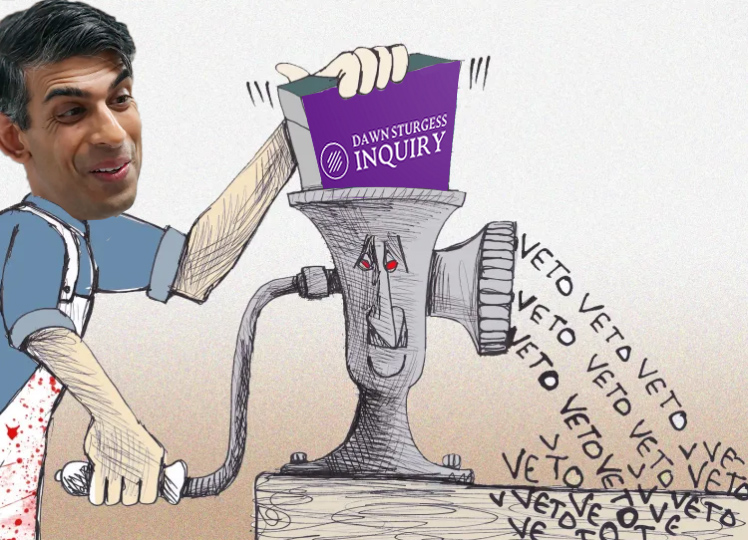
The British Government (lead image, Prime Minister Rishi Sunak) has decided that in public hearings to confirm that Russian-made, Russian-delivered Novichok killed Dawn Sturgess in mid-2018 – after failing to kill Sergei and Yulia Skripal weeks earlier – nothing can be said or revealed without being subject to an immediate veto by the police, the MI6 spy agency, and other UK officials.
The veto will cover police records; closed-circuit television (CCTV) films; laboratory reports by the Defence Science and Technology Laboratory at Porton Down; Salisbury District Hospital patient admission and clinical test results; witness testimony; coroner’s cremation forms – in fact, everything which may expose, not what really happened to the Skripals and to Sturgess, but what didn’t happen to them which the British Government insists it did.
That evidence is what is called “sensitive information” in the state inquiry into the cause of Sturgess’s death which held a new courtroom session in London on Friday.
Lord Anthony Hughes, the retired judge appointed to run the proceeding, acknowledged this month that “there is a risk that sensitive information might be disclosed, inadvertently or otherwise, during the course of the open preliminary hearings.” Accordingly, he has announced, that “there will be two video links to afford those not present in the hearing room with access to the hearing – a ‘live link’ and a ‘delayed link’, which will be delayed by 5 minutes. The public and media attending the hearing remotely will do so by means of the delayed link.”
In the 5-minute delay, Hughes has decided, “in the event that sensitive information is disclosed in the course of an open hearing whilst these measures are in place or a Core Participant informs the Chair that he considers that sensitive information may have been disclosed, the Chair will consider taking the following steps (if necessary by receiving submissions in closed session): a. an immediate termination of the delayed link; b. making a restriction order to prohibit the publication of the sensitive information; c. ensuring that when the delayed link feed is resumed, the sensitive information (including any submissions concerning any information which a Core Participant considers may be sensitive information) is not broadcast.”
The inquiry has already decided that the “core participants” include the Sturgess family, several branches of the British police, the Home Office representing the intelligence agencies and Porton Down, the Wiltshire Council, and the regional ambulance service which responded to emergency calls for the Skripals on March 4, 2018, and for Sturgess on June 30.
Sergei and Yulia Skripal have been designated core participants, but their lawyer, Adam Chapman, has refused to confirm that the Skripals have appointed him to represent them or that they are still alive. Without explanation Chapman was absent from the latest court hearing last Friday.
When the Obama Administration pulled their Kiev putsch of February 21, 2014, they, German Chancellor Angela Merkel, and their British and French counterparts understood they were in for a long war. Merkel has admitted as much; the British and French have lost power and been replaced by successors impatient to win propaganda victories if they can — and not lose on the battlefield too quickly if they cannot.
By December of 2021, US officials believed they were almost ready to expand their war, recover Crimea and the Donbass, and inflict such a battlefield defeat on Russian forces as to trigger chaos, then regime change in Moscow. This calculation is why the US and NATO dismissed negotiations on the terms of the small pact, the Minsk accords of 2015, and then the larger pact for Europe of December 2021 – an idea the Russians called indivisible sovereignty, the Americans reciprocal security, the Europeans non-aggression.
A quick preemptive defence and preventative war was an idea of President Vladimir Putin’s. It was neutralized in the Kiev operation during the first month of the campaign last year. The aim then was not to capture the city, but to trigger Ukrainian regime change, then negotiations. By the time the Istanbul talks began, the Zelensky group remained intact, and the long war commenced. This had been the anticipation of the Russian General Staff then. It still is.
Long means years.
Long enough in the US calculation for President Joseph Biden not to die before his re-election in November 2024. This is the only war casualty the US cares about for the foreseeable future; it explains why there is, and can be, no American anti-war movement of any consequence. So far, so good – Biden’s death has been averted at a cost of at least 250,000 Ukrainian combat and civilian deaths, plus Poles, Germans, French, British et alia. But these numbers don’t count in Washington because Biden is currently beating every potential Democratic or Republican Party presidential candidate in next year’s election. Polled about this, US voters who are negative towards Biden regard his conduct of the war against Russia in the Ukraine more positively, less negatively than any of his other policies.
This is not only curtains for anti-war voter mobilization in the US. It makes recent statements by Donald Trump that if elected, he will stop the war “no longer than in one day” a desperate, cynical bid, not for American votes, but for Kremlin support to his candidacy.
The Russian General Staff counts the length of the war as the time they plan to spend destroying all Ukrainian force capabilities east of the Dnieper River, and establish a demilitarized zone west of the new Russian border of the Donbass so deep as to put NATO artillery and other forms of attack out of range. Long enough also to destroy every new NATO weapon system promised, transported, or deployed from the US and NATO to Ukrainian territory.
The Chinese government and President Xi Jinping count the length of this war as even longer. They see the acceleration of US economic warfare and sanctions against them; new force deployments around China’s borders; and the expansion of US gun platforms like Japan, South Korea, and Australia will follow the pattern already set against Russia. Only by Russia’s victory on the field and the retreat of the NATO side to the underground bunkers of Lvov can China be secure for Xi’s Central Military Commission, who also need time to practice, plan, test, plan again.
All of this was very well understood in the talks between the Xi and Putin and their staffs in Moscow last week. The talks were a success because neither side is in a hurry now and said so. Negotiations on the Ukraine, Putin said in his concluding Kremlin statement, will start “when the West and Kiev are ready for it. However, so far, we have not seen such readiness on their part.” Xi replied in his Kremlin statement that his timing is longer than that. “We…firmly stand on the right side of history”, Xi said.
For failing to appreciate this, the Biden Administration warfighters and their propaganda organs can be excused. So long as Biden doesn’t die, they keep their confidence the field will be theirs, or at least the election clock.
Less excusable are the failures to read correctly what the hands on the Russo-Chinese clock are pointing to by the anti-war Americans – old soldiers like Douglas Macgregor; old professors like John Mearsheimer; old dissenters like Noam Chomsky and Daniel Ellsberg; old journalists like Seymour Hersh. Because this is a long war, they are running out of time.
by Evan Jones, Sydney, introduced by John Helmer @bears_with
Fascism is the combination of force, fraud, and propaganda which replaces constitutional rule by parliament and the rule of law.
Spain under Franco, Portugal under Salazar, Germany under Hitler, Italy under Mussolini, and Greece under the Colonels, are 20th century examples in Europe. There are more recent and current ones — Ukraine since the putsch of February 21, 2014, is the obvious example. Another is French President Emmanuel Macron’s rule by decree, without the National Assembly, which began in 2020 with the emergency powers of the pandemic, and accelerated last week with the imposition of “pension reform” by decree, instead of parliamentary vote.
Outside Europe, there are the Australians who have been testing, training and practising fascist rule since the beginning of the pandemic. So successful were they at that, they managed to keep several hundred thousand of their own citizens out of the country on a deception, unvoted by parliament, untested in the courts, but approved by the mass media. They are now preparing the population to go to war against China.
One of the chapters of the Australian story has just been reviewed by Evan Jones in Independent Australia, an internet site published in Brisbane. Here’s the site; read on for the review.
Igor Zyuzin (lead image), owner of the Mechel steel and coal group, and one of the few Russian metals oligarchs not presently sanctioned by the US, is a running sore on the Kremlin’s policy of halting, and also continuing, industrial pollution.
From his base in Chelyabinsk, and at factories, mines, and ports from Moscow through the Urals to the Pacific coast, Zyuzin has defied decades of protests by residents, city and region investigations, court rulings, and promises by federal officials to stop the water, ground, and air pollution which his businesses have been producing.
Zyuzin is now telling the Kremlin he wants permission for more – more pollution, that is, at lower cost to the profit line on his balance-sheet.
The emergency economic measures being adopted for the war in the Ukraine, Zyuzin is claiming, should now relieve him and his company executives of criminal liability for intentional pollution, and Article 251 of the Criminal Code should be cancelled. This provision in the Russian law allows regulators, prosecutors and courts to force the dismissal of culpable managers or to send them to prison for up to one year.
Zyuzin has appealed through the Russian Union of Industrialists and Entrepreneurs (RUIE), the oligarch lobby, for President Vladimir Putin to do this by implementing the promise announced in his Federal Assembly address last month. “I will repeat,” Putin said on February 21, “against the backdrop of external attempts to contain Russia, private businesses have proven their ability to quickly adapt to the changing environment and ensure economic growth in difficult conditions. So, every business initiative aimed at benefiting the country should receive support. I believe it is necessary to return, in this context, to the revision of a number of norms of criminal law as regards the economic elements of crime. Of course, the state must control what is happening in this area. We should not allow an anything-goes attitude here, but we should not go too far either. It is necessary to move faster towards the decriminalisation I mentioned.”
“Everything we do is solidly rooted in market principles…We have avoided having to apply excessive regulation or distorting the economy by giving the state a more prominent role,” Putin added.
The head of the RUIE lobby, Alexander Shokin, has been a Zyuzin retainer for many years. Over this time he and Zyuzin have persuaded Putin to accept the principle that Mechel should be allowed to violate the anti-pollution laws on condition it pays small cash penalties for its poison.
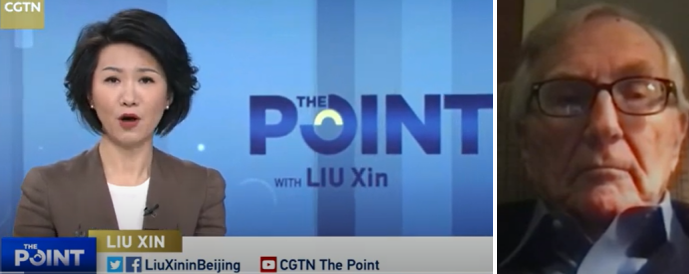
If China’s journalists, foreign intelligence analysts, and People’s Navy staff have needed an opportunity to demonstrate, if not to the Middle Kingdom audience, then to the US exceptionalist public how peripheral and how mediocre American legends have become, Seymour Hersh has provided it in an interview Hersh (lead image, right) recorded with China’s state broadcaster CGTN on Saturday.
For the first time since Hersh’s earlier interviews with American, British, German, and Russian reporters, Hersh faced skepticism and cross-examination of the account he published on February 8 of what he claimed then, and insists still, was a joint US and Norwegian operation to destroy the Nord Stream gas pipelines on September 26, 2022.
According to Hersh, the operation was directed by the White House and ordered by President Joseph Biden, with the reluctant support of the Central Intelligence Agency (CIA).
In his 28-minute interview with Liu Xin (left), Hersh repeats his original claims; makes fresh mistakes of fact; discloses new source information.
Hersh also reveals he is so confident of the seniority and veracity of his US intelligence ageny source – make that the CIA – he is not reading nor understanding the fresh evidence which has been published in the German mainstream media, the international internet, the US alt-media, and the New York Times. Dismissing it all, while revealing he has analyzed none of it, Hersh told Beijing television: “they are trying to divert attention from the story I wrote.”
Hersh also reveals that for verification of his story, he employed fact-checkers from the New Yorker, the most virulently anti-Russian, pro-Ukrainian magazine in New York.