

By John Helmer, Moscow
@bears_with
1. Jeffrey Epstein’s failure to develop any business or political connection to the Kremlin or Russian oligarchs.
2. Foreign Minister Sergei Lavrov’s open break with Kirill Dmitriev’s negotiating strategy with the US; indirect criticism of President Vladimir Putin.
3.Escalation of the US war at sea against Russian oil trade, sea lanes, and tankers, and the continuing delay in Putin’s orders to the Russian Navy.
4.The disagreement between Putin and President Xi Jinping.
5.The precarious balance of force deterring US and Israel from attacking Iran, and Russian assessments of the survivability of the Iranian government.
Recorded on Thursday afternoon, US Eastern Time, view or listen to the newsbreaking discussion with Dimitri Lascaris: https://www.youtube.com/watch?v=qF-uCJ8Fza0
For background and documentary evidence:
The Epstein Evidence. Jeffrey Epstein was a specialist in insider trading; leveraged puts, calls and other derivatives; distressed asset and bankruptcy fraud; tax evasion schemes; and money laundering. They were his principal source of income and of his wealth at death; that has been estimated at $380 million in cash, stocks and other investments, plus real estate assets in New York, Paris, and the Caribbean, for an aggregate of $578 million.
Between 1999 and 2018 Epstein’s two US Virgin Islands-based companies, Financial Trust and Southern Trust, generated more than $800 million in revenue comprising more than $360 million in dividends, and $488 million in fees from high net-worth clients. They invoiced Epstein for “estate planning” and other financial services. Follow the Forbes reporting on the sources and method of this money-making here and here.
The accumulating investigative record also shows that Epstein stole from the principal his clients gave him to manage in the belief that because the money was generated unlawfully, his thieving would not be brought to account. Leslie Wexner appears to have been the only one of Epstein’s clientele to do so.
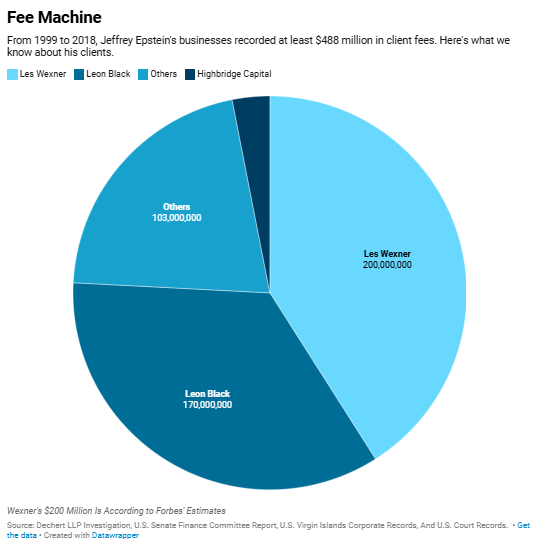
Source: https://www.forbes.com/sites/giacomotognini/2025/07/25/how-jeffrey-epstein-got-so-rich/ The email record indicates that Epstein didn't have the staff to run these schemes, at least not in New York. The schemes require lawyers and accountants to create the network of entities and bank accounts through which the movement of money is directed. Epstein's 11-person staff in the Virgin Islands may have performed these functions.
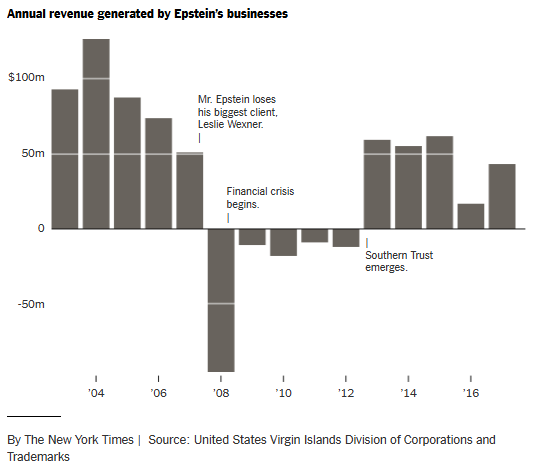
In this New York Times investigation of balance sheets and financial reports from the Virgin Island entities, Financial Trust and Southern Trust, the value of Financial Trust peaked at the end of 2004, when it reported $563 million in assets and net income of $108 million. When the Wexner funds were withdrawn, however, a new clientele was created in a successor entity, Southern Trust. Read more: https://www.nytimes.com/2019/10/03/business/jeffrey-epstein-southern-trust.html The DOJ files reveal many types of racketeering and tax fraud offences -- “insurance policy” schemes; “art advisory” schemes; and rent-a-name for disguising real estate ownership:
According to a published statement last July from Senator Ron Wyden (Democrat, Oregon) of the Senate Finance Committee, “Treasury’s Epstein file details 4,725 wire transfers adding up to nearly $1.1 billion flowing in and out of just ONE of Epstein’s bank accounts… Hundreds of millions more flowed through other accounts”. Wyden claimed that the US Treasury had promised to release these Epstein records, but after allowing Senate investigators to read the files without copying them in 2024, Scott Bessent, Trump’s Treasury Secretary, has refused to go as far in disclosure as the Justice Department (DOJ) has been compelled to do by Congress.
Assuming (on the high side) a 10% yield for Epstein’s dividend stream, the reported numbers suggest Epstein may have been managing up to $3.6 billion over almost twenty years. If the financial transaction evidence is opened to accounting, it is likely to lead to Congressional and public pressure for prosecutions of Epstein’s clients under the Racketeer Influenced and Corrupt Organizations Act (RICO). The clients who are vulnerable include billionaires like Leslie Wexner and Leon Black, and also Noam Chomsky, Woody Allen, Steven Bannon, and Lawrence Summers.
Epstein claimed in his emails that he wanted to offer his schemes for largescale money transfers, including crypto currency operations, to President Putin and to Russian oligarchs. But none of his offers and indirect approaches led to his visiting Russia, or to meeting Kremlin officials or oligarchs living in New York such as Roman Abramovich, Len Blavatnik, and Victor Vekselberg. For more detail, read this.
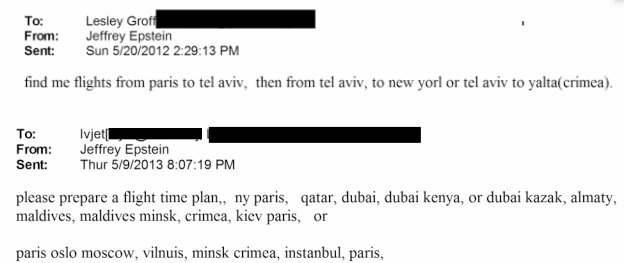
Sources: https://www.justice.gov/epstein/files/DataSet%2010/EFTA01885314.pdf and https://www.justice.gov/epstein/files/DataSet%2010/EFTA01976002.pdf After giving these staff orders a year apart in 2012 and 2013, Epstein abandoned his attempts to fly to Russia. He continued with efforts through Israeli, Norwegian, and other politicians and businessmen to set up a face-to-face meeting with Putin. However, the only Russian government official who agreed to meet with him was Vitaly Churkin, then Russian Ambassador at the United Nations in New York. Churkin asked Epstein to find a job for his son Maxim; no record has been found of a reciprocal favour Epstein sought from Churkin.
Sergei Lavrov v Kirill Dmitriev. For the detailed story of the Foreign Minister’s attack on the Kremlin faction promoting the “Anchorage Formula”, read this.
Following the reaction by Putin’s spokesman, Dmitry Peskov, the Kremlin arranged for the state propaganda organ RT to publish an unsigned editorial claiming that the difference between Lavrov and Dmitriev in the negotiations with the US is an intentional, Putin-directed “double track”:
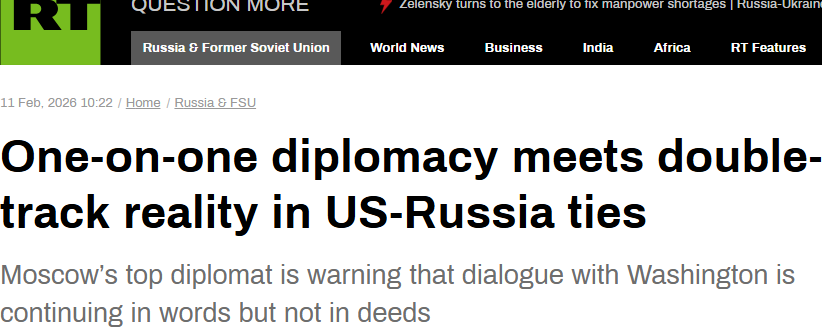
Source: https://www.rt.com/russia/632272-us-russia-diplomacy-ties-reality/
According to this publication, “this is Washington’s double-track policy: dialogue on paper, pressure in practice. In Moscow, that contradiction has crystallized into a division of labor. One set of officials continues to test transactional engagement with Washington. Another has begun saying openly that it is not possible. On one track is Kirill Dmitriev, the Harvard-educated financier and head of Russia’s sovereign wealth fund, tasked with maintaining dialogue and exploring large-scale economic deals with the West. On the other is Sergei Lavrov, esteemed diplomat and the longest-serving foreign minister in the world. He is increasingly the man saying publicly what Moscow believes privately: that the US is negotiating in words while escalating in practice. That contrast has come into full view following a series of interviews Lavrov gave respectively to RT, TV BRICS, and in subsequent public remarks.”
On the same day, Lavrov told the State Duma that the US escalation of maritime war against Russia and its allies is new. He appeared to endorse new Russian action in support of its allies under oil blockade from the US, and in support of Russian tanker movement of oil and other energy products.
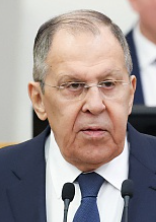
“The dramatic events earlier this year, including the armed invasion of Venezuela by the United States, the escalation of US pressure on Cuba, the attempts to destabilise the situation in Iran, and the crisis around Greenland – all of which you have seen and heard about – have confirmed our assessment that the world has entered an era of swift and profound change. Some experts even argue an era of upheaval. One thing is clear, though. This is not a fleeting or temporary development, but a new phase in global development, perhaps even an era, which may last many years, even decades… We stand in solidarity with the peoples of Venezuela and Cuba, who, as mentioned earlier, are under severe external pressure. We intend to provide our friends with all necessary support together with other like-minded partners – all those for whom the ideals of freedom, sovereign equality, self-determination of nations and democracy in international affairs are not empty words.”
The next day, February 12, Lavrov’s spokesman Maria Zakharova limited the action Russia is planning against the US oil blockade of Cuba to Russians in Cuba, not Cubans. She said: “In the context of the unprecedented measures taken by the United States to block the supply of energy to Cuba, including aviation fuel, there was a difficult situation with flights to the island of domestic airlines ‘Russia’ and ‘North Wind’. The Russian Foreign Ministry and our Embassy in Havana are in constant close contact with the Cuban authorities, air carriers and tour operators in order to provide the necessary assistance to Russian citizens in Cuba, primarily tourists. We believe that the actions of external forces that seek to exacerbate the energy crisis in Cuba, including the cessation of air communication with the island, are designed, among other things, to provoke discontent of the population and the inconvenience of foreign citizens against this background.In this situation, we call on everyone who has faced a forced delay in returning to their homeland, to show calm and restraint. At the same time, we ask those who plan to travel to this country to take into account the circumstances, including taking into account the recommendations of the Ministry of Economic Development of the Russian Federation. The Russian Embassy in Havana, our diplomats are doing everything to assist Russian citizens who are now under the fault of the United States, which have been blockading Cuba for many years in such a situation. Our Embassy provides our citizens with all the necessary assistance, hotline phones are working, information is being published on the return of their homeland, the organization of air flights.”
Escalation of the US war at sea. Read the background on the US war against the alternative oil tanker fleet, and the proposal to defend the Russian flag at sea by the chief of the Russian Navy, Admiral Alexander Moiseyev here.
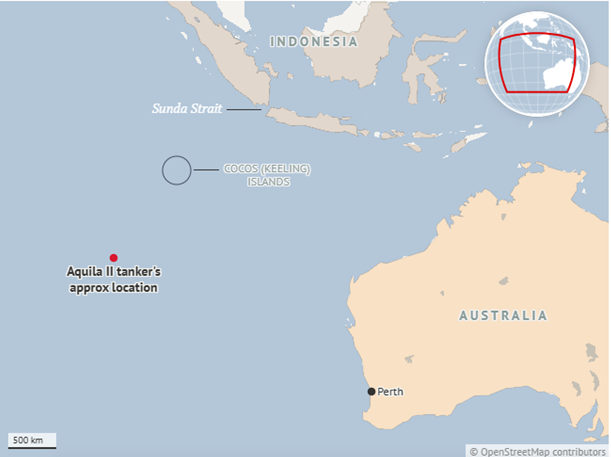
Detailed analysis of the US interceptions and seizures of the Russian-flagged Marinera off the UK-Iceland coast on January 7, and then of the Panama-flagged Aquila II in the east Indian Ocean, reveal that the US is being stretched to the limit of its military capacities. It took a combination of US Navy, Army and Air Force units 18 days over more than 7,000 kms to pursue the Marinera to capture; and about four weeks and 15,000 kms for the Aquila II pursuit to conclude.
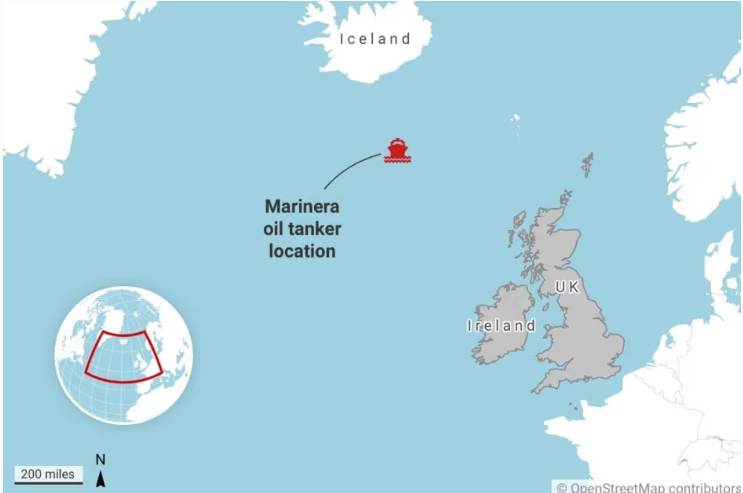
Source: https://www.irishmirror.ie/news/world-news/forces-seize-russian-marinera-oil-36512289








Leave a Reply