

By John Helmer, Moscow
@bears_with
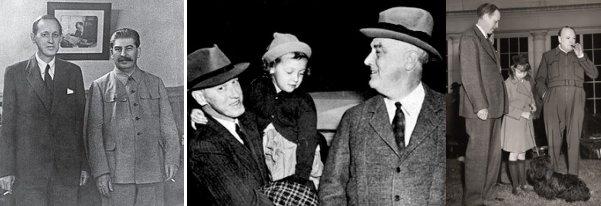
On his way to meet Joseph Stalin in July 1941, Harry Hopkins (lead images, left) landed just out of range of German guns on a Moscow city airfield which, later, stretched a few hundred metres from my kitchen window.
In Washington, DC, in 1976, his daughter Diana Hopkins (centre) sold her house to become my home, making a gift of some of her father’s books. For these reasons, among others, I remember him.
This month it is the eightieth anniversary of the death of Hopkins who died in Washington on January 29, 1946; stomach cancer was the cause; he was only 56.
Hopkins was President Franklin Roosevelt’s personal negotiator during World War II with the allies; he was the only American recognized by Stalin as both honest in what he said and honourable in his intentions. По душам, Stalin said of his conversations with Hopkins – heart to heart.
No American in the eighty years since then has been regarded by Russians in the Kremlin in the same way and to the same degree – not the deceptionist Henry Kissinger, and certainly not the corruptionists Steven Witkoff and Jared Kushner. Honour between the Americans of the White House and Russians of the Kremlin ended with the coup d’état which placed Boris Yeltsin in power for a decade. The US war which has escalated since then makes the recovery of honour between the representatives of the two Great Powers impossible.
Russians who say otherwise aren’t deceiving the deceivers. They may be fooling themselves.
When the combination of Bloomberg and Tass announced on January 14 that Witkoff and Kushner will make “a forthcoming visit to Moscow to meet with Russian President Vladimir Putin” , Tass added the conditional that if President Donald Trump launched an attack on Iran, Witkoff and Kushner “may be postponed due to ongoing developments in Iran.”
Adding more conditionals, Foreign Minister Sergei Lavrov has intimated that nothing they say nor any negotiator for Trump nor Trump himself, is worth flying to Moscow to say, or for President Vladimir Putin to open the Kremlin gate to hear.
“When the United States begins to act in disregard of all the norms it once promoted,” Lavrov told the press on January 14, and “abandons all its own principles, it raises the question of whether our American colleagues appear unreliable when behaving in such a manner. They are betting on the idea that wherever there is oil or other strategically important natural resources, they should think only of how to advance their own interests, employing threats and methods of direct pressure.”
“Unscrupulous methods”, Lavrov called them – the Witkoff-Kushner back channel is back to front, he explained, if they are camouflage and deception. “We are open to negotiations on Ukraine if these talks are approached seriously and if the stakeholders are truly ready for them and have things to say (I’ll note briefly why I emphasise the seriousness of any initiatives).”
Note the two if-conditionals. No По душам.
“All previous meetings with US Special Envoy Steve Witkoff and Jared Kushner who joined him recently, were serious, specific, and aimed at figuring out the root causes of the Ukraine crisis and agreeing on ways to overcome them,” Lavrov continued. “The initiatives discussed by Europe, including those discussed in Paris with the participation of Steve Witkoff and Jared Kushner, are aimed solely at preserving the current Nazi regime in that portion of Ukraine they hope will remain Ukrainian after the settlement… beginning with the Anchorage summit and subsequent talks with Steve Witkoff and Jared Kushner, we know that the United States is fully cognisant of the unrealistic nature of this scenario and wants to cut short any attempts to draw Ukraine into NATO.”
The if-conditional again: “We are open to contacts with Steve Witkoff and Jared Kushner…if they show such interest, it will be met with understanding…If our US colleagues wish to brief us on their impressions, we would be interested to find out what they have to say, all the more so as our contacts with the Americans on Ukraine rest on a solid foundation of the Alaska summit, where we reached an understanding shared by the United States and Russia alike.”
Lavrov was saying the Alaska summit understanding is not solid – it is conditional. By saying as much, the foreign minister is suggesting this ought to put an end to Witkoff and Kushner as negotiators because there is now nothing they say which reflects, obligates or binds Trump. Lavrov is also reporting that President Putin is agreeable to continue listening to what they say and waiting for what happens next.
But this is temporizing — the Thesaurus list of synonyms for that word are delay, equivocate, procrastinate, balk, stall.
This particular has been made part of a general theory of back-channel negotiators in an essay published last month by the pseudonymous American substack writer, Kautilya the Contemplator.
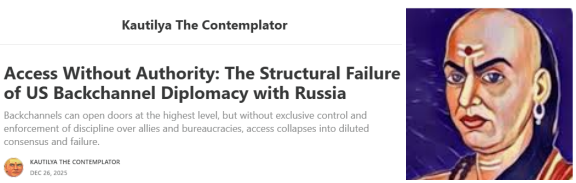
Left, the substack essay -- https://chandragupta.substack.com/p/access-without-authority-the-structural The original Kautilya, right, was also a pen name for the author of the Sanskrit treatise on statecraft, diplomacy, and war called the Arthashastra. It’s likely that the treatise was compiled and published several hundred years after the Maurya empire to which it referred had lost power. The work itself also disappeared until the 20th century. That there was a genuine master, political adviser and author of the treatise is as much of an invention as the picture.
Google, Grok, ChatGPT, and DeepSeek all acknowledge they cannot identify who this is. ChatGPT guesses he may be “Indian, educated in the United States and have some background in diplomacy having served in multilateral organizations, though they now work in the private sector.” Grok estimates his readership is “in the low thousands range”.
The Kautilya essayist compares the current US back-channelists with Hopkins for Roosevelt and Stalin, Kissinger for President Richard Nixon and Mao Tse-tung. “Trump’s backchannel with Russia follows the same underlying logic as these precedents. By deploying Witkoff and Kushner, Trump sought to bypass hostile bureaucracies, test intentions at the highest level and sketch a settlement framework before subjecting it to formal negotiation.”
This is the author’s attribution of clear and honest intention on Trump’s part, the author’s guess. Not intended deception which is a possibility the author fails to consider. He then blames internal politics, Trump’s lack of control of his own bureaucracy and of his European allies, for the failure of the current back-channelists to have achieved anything to date. The essayist has nothing to say about the Russian counterparts for Witkoff and Kushner, Yury Ushakov, the Kremlin foreign affairs adviser, and Kirill Dmitriev, representative of the Russian oligarchs. He doesn’t know what the Russian record reveals – he doesn’t appear to think that matters.
“The discussions [between Witkoff, Kushner, Putin, Ushakov and Dmitriev] have revolved around the familiar pillars of territorial realities, Ukrainian neutrality and sanctions sequencing among other points of contention. The blockage that followed, therefore, cannot be attributed to a lack of access, seriousness or clarity between Washington and Moscow. Kushner and Witkoff are fully aware that Moscow’s core demands have remained unchanged since the start of the Special Military Operation. The credibility problem has emerged in Washington’s approach to alliance management and in the behavior of Ukraine, Europe and hardline elements within Trump’s own Administration… From a process standpoint, this was decisive. By incorporating European and Ukrainian revisions at the exploratory stage, despite knowing these revisions contradicted Russian requirements, Witkoff and Kushner effectively transformed a backchannel framework into a negotiated coalition document before it had ever been tested with Moscow as a final concept. In doing so, the channel ceased to function as a presidential instrument for defining the settlement parameters and became instead a vehicle for alliance compromise. For Russia, this sequence is fatal to confidence. It signals not flexibility but reversibility – that understandings reached at the leader level of two great powers can be re-written downstream by actors whose interests are structurally opposed to settlement.”
“Up to the Anchorage Trump–Putin meeting in August 2025, the backchannel appeared to function as intended because Witkoff operated with relative exclusivity, preserving insulation and momentum. That logic nearly extended to a follow-on summit in Budapest facilitated by Prime Minister Viktor Orbán. The effort collapsed, however, once foreign ministers were drawn into the process, specifically after a call between Marco Rubio and Sergey Lavrov, underscoring how early bureaucratic re-entry, led by a Russia hardliner like Rubio, likely derailed a backchannel that might otherwise have progressed toward a second leader summit.”
This is the theory of the Witkoff-Kushner channel which the Kremlin repeats, along with its supporters in the Russian press, and its echo-endorsers in the US podcast media, and are continuing to repeat even after the attack on Putin’s Valdai, Novgorod, residence (December 29); after the kidnap attack on President Nicolas Maduro in Caracas (January 2); after the escalating US attacks and seizures of Russian-flagged or Russian-owned oil tankers (January 7-14 ); and after Trump himself admitted to planning fresh direct attacks on Putin.
“Would you ever order a mission to go and capture Vladimir Putin?” Trump was asked on January 9. “Well,” he replied, “I don’t think it’s going to be necessary.”
Has there been a back-channel discussion of the meaning of Trump’s “necessary”?
There is no evidence of the conversations between Ushakov, Dmitriev, Witkoff, and Kushner when they met in Paris on January 7, or when they have spoken since then by telephone. There is no nothing in the record which Dmitriev is making daily on Twitter that he has requested to know from Witkoff and Kushner what Trump’s intention is to strike, kidnap or kill Putin if Putin fails to accept Trump’s end-of-war terms that Dmitriev is publicly advocating Putin should accept.
Dmitriev has omitted to say anything himself on the Novgorod and tanker attacks – except to repost the reassurance from Kremlin spokesman, Dmitry Peskov: “Russia is NOT withdrawing from the negotiation process following drone attack on Putin’s residence . We’ll continue negotiations, primarily with Americans.” That the Novgorod raid was a message from Trump to Putin that he knows precisely where Putin is at all times, and if necessary, can strike him with precision – this is not a message for back-channel discussion, according to Dmitriev.
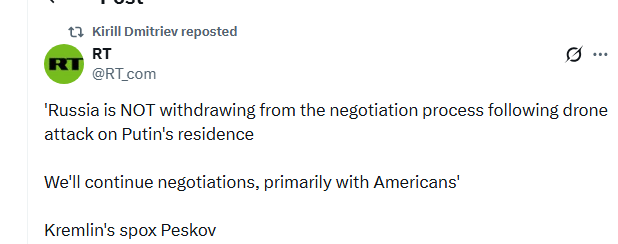
December 30 -- https://x.com/RT_com/status/2005940574587597075

January 2 -- https://x.com/kadmitriev/status/2007168093492318294
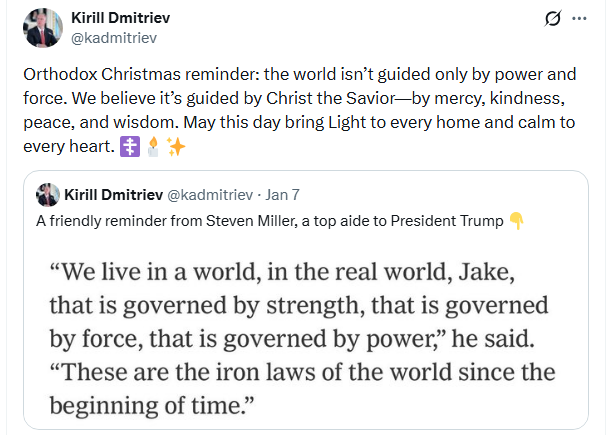
January 7 -- https://x.com/kadmitriev/status/2008870064469262740
On the evidence then, not on the substacker’s theory, what is turning out is there is no back-channel negotiation at all in the Harry Hopkins meaning. Instead, there is American justification for well-intentioned realism to which the Russian reply, Putin’s and Dmitriev’s reply, is Russian justification for well-intentioned temporization.
On the anniversary of Hopkins’s death, it can be remembered that there is a standard for gauging the deception in both lines. It was Stalin’s standard for judging Hopkins — honest in what he said, honourable in his intentions, По душам.




Leave a Reply