

By John Helmer, Moscow
@bears_with
There always comes a tide in the affairs of Russian businessmen when they think are on to a fortune.
“We must take the current when it serves, or lose our ventures,” Brutus famously told Cassius as they sought to capitalize on their assassination of Julius Caesar in Shakespeare’s play of that name. The outcome of their plot and of the play, however, was defeat in successive battles — Cassius first, followed by Brutus, and then their suicides to avoid the humiliation of arrest, trial for treason, and public execution.
The memorable quote to encourage farsightedness, audacity, and fortitude ought to come with a lethality warning, and in the small print the tested probability of failure, ruin, death. Russian businessmen, however, believe they can beat those odds by what they call “administrative measures”. These amount to lobbying of the presidential administration and government to secure their money at risk with state cash and rig the outcome of their ventures by agreement in advance to share the proceeds. This is known as racketeering in US law.
It has been the strategy of President Vladimir Putin and his special negotiator with the Trump Administration to rig the outcome of the war in the Ukraine and cancellation of US economic sanctions against Russia by billion-dollar dealmaking with Trump, his family, advisors, and friends. The negotiator’s name is Kirill Dmitriev. He has been Putin’s appointee since February 23, 2025. Almost fifteen months later, after monthly face-to-face meetings, weekly telecommunications, and dozens of MoUs and term sheets, Dmitriev’s record is what in Brutus’s warning to Cassius was called “shallows and miseries”. Bottom line net loss is the auditor’s term for it.
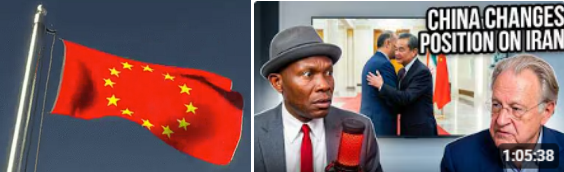
Dmitriev’s justification is to publish every day a stream of tweets in which he blames the British and European governments for their sabotage operations and his continuing confidence in Trump. In Dmitriev’s latest tweet (lead image, left) he has repainted the European Union flag in the red of the Soviet Union, Chinese and Vietnamese flags, declaring that “with woke, socialist, immigration-friendly policies and narrative control, the leftist EU bureaucrats have created a dysfunctional version of the USSR.” Ukrainian born, American educated and employed, Dmitriev is blaming the war against Russia on the Reds – the Bolsheviks of Brussels.
He is announcing himself as a White officer serving the Tsar although that’s not Putin, it’s Donald Trump. He announced himself king in February 2025, just before Dmitriev’s official appointment; as the Pope on May 5, 2025, a month after Dmitriev held talks at the White House; and then as the Son of God on April 13, 2026, four days after Dmitriev met with Trump’s representatives for talks “on economic issues”. The purpose of those talks was to negotiate an extension of the US Treasury’s waiver on the trade in Russian oil; Dmitriev failed, again.
This record is so plainly White, and so clearly a failure, it was surprising that the influential Wang Yi, member of the Politburo of the Communist Party of China, and also Foreign Minister, announced on April 30, that Xi and Trump are the “stabilizing anchor for China-U.S. relations”; and that those relations — he agreed on the telephone with US Secretary of State Marco Rubio — make “the most important bilateral relationship in the world, and that head-of-state diplomacy lies at the core of this relationship.”
The priority of this relationship, Wang told Rubio, is “the Taiwan question [which] bears on China’s core interests and is the biggest risk in China-U.S. relations.” Compared to that, Wang implied in the public summary of what he said, the US war against Iran and the “Hormuz question” are of secondary importance. He and Rubio “also exchanged views on the situation in the Middle East and other issues”, Wang said dismissively in the last line of his read-out.
Trust in Trump to act as the “stabilizing anchor” – that was the Chinese Politburo’s variant of Dmitriev’s White line for Putin.
One week later, following Wang’s meeting in Beijing with Iran’s Foreign Minister Abbas Araghchi on May 6, China’s public priority appears to have shifted. Regarding the “illegitimate” war the US and Israel had launched against Iran, Wang said, “China deeply regrets this. A full end to the fighting cannot wait, any resumption of hostilities would be even more inadvisable, and staying committed to negotiations is particularly important.”
This was also a warning to Trump, as Wang’s spokesman then announced to the press.
“China believes that bringing about a full stop of hostilities is of utmost urgency, a relapse in fighting must be avoided and sticking to negotiations is highly important. China supports Iran in safeguarding its national sovereignty and security and commends Iran’s willingness of seeking political settlement through diplomatic means. On issues regarding the Strait, resuming normal and safe passage at the Strait is a shared concern of the international community. China hopes that parties concerned will respond to the strong call of the international community as soon as possible.”
Asked by a reporter for the US propaganda agency Bloomberg if this was being communicated to Washington — “do you have any details” on the arrival of Trump in Beijing scheduled for May 14, and “when it might happen?” — Wang’s spokesman refused to say. “Please stay tuned,” he said instead. China is not confirming the Trump summit; it is reserving its decision.
In the new podcast with Jamarl Thomas, broadcast on Thursday morning New York time, the discussion focuses on the flags, red and white, which are now flying. Click to view or listen.

Source: https://www.youtube.com/watch?v=dHWuNSC6iGg
In the discussion of Trump’s operation to force open the Hormuz Strait, the podcast clock was running from 07:15 until 08:20, New York time. The time in the Hormuz Strait was then mid-afternoon.
Several hours later, there was an exchange of fire between the US Navy and Iranian forces in the Strait. The precise position has not been disclosed in the announcement from US Central Command: “U.S. forces intercepted unprovoked Iranian attacks and responded with self-defense strikes as U.S. Navy guided-missile destroyers transited the Strait of Hormuz to the Gulf of Oman, May 7. Iranian forces launched multiple missiles, drones and small boats as USS Truxtun (DDG 103), USS Rafael Peralta (DDG 115), and USS Mason (DDG 87) transited the international sea passage. No U.S. assets were struck. U.S. Central Command (CENTCOM) eliminated inbound threats and targeted Iranian military facilities responsible for attacking U.S. forces including missile and drone launch sites; command and control locations; and intelligence, surveillance and reconnaissance nodes. CENTCOM does not seek escalation but remains positioned and ready to protect American forces.”
According to a Trump tweet, the US vessels were moving eastward out of the Strait. They were not escorting any civilian vessel.
Had their orders been to manoeuvre westward and then reverse course eastward in order to draw Iranian fire, and provoke Trump’s plan for escalation – this wasn’t known at the time of the podcast which concluded at 08:30 ET.
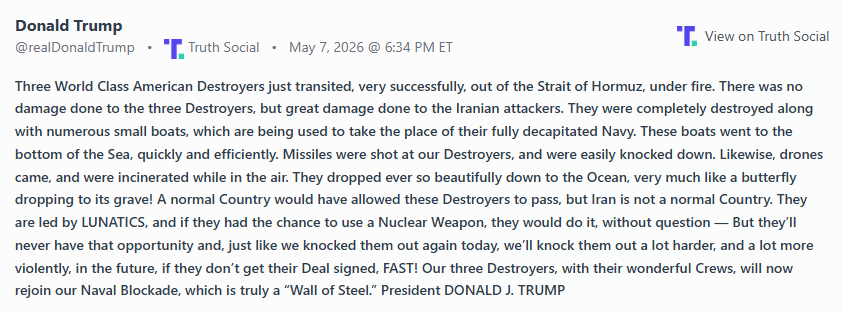
Source: https://truthsocial.com/@realDonaldTrump/posts/116535672760322109
The posting time for Trump’s tweet was ten hours later at 18:34 ET. At Hormuz, the time then was 02:00 in the morning of May 8. The military action appears to have occurred under cover of darkness.
How dark was the cover for Wang, Xi and the Politburo in Beijing?“A relapse in fighting must be avoided and sticking to negotiations is highly important” – that had been their warning to Trump the day before. Trump’s response in the Strait and then by tweet has provoked the Chinese to make good on their threat against next week’s summit – or to retreat under American fire.







Leave a Reply