

By John Helmer, Moscow
@bears_with
A little socialism and working-class patriotism still go a long way among Russians.
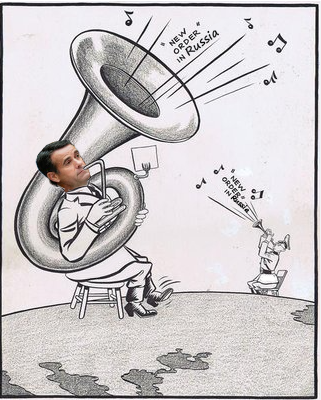
This is despite the new, carefully laid plans of CIA Director, John Ratcliffe (lead image, left) to make it appear otherwise, at least in the western media (right).
In the week before the US-Israeli war began, a nationwide poll asked Russian families, interviewed at home, how they would like to live. This is the classic question of class consciousness and aspiration for mobility, adapted from Soviet sociology to the American sociology which was first introduced in 1991 and then enforced since 2000. The Levada Centre in Moscow introduced this American sociology, and with US financing it has continued, despite drawing the government designation that it has become a foreign agent. Notwithstanding, the answers to the pollster’s questions have forced their way.
In Levada’s latest poll report — surveyed between February 18 and 25, then published on March 19 — the finding is that almost half of Russians across the country want to live in equality with their neighbours and their local community. “About half of the respondents say that their family aims to live no worse than the majority of families in the city, their area of residence – 48%. For the entire period of observations since 1998, this life strategy is the most popular for Russian families. Another third of respondents answer that they try to live better than the majority of families in their city and the district – 33%. This share has increased since March 1999 by 23 percentage points. In general, when choosing life goals, most families (81%) are guided by the way of life of the families of their place of residence.”
This is the Russian working class, and it identifies itself as such. The poll results show they are older than 55; educated to secondary school level but no higher; often living in villages or small provincial towns; struggling with the money to make ends meet, including food at their currently rising prices.
RUSSIAN GDP RECESSION SIGNAL – MINUS 2.1% IN JANUARY
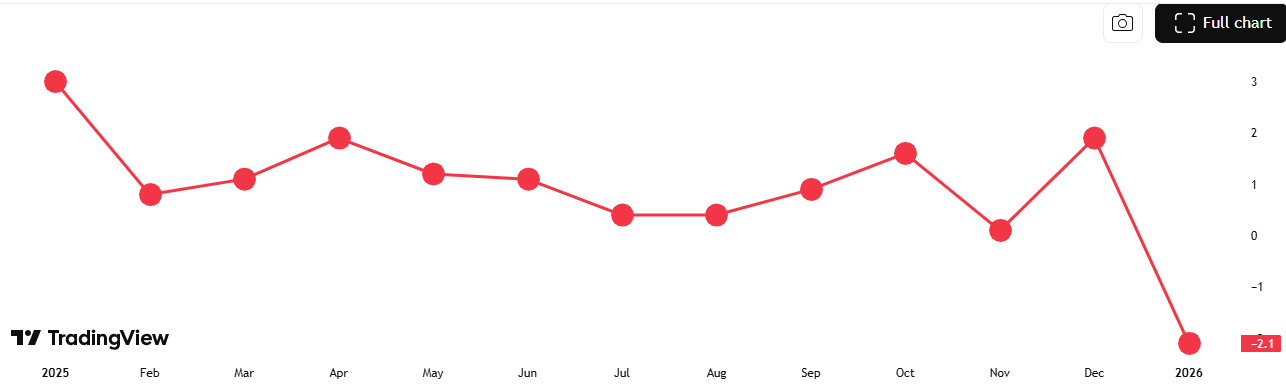
Source: https://www.tradingview.com/symbols/ECONOMICS-RUMGDPYY/ With a 2.1% month-on-month contraction of GDP as iof January 1, 2026, the two-year recession forecast by the Central Bank of Russia (CBR) last October in its worst-case scenario has begun. Over the past decade, there have been three recession episodes – in the year 2016, 2020, and between April of 2022 and February 2023. CBR Governor Elvira Nabiullina said last week as the Bank cut its prime rate to 15% that “Consumer demand is cooling. The economy is approaching its balanced growth path. This has enabled us to continue easing our monetary policy stance.” President Putin told Nabiullina and other economic policymakers on March 23: “What stands out most is the weak, negative trend in key macroeconomic indicators. While not entirely unexpected, the statistics confirm this pattern. In January, Russia’s gross domestic product fell by 2.1 percent compared to the same month last year, and industrial production decreased by 0.8 percent. On a positive note, mineral extraction grew by 0.5 percent, even before the recent rise in global energy prices…we need to return to the path of sustainable economic growth, while also slowing inflation.” For more on Nabiullina’s plan for recession and budget cutting to stop the war on US-NATO terns, read this.
There is a minority of Russians, the Levada poll reports, who identify themselves as bourgeois in its old-fashioned Soviet meaning. They want to live in the western capitalist world; they want to earn, consume, spend like Europeans or Americans. “One in ten (11%) tries to lead their lives on the model of the way of life of families in the West: 6% seek to live as a middle-class family of Western Europe or the United States; 5% want to live even better than that. The orientation to Western countries has grown in recent years, but after the beginning of the current conflict with the West, it has decreased markedly.”
This minority of Russians reveals itself in the poll to be predominantly under the age of 25; of high (university) education; urbanites, especially from Moscow and St Petersburg; and much wealthier than their fellow Russians. They are also ideologically opposed to President Vladimir Putin and would prefer to see him replaced.
By contrast, there are the Russian poor. “About 8% of respondents aim to survive, even at the most primitive level of existence. In 2021-2025, the share of such people [in the survey sample] has fallen to a minimum of 5% , but over the past year this has increased slightly.”
In February 2026, according to Levada, food and fuel-price inflation and the shrinking of employment opportunities, of bank credit, and of real incomes dominate voter concerns as the parliamentary election campaign gets under way. “The lives of half of the respondents is dominated by low incomes – 48%. The share of those who called this their priority concern has decreased by 25 percentage points since January 2005 (73%). But this, as before, remains the main difficulty for Russian families. The life of almost every third family is complicated, they report, by difficulties of poor health and access to medical treatment (30%). About one in four reports fatigue, overwork (28%); one in five – domestic difficulties (22%), lack of free time (22%), fear of losing work (20%).”
Although Levada poll report did not ask, and does not report, public attitudes towards military industry employment, army recruitment, war casualties, and exposure to war risk such as drone attacks, other reports – many of them from hostile sources in the US and UK – indicate that the Russian armed forces at the front are disproportionately drawn from the poorest of the country’s regions and social groups. Accordingly, they are suffering relatively higher casualty levels. Their loyalty remains with the country, with their class and their community. Levada reports relatively higher levels of support for Putin than among the bourgeois young of Moscow and St Petersburg who have avoided conscription; don’t volunteer for military service; and suffer disproportionately low casualty rates.
Into this class conflict, there has very recently appeared a Telegram “manifesto” from a 42-year old city lawyer named Ilya Remeslo.
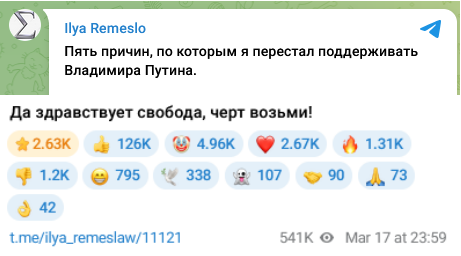
Source: https://t.me/ilya_remeslaw/11121#
Remeslo’s 672-word text started by declaring: “Five reasons why I stopped supporting Vladimir Putin. Someone had to say it.” Remeslo concluded by saying: “Long live freedom, damn it!”
In between, he criticized the operational management, human and economic losses of the Special Military Operation, and in particular security-related restrictions on media, public speech and internet access. “We, ordinary citizens, gain nothing from it, but only lose,” Remeslo claimed. “The system has gone so crazy that it even strangles Telegram…people are being driven into the [Max messenger system] depriving them of the right to medicine and education.”
Remeslo is far from an ordinary citizen himself. He is a representative of the young, university educated, professionally employed, western oriented, big-city bourgeoisie which supported the campaigns of Alexei Navalny in the past. However, when he was a public critic of Navalny, Remeslo had been a beneficiary of Kremlin patronage. That he has now announced he is switching sides and calling for Kremlin regime change is of passing interest to the anti-Russian media outside Russia. His reported detention in a psychiatric hospital has attracted more widespread publicity in Moscow and St Petersburg because of its echo of Soviet practice in suppressing dissidents.
For an American podcaster like Gilbert Doctorow to amplify the Remeslo case is of more than passing interest when it reaches this point: “Last days of the Putin regime? With forcible incarceration of dissidents in psychiatric hospitals Putin has taken over the relay race of Sovietism from Brezhnev”. That was Doctorow’s headline on March 19. “Make no mistake about it,” he announced in his analysis of the Remeslo case, “there is a power struggle going on today in the Kremlin. Putin and his entourage are fighting to hold onto power.”
Between the headline and the lead paragraph there is a gap known as a non-sequitur. Between the political sociology of Russian public opinion and Kremlin decision-making on the one hand, and on the other, the propaganda of regime change, planned and financed by the CIA and its allied agencies, published by western media, the gap is a yawning one.
The sociologically correct method for interpreting this gap is by yawning.


Leave a Reply