By John Helmer, Moscow

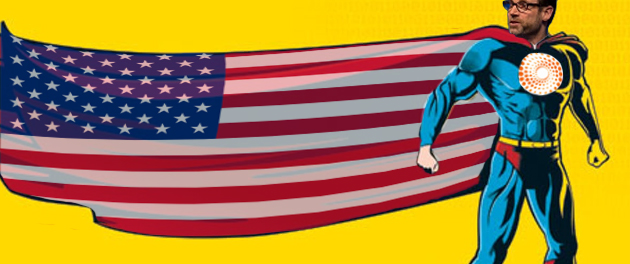
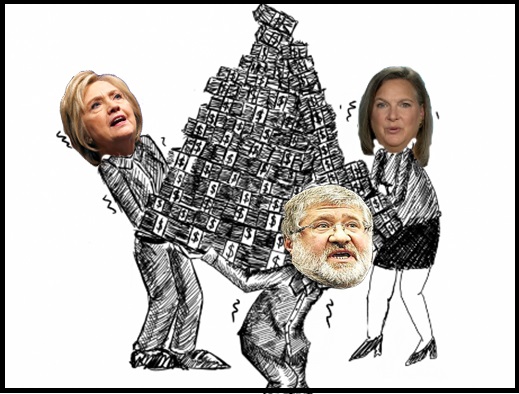
When Igor Kolomoisky (lead image, centre) financed anti-Russian units operating with the Ukrainian Army in the Ukrainian civil war, he was a staunch ally of Petro Poroshenko’s government in Kiev and the Obama Administration’s chief Ukraine policymakers, Secretary of State Hillary Clinton (left) and her Assistant Secretary for European Affairs, Victoria Nuland (right).
They in turn dominated the voting on the board of directors of the International Monetary Fund (IMF), led by managing director Christine Lagarde. Following the US regime change which installed Poroshenko’s regime in the spring of 2014, the IMF voted massive loans for the Ukraine to replace the Russian financing on which the regime of Victor Yanukovich had depended. More than a third of the fresh IMF money was paid out by the National Bank of Ukraine (NBU), the state’s central bank, into PrivatBank controlled by Kolomoisky and his partner, Gennady Bogolyubov.
At the time, investigations of Kolomoisky’s business and banking practices, and the special relationship he cultivated with the NBU, reported he was stealing the money through a pyramid of front companies lending each other the IMF cash which was not intended to be repaid. Clinton, Nuland, Lagarde and the IMF staff and board of directors ignored the evidence, as they continued to top up Kolomoisky’s pyramid. Criminal investigations by the US Department of Justice and the Federal Bureau of Investigation (FBI) were also reported at the time; they were neutralized by their superiors.
A new Delaware state court filing a month ago, triggering new US media reports, appears to signal a shift in US Government policy towards Kolomoisky. Or else, as some Ukrainian policy experts believe, it is a move by US officials to put pressure on the new Ukrainian President, Volodymyr Zelensky, whom Kolomoisky supported in his successful election campaign to replace Poroshenko.
In the new court papers, front company names and the count and value of US transactions between them, which PrivatBank has dug out of its own bank records, is published for the first time. But the scheme itself is not new. It was fully exposed in 2014-2015 in this archive. Nor is it news, as subsequent US media reports claim, that the FBI is investigating Kolomoisky and his US associates for criminal racketeering. The FBI investigation was first reported here.
What is missing is an explanation of why it has taken so long for the PrivatBank case against Kolomoisky to surface in the US courts and in the US press. Also missing is a list of the accomplices and co-conspirators in the scheme. These include officials of the IMF, the US and Canadian Governments who knowingly directed billions of dollars into the NBU, from which, as they knew full well at the time, the money went out to Kolomoisky’s Privat Bank, the largest single Ukrainian recipient of the international cash. At the top of the list of accomplices, immediately subordinate to Clinton, Nuland and Lagarde, are David Lipton, the US deputy managing director at the IMF, and the head of the IMF in Ukraine until 2017, Jerome Vacher. (more…)
by Editor - Sunday, June 30th, 2019
No Comments »