The two documents that are now the pointers for the outcome of the BRICS summit on Saturday are the Foreign Ministers’ statement of last May 15 and the Bishkek Declaration of the Shanghai Cooperation Organisation (SCO), issued on September 1. For the time being, there are only two publications of the Bishkek Declaration, one in Russian and one in Chinese. There is no official English translation; the translation discussed in the podcast with Jamarl can be read by podcast viewers through an auto-translation.
by Editor - Monday, September 14th, 2026 No Comments »
The editor-in-chief of The Sunday Guardian, Joyeeta Basu, asks the questions which the BRICS summit meetings over the weekend will answer in a consensus communiqué; in photo displays of smiles and handholding; and in bilateral meetings whose substance will be a combination of smokescreen and confidences to defend against Private Enemy No. 1 – President Donald Trump.
To understand the political context of this discussion, and the directions from which the wind is blowing for Indian voters and Delhi policymakers at which the podcast is directed, look carefully at the planks in the media platform:
The Sunday Guardian is owned by Information TV Private Ltd Ltd. (ITV) whose controlling shareholder is Kartikeya Sharma. An English university-educated “entrepreneur with deep pockets”, Sharma is an independent MP in the upper house of the Indian parliament, and is backed politically by Prime Minister Narendra Modi’s BJP party. Sharma’s constituency is Haryana state; his cashflow comes from sugar refining, hotels, and real estate construction concentrated in the north of India – Delhi as well as Haryana and Punjab states. The sensitivity to Russia of the cost and profitability of these Sharma lines of business are to be found in Russian exports of agricultural fertilizers, fuels, and construction steel.
This was Sharma’s media strategy when he took over iTV.
In Indian political terms, the Uttar Pradesh (UP) state election, due in five or six months’ time, is the priority for news media like the Sunday Guardian and for the political futures of Sharma, the BJP, and the state’s chief minister Yogi Adityanath, a potential successor to Modi when he decides to retire. UP is Haryana’s and Delhi’s geographic and political neighbour.
The themes of China’s hostility towards India and of Russia’s unreliability as a strategic ally of India are important to hear in the questioning of this podcast.
So is the downplaying, relatively speaking, of US hostility towards India, its support of Pakistan as India’s enemy to the west, and the damage to India which has been caused by the US-Israeli war against Iran. In response, US threats to India’s gateways at the straits of Malacca in the east, Hormuz and Bab el Mandeb in the west, are emphasized from the Russian point of view.
Right now these are not the pressing issues of the Indian audience and Indian voters — their priorities are education, employment and social mobility – unobstructed by oligarchy and corruption. They don’t see the connection, not yet, between their future and the wars the Trump Administration is waging outside India’s borders, the influence operations it is running inside India, and the punitive threats Trump has been making against Modi on tariffs against Indian exports and visas for Indian expatriate employment.
Modi’s performance at the BRICS summit, and the roles to be played by Putin and China’s President Xi Jinping in Delhi, are the focus of the discussion, which was recorded just before the official announcement was issued in Beijing of Xi’s participation.
The men of the Russian military forces doing the fighting on the Ukraine front are defending far more unequally distributed Russian national income and asset wealth on the home front than the Red Army which fought and won the war against Germany and Japan, the Great Patriotic War of 1939-45.
Moreover, if expert estimates are correct, the men fighting World War I were defending the Romanov-regime tsarist nation whose measurable inequality was less – repeat less – than the Russian society of today. In 1917 that inequality triggered the Bolshevik Revolution.
“Our benchmark estimates,” reported Thomas Piketty and two other French academic economists, Filip Novokmet and Gabriel Zucman, in 2017, “suggest that inequality levels in Tsarist and post-Soviet Russia are roughly comparable. Very top income shares seem if anything somewhat larger in post-Soviet Russia.”
In conclusion, the Piketty report said: “The dramatic failure of Soviet communism and egalitarian ideology – in the form it was applied in Russia – seems to have led to relatively high tolerance for large inequality and concentration of private property (partly coming from outright plundering of the country’s natural resources and foreign reserves). In effect, extreme inequality seems acceptable in Russia, as long as billionaires and oligarchs appear to be loyal to the Russian state and perceived national interests. Whether this fragile equilibrium will persist in the coming years and decades remains to be seen.”
That was the equilibrium of 2017.
Today, almost a decade later, after four years of war on the battlefield and on the high seas, and of sanctions war against Russian private and state offshore assets, the money being spent by the state on the war effort has helped to reduce the cash inequality of Russia’s poorest regions and lowest-income population. This state budget process has been called Russian military Keynesianism.
“Massive redistribution of state income to industries [is] linked to the war effort on the one hand, and significant financial support for the hundreds of thousands of men at the front on the other. This military Keynesianism has transformed society at both the socioeconomic and cultural levels. It has partially rebalanced the wide disparities in wealth, levels of consumption, and social prestige in Russian society by granting substantial financial and symbolic advantages to peripheral Russia, which has long been overlooked by the central government.”
As President Vladimir Putin has emphatically, sometimes angrily, declared, this “Keynesianism” is not nationalization, not revolutionary, not permanent – as temporary and exceptional as the Special Military Operation.
Asked last week by a reporter if this “could lead to the nationalisation of these assets, turning them into state property”, Putin replied: “Of course not. What are you talking about? This is not a matter of nationalising anything – do not even think about it. There was never any such intention behind this move. Nationalisation is not an option.”
However, egalitarianism is an option in Russia’s domestic politics.
In that direction, a slow, unpredictable, unmeasured revolution is under way; it is about to express itself in the nationwide vote for the new State Duma on September 18-20. This revolution is being joined by the Russian businessmen who are taking over the assets in Russia of the enemy states, and who aim to replace the thirty-year old, 1996-2026 generation of oligarchs. It is also a revolution of the working class which has fought on the front and whose cash gains have been earned by death.
“This monetization of service to the fatherland,” reports a US academic who is hostile to the Russian side in the war, “which some have called the ‘economics of death’, or ‘deathonomics’—because it gives greater value to a soldier who has died at the front than to his labour—has paradoxically enabled peripheral Russia to access public spending on a scale unseen since the fall of the Soviet Union. Yet this has not profoundly altered post-Soviet social stratification. Three years after the start of the war, the socioeconomic benefits that military Keynesianism has brought to the poorest strata of Russian society seem to have reached their limits. The wealthy and well-off strata have largely avoided the front line thanks to the large-scale enlistment of poorer members of society, resulting in the indirect legitimation of each group’s fixed social role in contemporary Russia.”
“Furthermore, maintaining the cost of this social spending will remain a challenge for the Russian economy and for the new regional balance that has emerged from it. The regions that have gained from the conflict due to the presence of the military-industrial complex on their soil have no interest in seeing the public financial windfall come to an end, and are hoping that a Cold War approach will be retained, where military spending will continue to take priority, even when there is no ongoing military conflict. The regions that have provided the most men, and which are therefore suffering demographically from high combat mortality rates, might also be penalized by the loss of income reinvested by soldiers’ families if the generous salaries paid to contract soldiers were to come to an end. Ethnic resentment in the republics and regions that have have sent men from their minority groups to the front is also a possibility.”
What is happening is visible — but not to Anglo-American propagandists engaged by Moscow to podcast to Americans.
After dining this week in Moscow as Foreign Minister Sergei Lavrov’s guest, an ex-CIA official named Larry Johnson, accompanied by American podcast impresario Andrew Napolitano, Chicago professor John Mearsheimer, and MI6 agent Alastair Crooke, declared: “The propaganda percolating in the West about Russia’s failing economy and rising political unrest is a complete fabrication. If you have ever walked around a vibrant city filled with happy people going about their business, then you know the vibe in Moscow.”
Johnson and the others had just eaten Lavrov’s halibut and meringue roll with cherry, washed down with a Krasnodar region wine, Усадьба Дивноморское Пино Блан (Manor Divnomorskoye Pinot Blanc). The vineyard is owned and the bottle sold by Gennady Timchenko, one of the most powerful of the oil and shipping oligarchs to rise during Putin’s term; he was forced by the war to return from homes in Geneva and France to Moscow. Timchenko and his son-in-law Gleb Frank have also owned the largest of Russia’s fish market producers and suppliers. Timchenko’s Alma Holding, based in Krasnodar, also grows the cherries on Lavrov’s cakes. For more, click on the Timchenko file and the book.
The Anglo-Americans whose mouths have just been filled by Timchenko and whose eyes closed by Lavrov are propagandists for an outcome to the current stage of the war against Russia which serves the oligarchs in their long war against the Russian nation and its people – that’s the alliance of the Russian oligarchs with their American and European counterparts.
This alliance is represented in the current round of negotiations by Kirill Dmitriev on the Russian side; Steven Witkoff and Jared Kushner on the US side. CIA director John Ratcliffe has introduced a parallel round of negotiations. Putin has described them all as “sharks of imperialism”. At the same time, he has also said: “we are quite comfortable with working with those who we know well and generally trust. These people are close to President Trump. In my opinion, they are sincere people who try to add practical content to our efforts. And President [Trump] trusts them, which is very important and without which no negotiations are possible.”
According to a London newspaper report claiming as sources “five people familiar with the plans,” Ratcliffe “will play a larger role in shuttle diplomacy between Russia and Ukraine — which is currently the purview of Witkoff and Kushner — while maintaining contact with intelligence officers in both countries…The US administration has considered shaking up its negotiating team after US-led efforts to broker a peace deal foundered in late February, according to two people involved in back-channel talks to end the war… Two of the people said there was a tug of war under way between Ratcliffe and Witkoff about who leads on what.…Putin had initially planned to meet Ratcliffe, according to two people familiar with the matter. The Russian president then backed out after Ratcliffe delivered a downbeat assessment of Moscow’s war effort to senior Russian intelligence officials.” Spokesman for the CIA, the White House, and Kremlin denied the claims.
The same London newspaper has issued an editorial opinion attacking “Kushner and Witkoff’s blind amateurism.”
The apparent contradictions between the Americans themselves, between them and the Europeans, and between Putin’s two descriptions of them are explained in the discussion with Chris Cook in this new Gorilla Radio podcast. Click to listen from Minute 32.
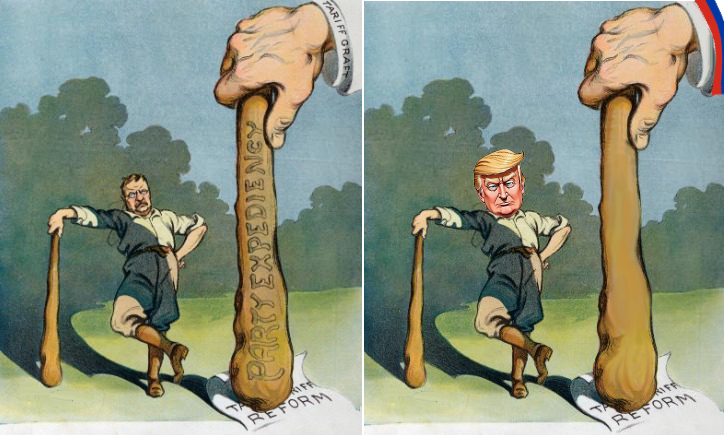
In his late afternoon, Tuesday, telephone call with President Donald Trump (lead image, right), President Vladimir Putin has followed the old Theodore Roosevelt (left) line. But he stopped short of agreeing to a summit meeting with Trump and Vladimir Zelensky in Delhi this coming weekend.
Kirill Dmitriev disguises the failure with a tweet: “President Putin specifically praised First Lady Melania Trump’s efforts to reunite both Russian and Ukrainian children with their families — an important humanitarian contribution that rises above politics.”
Yury Ushakov has revealed what didn’t happen: “The leaders agreed to continue the work on resolving humanitarian issues, including detainee and prisoner exchanges. Our President noted the efforts made by US First Lady Melania regarding the return of both Russian and Ukrainian children to their families…The presidents agreed to stay in touch and speak to each other by phone if the need arose.”
That’s a big IF.
This is the third time Trump and Dmitriev have tried pushing Putin into a troika summit. The first failed for Abu Dhabi in May 2025; the second failed for Budapest in October 2025.
Zelensky has told European reporters he is working on “on plans for Zelensky and Trump to potentially meet on the sidelines of the UN General Assembly later this month.” He has also told the Israelis in Washington that there is “the possibility of another trilateral U.S.-Ukraine-Russia negotiation session, though no decision has been made. ‘We have this September, October to find any way to speak.’”
Listen to the new podcast with Nima Alkhorshid spelling out the three tracks of the negotiations which have now taken place; the soft-talk, big-money giveaway Dmitriev has told Putin will clinch a peace and pause deal; and the argument from the General Staff and Foreign Ministry for the big-stick options now and through the coming winter. Click.
Roosevelt had issued the same warning in 1901: “If you simply speak softly the other man will bully you. If you leave your stick at home you will find the other man did not. If you carry the stick only and forget to speak softly in nine cases out of ten, the other man will have a bigger stick.”
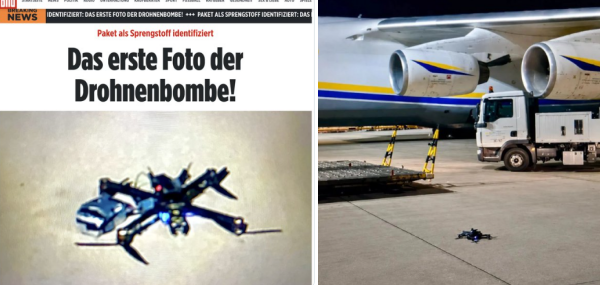
Photographs published in the German media, then republished in the press of the NATO allies, of an explosive device allegedly planted by Russian agents at Leipzig airport last month “do not correspond to what airport employees initially saw at the scene…the drone itself was a small, inexpensive consumer device intended primarily for photography and video recording.”
This has been reported by Ukrainian investigative journalist Anatoly Sharij in two lengthy Twitter (X) posts on September 6.
Sharij’s account is based on sources identified as Leipzig airport employees who said they were eye-witnesses of the discovery of the drone and of the official reaction which followed. According to Sharij, one of the sources “doubts that such a device could have carried any significant additional payload at all.”
The German government has officially blamed Russia for the Leipzig incident.
“With the attempted attack in Leipzig,” declared German Foreign Minister Johann Wadephul on September 1, “Russia’s leadership has instead made a conscious decision to inflict further significant damage on our bilateral relations, which are already under tremendous strain. The Federal Government’s line, which the Federal Minister of the Interior has just mentioned, thus applies. Germany remains secure, and Germany is defending itself against opponents who seek to spread insecurity. The Federal Government is therefore taking action against Russia as the perpetrator of the hybrid attack in Leipzig.”
“The dangerous conduct of the Russian Federation described just now is part of a long series of attempts to destabilise, spread disinformation, threaten, sabotage and show aggression towards Europe. Unfortunately, Germany is no exception here. Russia’s leadership is treating our country with blatant hostility.”
President Vladimir Putin responded, telling the Russian press on September 1 the drone incident was a plant. “I believe that it mostly has to do with the internal political situation. The Chancellor’s political standing is complicated. He is not trusted by his citizens, and it is clear why – because he does not uphold but sells out national interests, and because of apparent economic missteps: enterprises are being shut down, people are losing their jobs, and living standards are plummeting. It is not clear why they did what they did. They have only one explanation: they need to stand up against ‘aggressive Russia.’ You want proof? Here you are; they have planted it.”
“I would like to remind everyone that some time ago – several months or even a year ago – the German authorities accused Russia of blowing up the Nord Stream pipeline. I was really surprised that they came up with such a strange idea because we were interested in selling gas to Europe. We would be ready to provide gas today too. They only need to press the button, to make the decision to do it. But they don’t have the stomach for this, because of the US sanctions and everything else. Good, but now they need to explain the reasons behind their actions. Considering the falling ratings and the upcoming elections, including in Saxony, this puts the political future of the German ruling circles in question. I believe that this is the explanation. I think that this is yet another blunder, and that it runs contrary to the interests of the German people.”
On September 6, Foreign Minister Sergei Lavrov said the German government’s fabrication was an act of war. “ ‘Leipzig, the airport. They found some drone there. They said it was a Russian drone, and no one bothered to investigate. This is, in essence, the beginning of a real war. They expelled the Consulate General from Bonn, announced that they had terminated the agreement. The Russian House in Berlin is being closed. I recall that before the start of World War II, or more precisely the Great Patriotic War, the Germans also closed their diplomatic missions,’ he said, with the head of Russian diplomacy’s words quoted on the Vesti website. ‘And all those statements made by Merz about making Germany the leading military power in Europe again — they are being put into practice. He is essentially declaring war on us. And the lessons of history have not been learned at all. It turns out that these metastases of Nazism are beginning to break through. This is a dangerous phenomenon. I believe the Russian leadership will draw appropriate conclusions,” Lavrov said.”
German sources have told me that “useful idiots”, German opposition groups monitored and infiltrated by German police and intelligence agents, are likely to have been involved in the Leipzig incident, with foreknowledge on the part of the German services. “There are forces in Germany like the old Red Army Faction, belonging to extreme left groups, which are training now to interfere with military production. Also, the Ukrainians could very easily with their drone experience build drones with Russian parts and launch them in Germany. They are able to perform a false flag operation. And not least, I see the connection to the Nordstream case here. Kiev has a motive to avenge the imprisoned divers in Germany.”
Two years before the Nordstream sabotage on September 26, 2022, German officials participated in the fabrication of the Novichok poisoning claims of Alexei Navalny in August 2020. For the full account of that deception operation, read this book.
Sharij, the author of the new and detailed account of the Leipzig incident, has been in forced exile from the Ukraine since 2012 and has been the target of reputational and physical attacks for many years.
Sharij’s report was published by him in English. It follows verbatim. The lead photograph, right, was published by him without source attribution. Parentheses and links in have been added to the text for clarification of the references.
When it comes to truth-telling at the standard of traditional investigative journalism, podcasting and podcasters don’t — not by a long chalk.
That’s an expression which appeared in British pubs long ago when darts players kept score by scratching it in chalk on an old slate tile. A long chalk was the large trailing margin between winners and losers.
Podcasting isn’t a pub game but a part of the audience wishes it was. They are the commenters who write out their comments after the podcast has wound up, usually to support with bouquets or attack with brickbats what was said. Brickbat is another pub expression, centuries older than long chalk, and not as neutral. It meant a piece of brick thrown for the purpose of hitting someone.
In podcasting, brickbats have turned into thumbs-down icons and up to a half-dozen lines of words, sometimes with insults, emojis, expletives.
A computer analysis of 4,000 comments for Andrew Napolitano’s pro-Russia, pro-Iran podcast, Judging Freedom, recently discovered that they amount to no more than one percent of the total podcast audience. In making their mark, scratch the chalk or toss their brickbat, they are also erratic. More than three-quarters of the commenters made their mark only once, and then disappeared from the podcast record. Just 17.1% of the commenters registered their comment on two or more of Napolitano’s podcasts; 5.5% commented on three or more. Only 0.15% of the commenters — that turns out to be just six individuals — commented on ten or more Napolitano’s videos. Nobody commented on more than fifteen in the sample.
Dogs are more loyal to trees than commenters to Judging Freedom.
The minority of this dwindling and disappearing stream want to set the record straight; that is, they aim to add something they know in order to clarify or correct something that was said on the podcast. In the time of print newspapers, they appeared in the Letters to the Editor column. In the old days that was better read than the news columns: so popular it was, in fact, that newspaper editors introduced a new page of signed opinions which came to be called the Op Ed page. It is still the tree which invites all breeds of dogs.
The majority of podcast commenters, however, want to see their names on the screen and appeal to the podcast producer to support the guest against rivals for ratings, or sack the guest with whom they disagree, and replace him with others they nominate for substitution. This is action gaming; it’s the intellectual equivalent of custom robos which blast away at each other until the commander’s robo has won all the hit points and destroyed the rivals.
Russian robos and Iranian robos versus American, Ukrainian, German, British, and Israeli robos. This isn’t journalism. It isn’t armchair warfighting. Maybe it’s fun, but it’s factless, feckless too, because the winner is always the commander’s robos, otherwise the game wouldn’t be worth playing. For gamers there’s no fun in losing. This is why in podcasting like Napolitano’s, the commander’s Russian and Iranian robos are always within hours or days or weeks of winning their wars, and always certain to win. Robos with recognisable podcast names are always winning their games, always wrong on the battlefield: if they weren’t robos, this would be a disqualification from the game. Watch Robo Mearsheimer play to win. And Robo Macgregor.
For the past month, when the Moscow office was closed for its annual summer holiday, there was time to compile a list of the main questions commenters have been asking of me in recent podcasts, or brickbats they have been throwing.
One thing this minority of a dwindling minority share in common with each other — they don’t read. If they do or did, they would have discovered that the answers they ask for and the facts they guess at have all been published before: they can be read in Dances with Bears or in the books listed on the home page. In just seconds, they can be retrieved with an AI machine. This is what the box or bar on the screen called SEARCH or PROMPT is for.
However, for podcast commenters and robo gamers who demand a quick-start manual, I have compiled the answers to the most frequently mentioned questions and allegations; and for a bonus, there is the AI machine answer to the most difficult question of all that has never been openly asked before.
When an enemy sworn to destroy Russia comes to the Kremlin for talks, the record of what exactly was said can remain secret for so long that whatever calculations and interpretations were made at the time – by the enemy and by the Russian side – are no longer remembered and be taken into account when the visits are repeated and the enemy’s intention remains the same.
Trying to remember and take into account – that’s a task requiring блокноты, aides-mémoire, prompt cards. Sherlock Holmes wrote his reminders on his shirt cuffs. But more important than where they are hidden is whether they are remembered before it’s too late. In war it’s always that time.
A week ago in Washington, DC, the records of Mikhail Gorbachev, at the time General Secretary of the Communist Party of the Soviet Union, talking with his fellow Politburo members after the visit to Moscow of British Prime Minister Margaret Thatcher were declassified and published for the first time. The records date from 1987 and 1988.
Excerpts are reprinted here, along with links to the full documents.*
On Saturday in Moscow, Vladimir Putin, President of the Russian Federation, received Steven Witkoff and Jared Kushner, as he had anticipated in a press conference with Russian reporters four days before, on September 1. Between then and now, reading from papers and prompt cards, Putin has made several statements about the Americans.
Excerpts are reprinted follow, along with links to the full documents.By way of bloc-noting them, the question to be asked and answered is whether the intention of the enemy remains the same and of the Kremlin leader.
On August 24, 1991, Marshal Sergei Fyodorovich Akhromeyev committed suicide. He had returned from his holiday at Sochi responding to the attempted removal of Mikhail Gorbachev from power. According to the reports of the time, he hanged himself in his Kremlin office, leaving behind a note. One version of what it said was: “I cannot live when my fatherland is dying and everything that has been the meaning of my life is crumbling. Age and the life that I have lived give me the right to step out of this life. I struggled until the end.”
by Editor - Tuesday, August 25th, 2026 No Comments »
Every year at this time, as certain and regular as the Moscow city administration turns off the central hotwater boilers for cleaning, we close the office, postpone the flow of Dances with Bears, suspend the tweets.
But just as surely as Muscovites install electric water heaters for substitutes during the profilaktika (профилактика — профилактические работы), we will continue with occasional podcasts and write a book for Christmas release. We will restart on September 7. Like all ZHEK (Жилищно-эксплуатационная контора) notices, not all official announcements come true exactly on time.
By John Helmer, Moscow, with Sahar Dadjoo, Teheran @bears_with
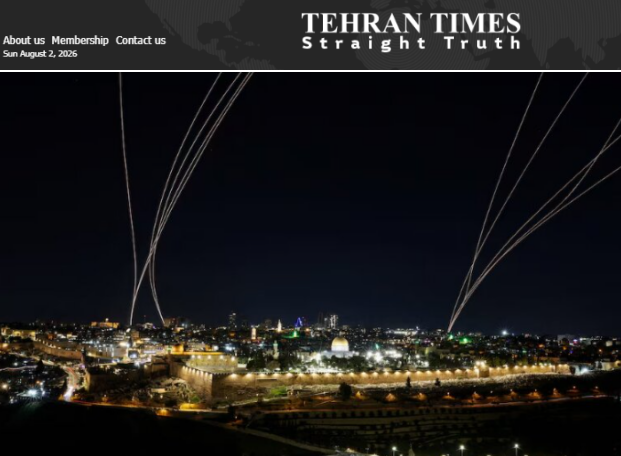
In an interview and video recorded in Teheran on Wednesday, Sahar Dadjoo asked the questions and these are the answers published on August 1.
In focus is the US-guided Ukrainian drone attack on the Iranian cargo vessel Ana in the Caspian Sea which occurred on July 25. The timing is important. On July 17 and 20, Iran struck the US base Al-Tanf inside Syria near the Jordan border. The target was US special forces and a unit of Ukrainian drone operators which, according to Beirut sources, were identified by Russian military intelligence for the Iranian counter-attack. “The IRGC said its target was a US special operations command centre, claiming it had destroyed helicopters and a radar system.” US troop casualties have been denied by the US; casualties among US special forces and Ukrainians have not been corroborated.
The Caspian Sea attack on the Ana, killing one Iranian mariner, followed on Saturday, July 25.
On the next day, July 26, Lavrov was telephoned by Iranian Foreign Minister Abbas Araghchi to discuss the Caspian Sea attack and the measures Iranian and Russia officials were discussing for response and retaliation. For more evidence and consequences, click to read.
Three days later, on July 23, US Secretary of State Marco Rubio called for a meeting with Russian Foreign Minister Sergei Lavrov. In their 30-minute exchange of warnings and ultimatums, Rubio said President Donald Trump had instructed him to tell President Vladimir Putin to stop aiding Iranian forces to target and kill Americans. Lavrov replied with Putin’s message for Trump to stop aiding Ukrainian forces to kill Russians. The full story can be read here.
This is the timeline in which the military operations planners in Moscow, Teheran, Washington, and Kiev took the decisions that have had the consequences in telephone calls and face-to-face meetings just reported at the very top of the three governments at war with each other.
For the strategic meaning and likely outcome, here is the interview with Sahar Dadjoo.