
By John Helmer, Moscow
@bears_with
Never mind that King Solomon said proverbially three thousand years ago, “a merry heart doeth good like a medicine.”
With seven hundred wives and three hundred concubines, Solomon realized he was the inventor of the situation comedy. If not for the sitcom as his medicine, the bodily and psychological stress Old Solly had to endure in the bedroom would have killed him long before he made it to his death bed at eighty years of age, after ruling his kingdom for forty of them.
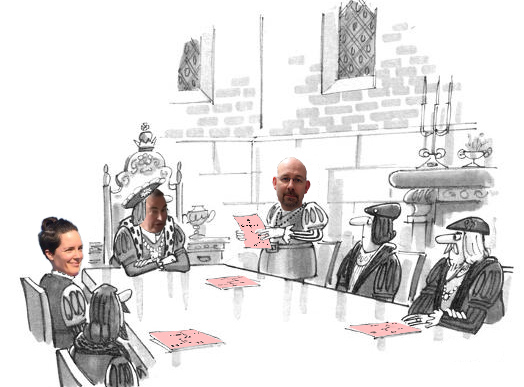
After the British sitcom died in the 1990s, the subsequent stress has not only killed very large numbers of ordinary people. It has culminated today in a system of rule according to which a comic king in Buckingham Palace must now manage the first prime minister in Westminster history to be her own joke.
Even the Norwegians, the unfunniest people in Europe, have acknowledged that the only way to attract the British as tourists, was to pay John Cleese of Monty Python and Fawlty Towers to make them laugh at Norway itself. This has been a bigger success for the locals than for the visitors, boosting the fjord boatman’s life expectancy several years ahead of the British tourist’s.
In fact, Norwegian scientists studying a sample of 54,000 of their countrymen have proved that spending the state budget on public health and social welfare will only work effectively if the population is laughing all the way to the grave. “The cognitive component of the sense of humour is positively associated with survival from mortality related to CVD [cardio-vascular disease] and infections in women and with infection-related mortality in men” – Norwegian doctors reported in 2016. Never mind the Viking English: the Norwegian point is the same as Solomon’s that “a sense of humour is a health-protecting cognitive coping resource” – especially if you’ve got cancer.
The Russians understand this better than the Norwegians or the British. Laughter is an antidote to the war propaganda coming from abroad, as Lexus and Vovan have been demonstrating. The Russian sitcom is also surviving in its classic form to match the best of the British sitcoms, all now dead – Fawlty Towers (d. 1975), Black Adder (d. 1989), You Rang M’Lord? (d. 1988), Jeeves and Wooster (d. 1990), Oh Dr Beeching! (d.1995), and Thin Blue Line (d. 1996).
The Russian situation comedies, alive and well on TV screens and internet streaming devices across the country, are also increasingly profitable business for their production and broadcast companies – not despite the war but because of it. This has transformed the Russian media industry’s calculation of profitability by removing US and European-made films and television series, as well as advertising revenues from Nestlé, PepsiCo, Mars, and Bayer. In their place powerful Russian video-on-demand (VOD) streaming platform companies like Yandex (KinoPoisk), MTS (Kion), Mail.ru (VK), and Ivi (Leonid Boguslavsky, ProfMedia, Baring Vostok) are now intensifying the competition for audience with traditional television channels and film studios for domestic audiences. The revenue base of the VOD platforms is less vulnerable to advertisers, more dependent on telecommunications subscriptions.
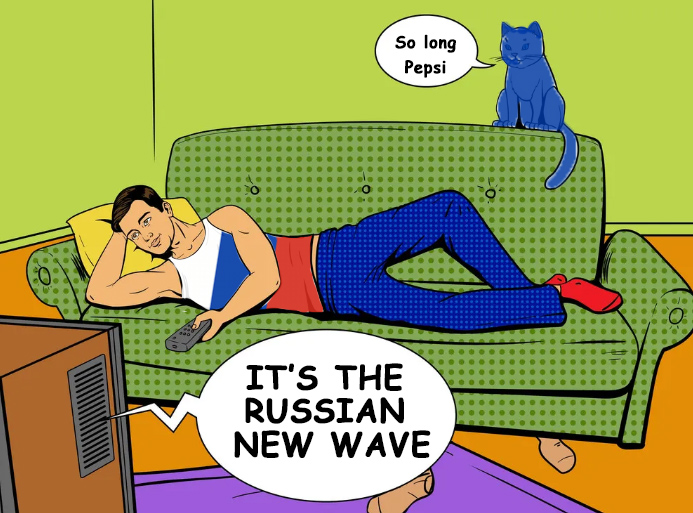
Russian script writers, cameramen, actors, designers, and directors are now in shorter supply than ever before, and earning more money. “It’s the Russian New Wave,” claims Olga Filipuk, head of media content for Yandex, the powerful leader of the new film production platforms; its controlling shareholder and chief executive were sanctioned last year.