
By John Helmer, Moscow
@bears_with
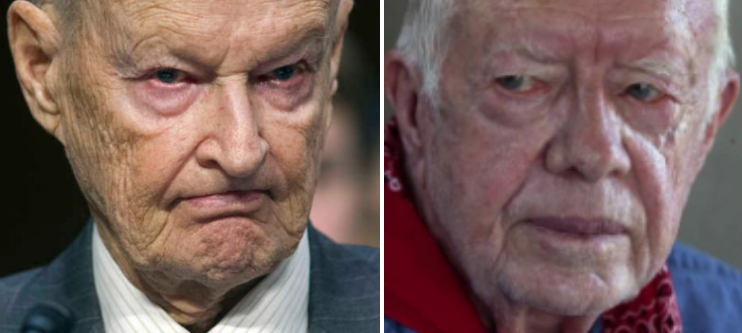
If ever there was a man who displayed on his face the evil in his mind, it was Zbigniew Brzezinski (lead image, left), the national security advisor for President Jimmy Carter (right) when the US plot to start the war against the Soviet Union on the Afghan front was hatched in 1979. “Now we can lure the Russians into the Afghan trap,” he wrote Carter in a secret note of February 1979. In July of that year he followed with the directive Carter signed in secret to supply arms to the mujahideen “to induce a Soviet military intervention”. In December 1979 Brzezinski told Carter: “we should not be too sanguine about Afghanistan becoming a Soviet Vietnam”. Later he used to boast that had been precisely his intention and also his crowning achievement.
Brzezinski’s lips are sealed now because he’s been dead for four years.
Carter is still alive. In 1979 he kept the evil on his mind secret behind the smile on his face. His lips are sealed now, since the retreat from Afghanistan began by the US Army, and after the rout last month in Kabul. The mainstream American press are not reporting they have asked Carter for comment, or that he has refused. Not even the alt-media investigators have pursued him.
But it’s already clear what Carter thinks. He believes he scored one of the wold’s great strategic victories; he is disgruntled that he has never received the public credit he thinks he deserves. In the words of one of the CIA men in charge of Afghanistan operations in 1979, Carter’s strategy was to wage the “fight [against] the Soviets that went on to win the final and decisive battle of the Cold War.”
A new book by Paul Fitzgerald and Elizabeth Gould, just published, opens the story of what Brzezinski and Carter really did to start the US war in Afghanistan, starting with the assassination of Adolph Dubs, the US Ambassador in Kabul on February 14, 1979; his killing with four pistol shots to head in a Kabul hotel room, the book concludes, was part of the White House plot.
“Some unnamed Americans claimed the Soviets wanted Dubs out of the way so they could set up for their invasion,” Fitzgerald and Gould report. They go on to name the Americans, one an agent of the Drug Enforcement Administration (DEA) in Kabul, another a CIA agent. “But the Soviets got along famously with Dubs because he wasn’t an anti-Soviet Russophobe like Brzezinski. There was also plenty of evidence to show the Soviets didn’t want to invade. They went on record with the U.S. embassy throughout the summer of 1979 trying everything to avoid it. And besides, the rules of the game made ambassadors virtually untouchable. There was no upside to killing one, and a big downside.”
The assassination of Dubs, Fitzgerald and Gould argue, “led to the Soviet invasion nine months later….Who would kill an ambassador? Not a rival superpower trying to get the American Congress to sign a nuclear arms deal they’d desperately needed. And certainly not a third-world backwater desperate for U.S. aid and recognition. Only someone trying to provoke retribution. And who would want that retribution? Zbigniew Brzezinski. Brzezinski blamed the Russians, but then Brzezinski always blamed the Russians… If it hadn’t been for the Dubs murder there would never have been a Soviet invasion.”
(more…)